Published on 6/24/2026
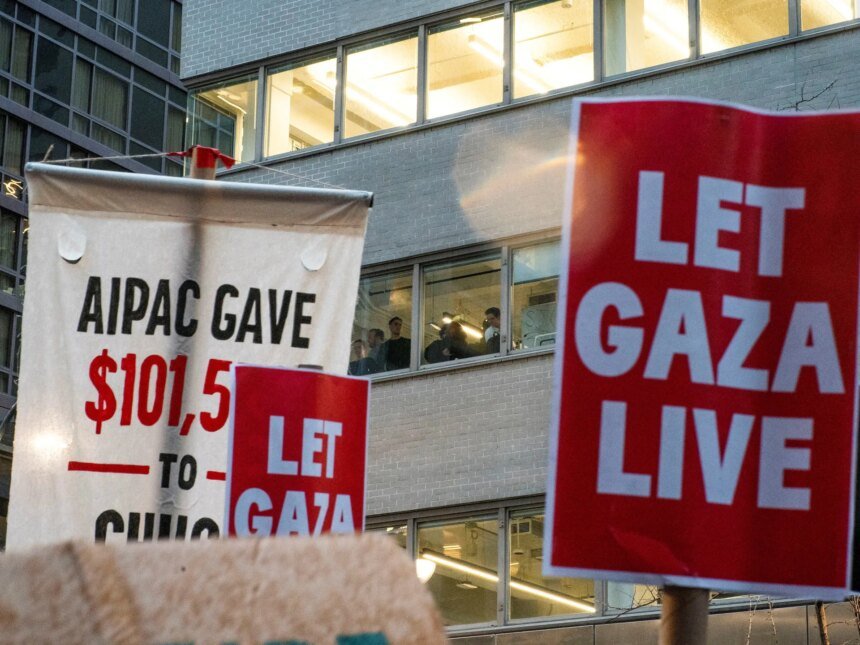
In an article in the Israeli newspaper Haaretz, journalist Ben Samuels warned that the escalating attack on the American Israel Public Affairs Committee (AIPAC) had, in some of its expressions, exceeded the limits of political criticism of an influential pressure group, and had begun to slide into language that places “Israelis” and American Jews in the position of being accused of the policies of the Israeli government and the influence of the lobby that supports it.
Samuels began his article – in Haaretz newspaper – by asserting that he is not a traditional defender of AIPAC, but rather one of the most prominent journalists who have followed the organization and criticized its role in turning Israel into a highly polarized issue within American politics.
Read also
list of 3 itemsend of list
It is noteworthy that he wrote repeatedly about AIPAC’s bias towards Israeli Prime Minister Benjamin Netanyahu, about the role of large money in its influence, and about its demands, which – in his estimation – have become far from the changing mood within the American democratic and Jewish base.
Dangerous language
Samuels believes that the issue is no longer in criticizing AIPAC as a huge player, but rather in language that summarizes all of America’s crises in Israel or in the lobby that supports it.
The writer cited New York Mayor Zahran Mamdani’s description of the organization as “monsters,” progressive election speeches linking American aid to Israel to depriving American children, and accusations against candidates of being “paid for” by Netanyahu or AIPAC.
According to Samuels’ opinion, this language does not affect the organization alone, but rather calls up old shadows about Jews, money, and political dominance. He says that AIPAC’s burden here expands beyond it, as the more its name is attached to money, pressure, and wars, the greater the danger of treating American Jews as if they are an extension of the Israeli government or internal agents of its policies.

A burden created by AIPAC
But Samuels does not deny the existence of serious reasons for anger at AIPAC. In another analysis in Haaretz, he wrote that the organization faces an identity dilemma after its long bet on US President Donald Trump and the Republicans, and then its inability to attack its understanding with Iran with the intensity with which it attacked Barack Obama’s nuclear agreement in 2015.
According to this reading, AIPAC contributed to the politicization of Israel within America to the extent that it lost its old image as a “bridge between the two parties.” It supported more than 100 Republicans who refused to certify the results of the 2020 elections, used Republican donors’ money in democratic primaries, and continued to defend an Israeli government that pushed far to the right.
Thus, in the eyes of many of its critics, the organization is no longer a general title for “supporting Israel,” but rather a title for identification with Netanyahu and the Israeli right.

Consensus is eroding
Polls and media follow-ups painted a broader background for this transformation. According to the Pew Center, in April 2026, 60% of Americans’ view of Israel became negative, and the percentage rises to 80% among Democrats and those leaning towards them, and the majority of those under 50 years of age from both parties view Israel and Netanyahu negatively.
As for Gallup, it found in February 2026 that American sympathy for the Israelis no longer took precedence over sympathy for the Palestinians, as it had been for decades.
Reuters notes that AIPAC’s support has become a line of contact in some Democratic primaries.
As for the Washington Post, it says that the pro-Israel consensus is crumbling within the two parties, and that the name “AIPAC” has become so toxic in some Democratic races, that an unconfirmed connection to it may be enough to drop a candidate’s chances.

No Jewish rupture
Other statements warn against reducing the scene to the notion that American Jews have turned against Israel, because J Street polls reported by The Forward and the Jewish Telegraphic Agency indicate that a majority of American Jews, especially Democrats and young people, oppose the use of Republican funds in Democratic primaries to support AIPAC candidates.
But another poll by the Jewish Voters Institute and Mailman revealed that AIPAC’s image among American Jews is mixed, not collapsed, with many remaining unaware of the details.
This is an indication that American Jews have not fallen out of the circle of interest in Israel, but many of them refuse for AIPAC to have a monopoly on defining the meaning of their support, or for Netanyahu, electoral money, and unconditional support to be turned into a burden placed on them in the public sphere.