
Published on 6/24/2026
|
Last update: 6/25/2026 09:19 (Mecca time)
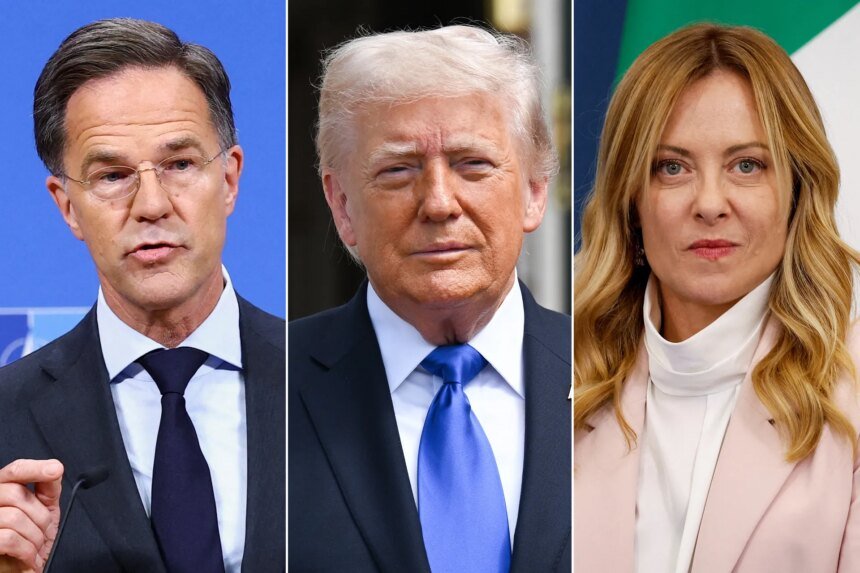
No sooner had Italian Prime Minister Giorgia Meloni ended a tense chapter with US President Donald Trump, than she found herself facing a new, no less sensitive crisis, this time with the leadership of the North Atlantic Treaty Organization (NATO), after statements that sparked widespread controversy about the nature of the use of military bases inside Italian territory in the context of operations related to the war on Iran.
At a time when Rome was trying to contain the repercussions of the public political debate with Washington, the political debate quickly moved to Brussels, after statements by NATO Secretary-General Mark Rutte, in which he spoke about the role of bases inside Italy in supporting military operations, which Rome considered “inaccurate” and confused between logistical support and combat operations.
This overlap between the two crises – with Trump on the one hand, and NATO on the other – put the Italian government in a circle of double political pressure, and reopened a broader debate about the limits of national sovereignty within the European alliance, and the size of the role that European countries can play in American military operations outside their territories.
Direct Italian denial of NATO’s statements
At the heart of the new crisis, Rome came out to refute what was stated by Rutte, who indicated that 500 American planes took off from bases inside Italy to support military operations against Iran.
The Italian government responded quickly, clarifying that what was permitted does not go beyond technical and logistical trips, and does not include any direct combat operations.
Italian Defense Minister Guido Crosetto confirmed that his country “fully committed to the constitutional framework and international agreements regulating the presence of foreign bases,” stressing that Rome rejected requests that exceeded those limits.
The timing increased the sensitivity of the situation, as Italy was still in the process of absorbing the repercussions of its dispute with Trump, who publicly criticized some European allies and accused them of not providing sufficient support in military operations, before the circle of controversy over the use of Italian military infrastructure expanded.
While the Meloni government was trying to confirm its narrative that the sovereignty of the Italian decision was not subject to negotiation, Rutte’s statements came to increase the severity of the complexity, especially since they were formulated in a way that Rome considered misleading and inaccurate, which opened the door to sensitive political interpretations.
According to the American newspaper “The Hill”, the Italian refusal was not only technical, but was linked to Meloni’s fears of the repercussions of any strikes that might affect targets inside Iran, in addition to its adoption of the Vatican’s position calling for avoiding escalation and expanding the scope of the war.
Military base or national sovereignty?
Italy hosts about 120 American military facilities, making it one of the most important NATO logistical deployment centers in southern Europe, but these bases operate, according to the Italian government, within specific agreements that clearly distinguish between logistical support and combat operations, in an attempt to avoid any confusion that might put it in an internal or external political confrontation.
Within the alliance, officials tried to contain the controversy by emphasizing that the Secretary-General’s statements were not intended to indicate direct Italian participation in combat operations, but rather to highlight the role of the Allies in supporting the logistical infrastructure for joint operations.
But this clarification did not prevent the continuation of the debate about how to manage political discourse within NATO, especially in light of the growing gap between public statements and the legal accuracy of military agreements between member states.

Meloni between internal and external pressures
For Meloni, it is not only a matter of an external crisis, but also a delicate internal balance. Her right-wing government seeks to preserve Italy’s image as a strong ally within NATO, while at the same time avoiding being drawn into military commitments that might spark internal controversy or weaken its political position.
This balance has become more complex with the successive crises, from friction with Washington to controversy with the NATO leadership, which makes Italian foreign policy face a continuous test to redefine its position within the Atlantic system.
Between Washington and Brussels, Rome finds itself in a narrow political space that requires careful management of balances. The crisis with Trump revealed the limits of the political relationship with the United States, while the dispute with NATO re-posed deeper questions about sovereignty and the role of military bases in times of changing wars.
In both cases – according to observers – Meloni’s government appears to be forced to deal with a new reality: existing alliances but with varying interpretations, and an international political discourse that is changing at a faster pace than traditional diplomacy can contain it.
Meanwhile, the French newspaper Le Monde reported on the escalating tension between Meloni and Trump, noting that the various political movements in Italy stand behind Meloni in this dispute, but in return they express concern about its potential economic repercussions.