Published on 6/24/2026
While the world’s eyes turn to the wars in the Middle East and Ukraine, another war is taking place in Southeast Asia, no less bloody, but almost absent from international attention.
Since 2021, Myanmar – a country with a population of about 50 million people – has turned into an open battlefield, after army commander Min Aung Hlaing overthrew the elected government in a military coup that ended a short democratic experiment and returned the country to military rule.
Read also
list of 2 itemsend of list
The coup ignited a wave of popular protests that quickly turned into a widespread armed rebellion, after the army forcefully confronted peaceful demonstrators, prompting thousands of civilians to join resistance groups spread across the country, according to what was reported by the New York Times and The Independent.
Opposition groups were able to control more than half of the country’s territory, and established schools, hospitals and local institutions in areas they called “Free Myanmar.”
But – according to the two newspapers – these areas remained isolated and subjected to constant attacks from the army, which maintains air superiority and the ability to carry out continuous raids using combat aircraft, helicopters, drones, and even armed gliders.

Death numbers
A report prepared by New York Times correspondent Hannah Beach summarized the scale of the humanitarian and military disaster in Myanmar through a set of striking indicators and numbers:
- The death toll in Myanmar has exceeded 90,000 people, including civilians and combatants, after 5 years of war that broke out following the 2021 coup.
- In 2025, Myanmar will become the second most affected region in the world by armed conflicts after the Palestinian territories, according to data from the Armed Conflict Monitoring Project.
- More than 1,200 factions and armed groups are involved in the conflict, making the war in Myanmar one of the most fragmented and complex conflicts in the world.
- The war forced about 4 million people to flee their homes within a country with a population of nearly 50 million.
- Nearly a quarter of Myanmar’s population faces severe levels of food insecurity, according to UN estimates.
- Myanmar has become the country most polluted by landmines in the world, after soldiers spread them in civilian areas and combat zones.

A report by the United Nations High Commissioner for Human Rights – reported by The Independent newspaper – revealed an unprecedented escalation in human casualties among civilians in recent months, as shown by the following figures:
- The United Nations documented the killing of 702 civilians during the period between August 2025 and the end of January 2026, coinciding with elections organized by the Military Council, which critics described as an attempt to give the military rule a formal political cover.
- The death toll included 224 women and 153 children, while the United Nations suggested that the actual numbers were higher due to the difficulty of reaching conflict areas.
- Air strikes constituted the most lethal method of killing during that period, as they alone resulted in the deaths of 505 civilians.
- The majority of deaths were concentrated in central Myanmar and Rakhine State, where military forces are seeking to regain areas they lost to resistance groups, and the two regions together recorded 573 civilian deaths.
The United Nations warns – in its report – that the decline in international funding for humanitarian aid increases the suffering of millions of civilians living under bombardment or in displacement camps.

It is noteworthy that the Rohingya Muslim minority is one of the groups most affected by the conflict in Myanmar, after hundreds of thousands of its members were displaced to neighboring countries, especially Bangladesh, following military campaigns that the United Nations previously described as bearing “characteristics of genocide,” according to a report by Al Jazeera’s correspondents in Indonesia.
The Rohingya are still facing difficult humanitarian conditions inside and outside Myanmar, at a time when the United Nations has warned of their continued exposure to forced recruitment, violations and violence, in addition to the worsening suffering of refugees due to the decline in humanitarian funding allocated to them.
Reality on the ground
Amid this bleak backdrop, New York Times correspondent Hannah Beach and photographer Daniel Berholak headed to Myanmar’s central Anyar region, an area controlled by armed resistance that fighters say no foreign journalist has been able to reach since the military overthrew the civilian government and erased political and economic reforms.
The irony is that the Anyar region is located in the heart of the Bamar regions, the largest ethnic group in Myanmar, which historically formed one of the most important bases of popular support for the army, which is dominated by the same elite. However, the 2021 coup changed this equation, and the region moved from a traditional incubator for the military establishment to one of the most prominent strongholds of the rebellion against it.

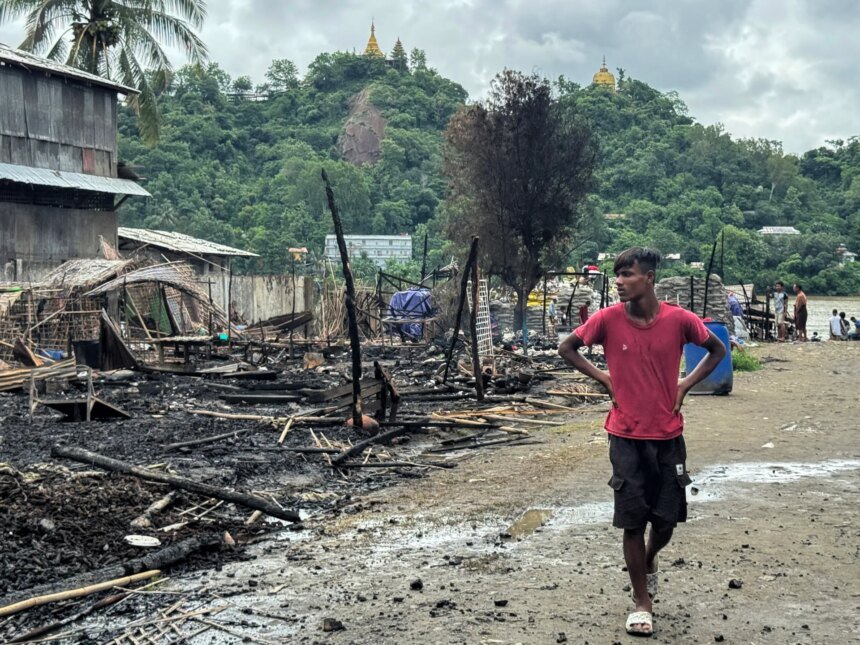
The correspondent describes the scene as a world that is slowly collapsing. There are burned villages, agricultural fields where displaced people work, and homes destroyed by bombing. The rebels and residents face a severe shortage of weapons, ammunition, and even hope in light of the absence of international aid and the scarcity of resources.
Among the burned villages, dirt shelters, and roads monitored by drones, two New York Times journalists met fighters and civilians living a daily war, which residents say is taking place in the shadows while the world is preoccupied with other conflicts in Ukraine, Gaza, Iran, and Lebanon.
Beach and Berholak, accompanied by the commander of a rebel unit, former Dr. Lun Lun, and a number of members of the local resistance forces, moved for three days in cars, motorcycles, boats and on foot, avoiding army positions, while fighter planes, helicopters and drones constantly flew above them.
Missing voices
In one of the villages that the two journalists visited, a man named U San Nyaung was sweeping the rubble of his house that had been burned by soldiers, and he told them that about 200 houses in his village had been destroyed.
After the fires came air raids that killed three people, including a Buddhist monk. The soldiers did not stop there, but planted mines near homes and temples before leaving.
While the man was speaking, he could not control his tears. He said, addressing the journalists, “Do foreigners know what is happening to us?” Then he added, “I know what is happening in Ukraine and Gaza, and I feel sad for them. We share the same sadness.”

As for Doctor Lun Lun, who is 41 years old, he never imagined that he would lead an armed force. Before the coup, he was preparing to travel on a tour to Europe, but months later he found himself receiving military training alongside employees, teachers, and students who took up arms for the first time.
The doctor says, “I was good at carrying a stethoscope, not a gun,” but the war changed his life completely. He went from treating patients to leading a battalion of about 120 fighters, many of whom were university students or employees in private companies before the outbreak of the conflict.
The soldiers talk about their previous lives, which they call the “pre-coup era.” One of them was studying physics at university, another was working in marketing, while some of them were still teenagers when they joined the fight.
The correspondent found that everyone had left behind a normal life that included study, marriage, work, and vacations, and had to replace it with a life of constant pursuit under the threat of missiles.

A forgotten war
But the biggest problem they face is not only the constant bombing – according to the report – but the lack of support. While the army obtains weapons from Russia and China, the rebels say they have lost hope of obtaining Western support similar to what Ukraine received.
Doctor Lun Lun says, “We are suffering from a shortage of ammunition, and I feel frustrated because we do not get support from the United States and Europe even though we are fighting for a federal democracy.”
As the war continued, signs of exhaustion were increasing within the ranks of the fighters. Some of them fled the fronts, others surrendered or defected. Weeks after the journalists’ visit, the rebels lost important positions and were forced to retreat. The size of Doctor Lon Lon’s battalion had also shrunk to almost half.
Despite this, the man is still trying to cling to some hope. One night, while the two journalists and their fighters were waiting for the threat of a new air strike to pass, the former doctor spoke frankly about his future if the war ended without a victory.

He told the reporter, smiling, before sadness took over his features, “If I cannot win the revolution, I will become a monk. I always try to meditate, but that sometimes becomes difficult in this world.”
This is what the war in Myanmar looks like, as observed by Hannah Beach, photographed by Daniel Berholak: a country living under constant bombardment, rebels fighting with limited capabilities, and residents trying to rebuild their lives while death falls from the sky, all in a long and costly war, but for many outside Myanmar’s borders it is almost invisible.