Published on 6/22/2026
When you see a flock of birds suddenly turning in the sky, as if it were a single organism and not a group of individuals, you are faced with one of the most complex mathematical problems that scientists are trying to solve until now.
In school physics, we usually start from Newton’s third law, which says that for every action there is an equal and opposite reaction. This law works very efficiently in describing the world of planets, balls, masses, collisions, and systems that can often be summarized in the form of mutual forces. You hit a ball on the ground and it bounces up.

Non-commutative interactions
But flocks of birds are not billiard balls. The bird does not interact with its neighbor as two solid bodies exchanging a simple mechanical force. Rather, it possesses a degree of awareness, as it sees, decides, responds, and adjusts its speed and direction based on what its eyes pick up and what its field of vision allows.
These are what physicists call “non-reciprocal interactions,” in which A and B do not affect each other in a mutual way, but the effect can be stronger in one direction, or present in one direction and absent in the other.
In a flock, a bird may observe a limited group of neighbors within its cone of vision, while not seeing others behind or outside it. Thus, group behavior becomes based on a network of unequal influences.
This does not mean that Newton’s third law collapses in nature, but it teaches us that the “behavioral effect” transmitted between flock members manifests itself differently.
This type of system confuses traditional physics tools. In many classical models, the physicist can write what is called an “energy function” for the system, and through this energy it is possible to know the most stable states, predict how the system will evolve, and use powerful computational methods such as Monte Carlo simulations.
But in non-commutative systems, there is not always clear classical energy, and it becomes difficult to construct a simple mathematical description similar to what we use with atoms, magnets, or planets.
Very special mathematics
Here comes the importance of the new study, which was recently published in the journal Nature Physics, where a team of researchers presented a mathematical framework that allows non-reciprocal interactions to be described as if they were, in some way, accessible in the language of traditional physics.
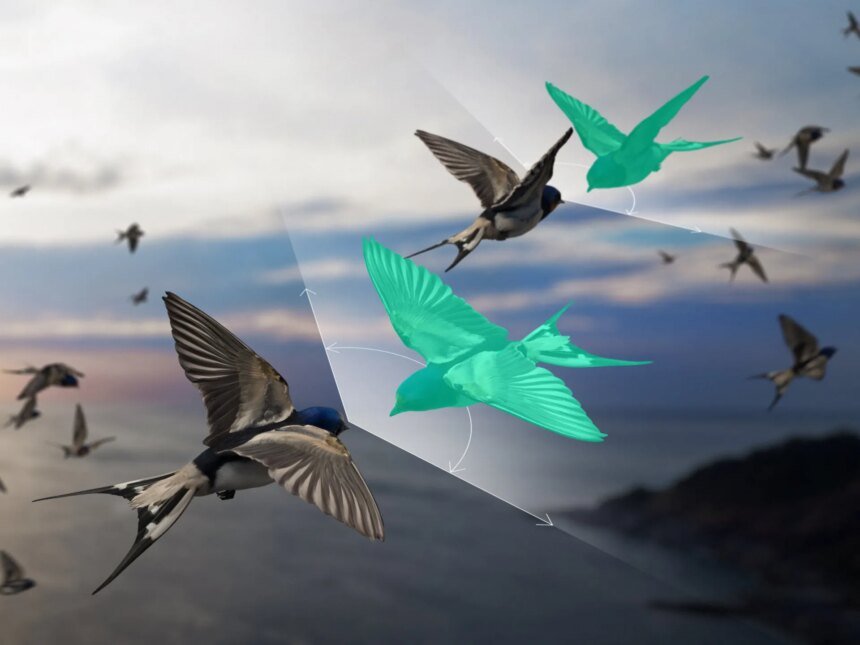
The basic idea seems strange but elegant, as scientists add a virtual partner, or an auxiliary degree of freedom, that does not exist in nature, to each element in the system representing a flock of birds, as if we were placing behind each real bird a hidden “mathematical bird” that helps the equations become treatable.
In this way, scientists have something of a bridge between two worlds: the world of complex collective behavior, and the world of statistical mechanics and Hamiltonians built over centuries to describe physical systems.
The idea is not just for scientists to study flocks of birds. Nonreciprocal interactions appear in schools of fish, in the movement of human crowds, in colonies of bacteria, in some cell systems, in small cooperating robots, and even in certain energetic materials or quantum systems.
Therefore, the study opens a broader door to understanding how complex groups are organized when the relationships between them are not fair or symmetrical, and therefore its applications include a wide range that begins with technology and reaches the social sciences.