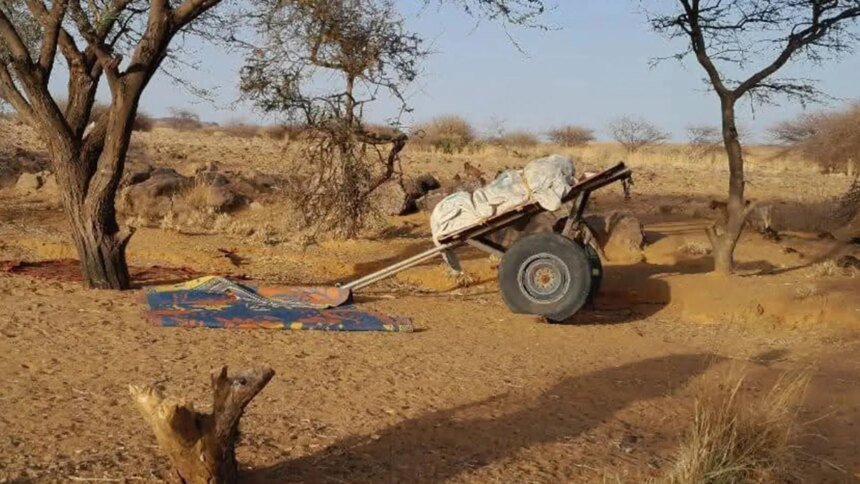
Darfur- Under the shade of a lone tree in the Ardmi refugee camp in eastern Chad, Hajj Soraya Mukhtar (45 years old) sits recalling the remnants of a life that was safe before the war uprooted it.
A week ago, the sound of explosions and bombing fire forced her to leave her home in the Orshi area. She left behind her years of life and her dream, and carried only the identity of displacement that haunts her like a shadow.
Soraya told Al Jazeera Net: “I left without realizing that I would not return. I carried my children and ran, with the fire behind us and bullets above our heads. We have not eaten for two days, and my children are crying from hunger. I do not know how I will feed them tomorrow, or where I will sleep tonight.”

Soraya is one of thousands of women who carry the weight of displacement on their shoulders. In their eyes there is an endless story of fear, hunger and wandering. They search in silence for a drop of water for their children, who ask every day: When will we return to our home?
The Rapid Support Forces had launched, On June 15, 2026, A massive attack on the Orshi area in Ambro locality, western Sudan, using military vehicles and fighters on horses and camels.
The attack resulted in the complete burning of 10 villages, and the looting and burning of the Orshi market, in addition to the looting of large numbers of livestock and household possessions.

Live in the open
A week after the attack, thousands of displaced families are still living in the open, without shelter, food, or medicine. They sleep on hard dirt, under trees that do not protect them from the heat of the day or the cold of the night. Some of them cover themselves with dry tree branches, while others do not even find this.
Speaking to Al Jazeera Net, a member of the Sudanese Sovereignty Council, Salah Rasas Adam Tor, said that “the Darfuris are an integral part of the Sudanese people,” warning that calls for partition are “mere illusions” aimed at destabilizing the country.
Rassas added that the ongoing military operations aim to “break the bones” of the Rapid Support Forces, stressing that “targeting civilians and displacing them is not a tactical error, but rather a systematic policy followed by the Rapid Support Forces to change the demographic composition of the region.”

He stressed that “the continuation of this policy will lead to a humanitarian catastrophe with undesirable consequences, and the state is seeking to put an end to this by eliminating rapid support,” calling on the international community to intervene to stop what he described as “the forced displacement of civilians.”
But the reality of the displaced people under the trees in the villages and valleys of Orshi paints a completely different picture. While leaders talk about military strategies, civilians pay a heavy price, and declared policies turn into daily suffering.

Hunger and thirst
Water is the first complaint. After the destruction of the Orchi reservoir, the burned villages and newly displaced people were cut off from water. Hawa Adam (35 years old), displaced from Orchi to Tina, Chad, told Al Jazeera Net: “We walked long distances before arriving at Tina, and on the way, we ate tree leaves and drank polluted water that we found in holes.”
She added: “Food is almost non-existent, and the remaining supplies were looted by the Rapid Support Forces, or burned in homes.”
For her part, Umm Ibrahim (40 years old) narrates: “We left our homes without food or medicine. The night is the hardest, and the children are crying from hunger and fear.” She continues: “My children have not eaten for two days and are crying, and I have nothing to offer them and my husband was working in agriculture, but our source of livelihood burned down along with our house.”
The disaster was not limited to the displaced within Sudan, but also extended to the camps in eastern Chad. The humanitarian activist and head of the Darfur Genocide Victims Commission, Mustafa Barra, told Al Jazeera Net that the regions of Kornoy, Al-Tineh and Ambro witnessed successive waves of displacement. Throughout the past three months.
He added, “After the Orchi events and the burning of about 10 villages, refugee camps in eastern Chad are now receiving between 70 and 80 fleeing families every day, most of whom are women and children. They arrive exhausted, without food or water. Some of them carry their sick children on their shoulders.”

Limited risks and relief
In a new development that reflects the continuing danger, citizen Adam Abkar told Al Jazeera Net: “The region is still witnessing intense flights of drones targeting water sources, livestock, and civilian homes.”
He added: “We cannot return to our villages. Planes fly over our heads every day and target any movement, as if they want to expel us from the last place we seek refuge.”
He continued that these continuous flights increase the suffering of the displaced, who found themselves between the hammer of bombing on their villages and the anvil of drones that pursue them even in their places of refuge.
Local activists and emergency rooms are trying to provide some assistance, but the capabilities are almost non-existent.
Muhammad Safi, media officer for the Al-Tineh Emergency Room, told Al Jazeera Net: “We are trying as much as possible to deliver water and food to the displaced, but the numbers are large and the capabilities are very limited.”
He added, “Over the past two days, we received more than 7,000 displaced families from the Orchi, Hami, Basau Valley, and Idar regions. All of them are in urgent need of tents, blankets, food, and drinking water. The situation requires urgent intervention from humanitarian organizations.”
This suffering comes at a time when a joint report by the Food and Agriculture Organization (FAO) and the World Food Program (WFP), issued on June 17, 2026, warned that Sudan is facing the worst hunger crisis in the world.
The report revealed that 19.5 million people face high levels of acute food insecurity, with famine threatening 14 regions in Darfur.
Al Jazeera Net tried to contact Rapid Support to get an opportunity to respond to the accusations related to burning villages and forced displacement in Orshi, but it did not provide any comment until the moment the report was published.
From Al-Tineh to Kornoui, from Kornoui to Umbro, and from Umbro to Orshi, the area of displacement expands and the tragedy is repeated. Leaders’ statements about “systematic displacement” find their daily expression in the eyes of children searching for a drop of water, and in the feet of women walking long distances to escape the fire.
While thousands of displaced people try to survive under the trees, amid international warnings of imminent famine, the biggest question remains: How many more villages will be burned? How many families will be forced to flee before the international community takes action to stop this systematic policy.