Is Britain closer to rethinking its decision to leave the European Union? This is the question that has become a major concern in British politics recently, and whose dimensions this report traces across 3 levels.
The report initially reviews a recent poll published by The Guardian newspaper that reveals Generation Z’s view of “Brexit” and the future of the relationship with Europe. It then moves to a critical reading provided by three of the newspaper’s writers who lived through the referendum and its repercussions over a period of 10 years, and finally turns to the options available to the next government in the file of resetting relations with the European Union.
Read also
list of 2 itemsend of list
What the numbers say
A new poll conducted by the More in Common research center, which included 440 young men and women between the ages of 18 and 28, reveals that 60% of them would vote in favor of returning to the European Union if given the opportunity, compared to only 9% who would support remaining outside the Union.
When the center calculates the participants likely to vote in any future referendum, the percentage of support for return rises to 81%, compared to only 19% against it, according to what was reported by the Guardian.

The results also show that 50% of Generation Z consider Brexit a failure, while only 16% see it as a success, while 34% have not decided their position yet.
When young people were asked about the reasons for the failure in their opinion, it was found that 37% of them believe that Brexit could have succeeded had it not been for politicians’ mismanagement of it, while 29% believe that the project was doomed to failure from the beginning, while those who believe that Brexit has succeeded so far do not exceed 11%.
Demographic change
These results come at a time when there is increasing talk about the demographic shifts that have changed the composition of the British electorate since the fateful 2016 referendum, which ended with the exit camp winning the European Union by 51.9% versus 48.1% to remain.
The death of millions of older voters who supported Brexit, and the entry of millions of pro-European youth into the electorate, may have effectively removed the majority that supported Leave a decade ago.
The newspaper indicates that the poll shows that 62% of British youth support holding a new referendum on returning to the European Union during the next five years, compared to only 11% who oppose that, while 27% are still hesitant.
Analysts confirm that the death of millions of older voters who supported Brexit, coinciding with the entry of millions of pro-European youth into the electorate, may have effectively removed the majority that supported Brexit a decade ago, opening the door to a renewed debate about the future of the relationship between Britain and the European Union.
Constant criticism
In a lengthy discussion between three of The Guardian’s most prominent writers, Aditya Chakraborty, Polly Toynbee and Simon Jenkins returned to the moment of the referendum and its aftermath, asking whether the fears raised by Brexit opponents had actually been realised, and whether Britain was once again approaching Europe.
One of the most dangerous effects of Brexit has been the normalization of hardline discourses on immigration and national identity
The writers recalled memories of the day of the referendum in June 2016, where Chakraborty described that period as characterized by anger and division, and said that he noticed a large gap between regions that felt marginalized and frustrated and political and media elites who spoke in the language of numbers and facts.
According to the article, Chakraborty considers that one of the most dangerous repercussions of the vote was the rapid escalation of racist rhetoric after the announcement of the result, referring to the experience of a friend of his, who heard someone screaming in the street after the referendum was confirmed: “We have regained our country, and now I will burn that mosque,” and there was a mosque at the end of the road.

As for Toynbee, who spent the referendum day in June 2016 at a Labor Party call center to support the Remain campaign, she said that the calls she listened to reflected widespread anger towards increasing immigration, and a desire among many voters to “take back control” of the country from the European Union.
On the other hand, Jenkins explained that he was a skeptic of the European project from the beginning, but he later changed his position after he became convinced that the alternative to European membership would be worse.
He told his colleagues that European academics and journalists told him while he was in Germany on the day of the referendum that they feared Britain’s exit because that would leave Europe’s future in the hands of other countries that might upset the balance that London represented.
When discussing the aftermath of the vote, the authors agreed that Leave campaign leaders did not have a clear plan for how to implement Brexit.

Blames and consequences
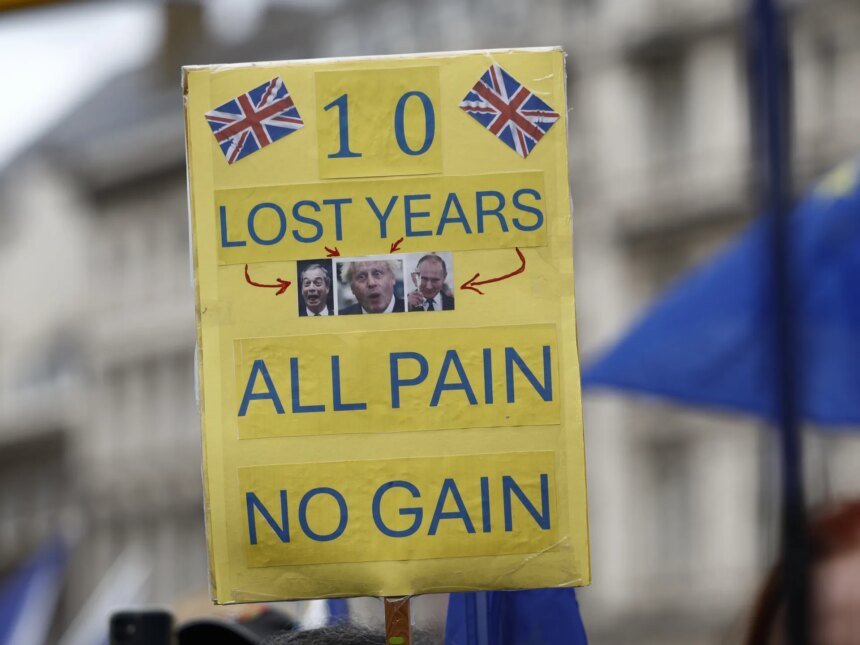
Chakraborty says that prominent figures such as former British Prime Minister Boris Johnson, politician Michael Gove, and leader of the Reform the United Kingdom party, Nigel Farage, pushed for exit without a practical vision of what would happen next, while Jenkins indicated that the division was not only about leaving the European Union, but rather about the nature of the new relationship that was supposed to be established with the continent.
In turn, Toynbee held former Labor Party leader Jeremy Corbyn partly responsible for his refusal to support a proposed settlement that might have led to a more flexible Brexit.
In their assessment of the past ten years, Jenkins argues that public debate has become less emotional and more focused on practical issues such as trade, student exchanges, and regulatory restrictions.
But Chakraborty rejects this characterization, and asserts that one of the most dangerous effects of Brexit was the normalization of extremist discourses on immigration and national identity, to the point that ideas that were considered extremist a decade ago have now become part of the mainstream political debate.
The future of Brexit
Regarding the future, opinions were divided between a gradual return to European cooperation through agreements in certain sectors, and eventually seeking to formally re-join the European Union.
Chakraborty believes that any new rapprochement must be achieved through a clear democratic mandate, while Jenkins calls for a public debate based on facts and economic data.
As for Toynbee, she confirms that she feels today that the warnings of opponents of Brexit a decade ago were correct, considering that exit was not just an economic mistake, but also political and emotional.
The author concludes that Britain has finally begun the stage of re-evaluating that experience and searching for a new formula for its relationship with Europe.

After Starmer’s resignation
Therefore, it seems that the debate over Brexit is no longer just a discussion about the past, but rather has become an urgent political issue facing the new British leadership, especially after resigned British Prime Minister Keir Starmer left his position.
According to the British newspaper The Times, the issue of resetting relations with the European Union will be one of the first issues on the desk of the strongest candidate for prime minister and Mayor of Greater Manchester, Andy Burnham.
The newspaper indicates that Burnham will find himself forced to determine his position on the negotiations with Brussels, especially with regard to the youth mobility agreement between Britain and the European Union.
Despite expectations that he will deal with the issue with caution and initially adhere to the red lines set by his predecessor, Keir Starmer, any European pressure or demands to make concessions may put him early in the face of a difficult political test, at a time when calls are rising within Britain, especially among young people, to reconsider the country’s relationship with Europe after a decade of exit.