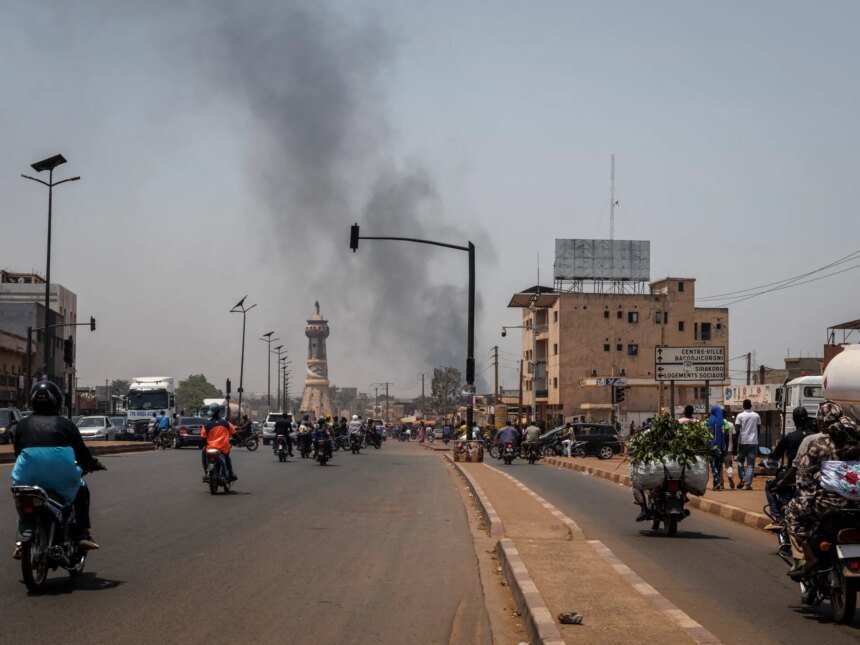
Mali is facing the most dangerous historical turning point since the 2020 coup, as the ruling military authority found itself under the weight of unprecedented coordinated attacks that resulted in the killing of the Minister of Defense, and conflicting news about the fall of the strategic city of Kidal into the grip of the Front for the Liberation of Azawad, amid mysterious silence from the head of the ruling military junta, Assimi Goita.
A blow to Katie’s heart.
Reports confirm that Malian Defense Minister General Sadio Camara (47 years old) was killed as a result of a suicide attack targeting his residence in the town of Kati (15 kilometers north of Bamako). According to the government statement broadcast on state television, a suicide bomber driving a car bomb rammed the minister’s house, leading to the outbreak of violent armed clashes.
Sources indicate that Kamara personally clashed with the attackers and was able to neutralize some of them before sustaining injuries, as a result of which he later died in the hospital. The explosion resulted in the complete destruction of his house, and members of his family were reportedly killed, including his second wife, according to some reports.
Kamara was not just a minister, he was the most influential figure in the military junta after Assimi Goeta, and his importance can be summarized in the following points drawn from the reports:
Russian Alliance Architect: Kamara is considered the main architect of Bamako’s rapprochement with Moscow, as he managed the file for recruiting Wagner fighters (which became the Africa Corps). He is a graduate of the Russian military academies and is described as a “hawk” who pushed for a break with France and international forces.
Dynamo of military operations: He was the driving force behind the Malian army’s offensive strategy, including the “Retake Kidal” operation in November 2023, which the regime promoted as a major symbolic victory.
The political legitimacy of the Council: As a member of the “hard core” of officers of the 2020 coup, Camara represented the guarantor of the stability of the military power hierarchy, and his killing represents a “blow to the heart of the regime” and makes it lose one of its most important pillars that shaped Mali’s new sovereign policy.
advertisement
The analyzes contained in the sources indicate that Kamara’s absence opens an “area of ambiguity” about the future of the alliance with Russia, as he was the direct link with Moscow.
His killing in Kati – the most secure area – reveals a major security breach that weakens the image of the military junta, which promised Malians security and stability.
The Malian authorities declared national mourning for two days, during which flags were flown at half-mast on official buildings, in appreciation of Camara’s role as one of the pillars of the regime.
While the government spokesman offered his condolences to “all civilian and military deaths” who fell in the coordinated attacks that affected 6 locations across the country, the government statement avoided providing a final tally of the number of victims, only referring to “limited injuries and material damage,” while stressing that the late minister would be held at a “national funeral.”
The fate of leaders
The fate of the head of the military junta, General Asimi Goeta, remains a subject of widespread questions in light of his complete absence from the scene since the attacks began.
Security sources indicate (according to Radio France Internationale and Agence France-Presse) that he was evacuated from his residence in Kati on Saturday during the day, and transferred under the protection of his bodyguards to a “safe place”, believed to be a special forces camp on the outskirts of Bamako.
Despite the “Support for Islam and Muslims” group announcing that it had targeted his residence, Goeta did not appear or deliver any speech, a silence that analysts and diplomats described as “surprising” and worrying in light of a crisis of this magnitude.

In the same context, there were reports from security sources that senior military commanders were directly injured during the attacks on the town of Kati:
General Modibbo Kony: Head of State Intelligence (State Security) and one of the most powerful men of the military junta, as sources including Le Monde and Le Figaro newspapers reported that he was seriously injured during the attack that targeted the leadership headquarters in Kati.
General Omar Diarra: Chief of the Army General Staff. Security reports indicated that he was shot during Saturday’s clashes. Although he later appeared on state television to make a statement about the military operations, security sources described his situation and that of Kony as being among the direct targets of the coordinated assassinations.
The impact was not limited to the Malian leaders, but extended to their Russian partners. In the city of Kidal, sources revealed that the field commanders of the “Africa Corps” (formerly Wagner) submitted to an agreement with the rebels of the Front for the Liberation of Azawad, which stipulated their withdrawal from the besieged “MINUSMA” camp.
Reports confirmed the evacuation of at least 400 Russian personnel under the guard of the Tuareg rebels towards Tessalit, which reflects a collapse in field leadership coordination between the Malian army and its Russian allies in strategic areas.
According to a group of media reports, analyzes conclude that the military regime lost within hours part of its “solid core” that led the 2020 coup.
Between the dead (Camara), the injured (Koni and Diarra) according to the media, and the out of sight (Goeta), the military junta became in an unprecedented state of vulnerability, which opened the door for opposition forces, such as the Imam Mahmoud Dicko coalition, to demand the immediate “resignation of the military junta” and the formation of an alternative transitional authority.
advertisement
On the other hand, Imam Mahmoud Dicko announced from his refuge in Algeria on behalf of the “Alliance of Forces for the Republic” that Mali had become “in danger” after the fall of state symbols, calling for the immediate resignation of the military junta and the opening of a comprehensive civil transition.
Reports indicate the beginning of a convergence of interests between the political opposition led by Dicko and the armed field forces, with a common goal of overthrowing the military regime and building a new political alternative, taking advantage of the state of “reeling” security and the loss of confidence in the Russian ally, which seemed unable to protect its strongholds.
Test for the Sahel Alliance
In addition, the Sahel coalition faces the most difficult existential test since its founding, as the recent attacks revealed the fragility of the joint defense coordination between Mali, Niger, and Burkina Faso.
Despite mutual defense treaties, there was deafening silence on the part of the two allies (Niger and Burkina Faso) during the height of the attacks on Bamako and Kati.
The coalition secretariat contented itself with issuing a statement denouncing what it described as a “brutal conspiracy” supported by enemies to liberate the Sahel, without providing tangible military support on the ground to save the heavy center of the coalition in Mali.