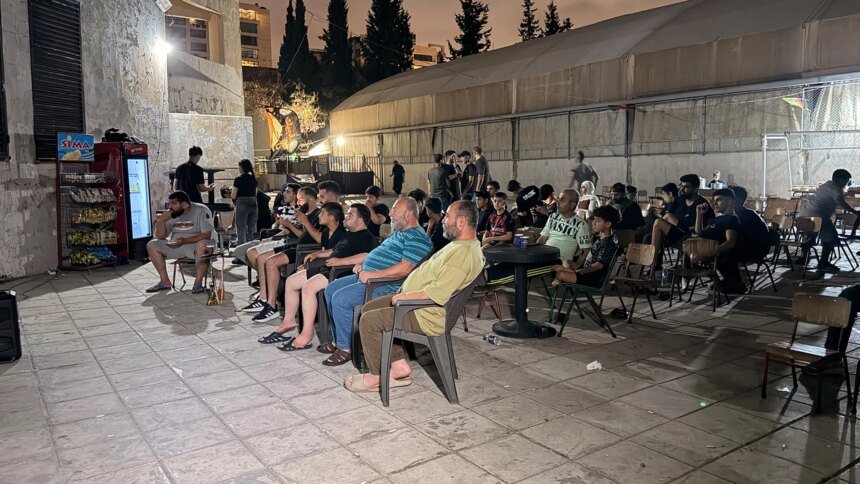
Beirut- On the night of the World Cup, the features of a Beirut school change. The white building, which was once a space for classes and morning lineups, and was transformed with the waves of displacement into a shelter center, its rhythm is no longer measured by the school bell, but rather by the match schedules.
With the kick-off whistle every evening, the entire mood of the building changes. The square, which was a daily corridor for students, turns into something like an open “collective amphitheater,” where a large screen is installed in the heart of the place, and the weight of the days is temporarily turned off in favor of a match being played in a far away country, but it is watched here as if it were part of daily life.

In the outdoor square, where queues used to line up in the morning in strict order, today there is an open space filled with organized chaos: makeshift electrical wires, scattered plastic chairs, and a floor covered in light dust that rises with every movement.
As the matches approach, the arena gradually begins to transform into a group performance space, as if it is preparing for an event that transcends the boundaries of sports.
A large screen is installed in the heart of the place, rearranging the daily rhythm of the square. The light emanating from it reflects on the tired faces, giving the place features that fluctuate between fleeting joy and permanent heaviness that does not leave the background. Here, the sounds of war recede, albeit temporarily, to give way to the voice of the sports commentator and the chants of a distant audience, the echo of which reaches more than its image.

Between memory and reality
In one of the corners sits Khader Taher, a fifty-year-old from the south, with pale features and heavy calm. He places his hands firmly on his knees, as if someone is trying to stabilize himself in a space that does not give him much stability. His gaze moves between the screen and the floor, and between them there is a distance of silent thought, interspersed with short sighs that do not need explanation.
Matches for him are no longer what they used to be. That rhythm that used to accompany the evenings at home and with the neighbors changed into a completely different view, but despite everything, it still carried a hidden thread that connected the present to what was called ordinary life. While matches are played in distant stadiums, another silent match is being played here between memory and reality.
Children fill the square with restless movement. They pass between mattresses and chairs, run in narrow spaces, and create a temporary playground for themselves within every possible space. Some of them sit on the ground indifferently, while others move closer to the screen with every exciting shot. Football for them is not only what happens on the screen, but what can be reproduced on the ground itself.
When the commentator’s voice rises, they automatically jump, as if the sound alone could ignite a collective reaction. When a goal is scored, short, quick laughter erupts, which quickly subsides and returns to its original form: a childish noise governed by the confines of the place, but which opens, even momentarily, a window into another life.

Escape space
In another corner, the young woman Jana Karim from Khirbet Salm sits, holding her phone from time to time, then putting it back next to her to continue watching the big screen. Do not treat the scene as just a sporting event, but rather as a short space to escape from daily pressure that does not stop at certain limits.
Her features are calm, but behind this calmness appears a fatigue that does not require much explanation. In this evening gathering, it seems that the most important idea is not the match itself, but the gathering around it. The presence of others in the same place, and being busy with the same event, creates a slight layer of reassurance, even if it is temporary, as if the group is restoring the destroyed sense of a normal day.
On the other side, Ahmed Raghda sits from a boat in apparent silence. He raises his head at dangerous opportunities, then returns to his initial calm. For him, the joy he experienced with football was at home: family, friends, and spontaneous laughter that preceded and accompanied the result. But here, the matter is different; Watching reduces the heaviness of the day more than it creates complete joy, but it nonetheless provides a moment of separation from reality.

As the match progresses, the atmosphere of the arena gradually changes. The voices rose and then died down, the children moved closer to the light, and the adults stole short moments of rest between fatigue and waiting. Despite this interaction, there remains a hidden feeling that does not leave the place, as if it were a permanent shadow attached to every movement: the realization that this joy is as temporary as the residence itself.
At the heart of this scene, the center’s official, Ali Reda, explains to Al Jazeera Net that the presentation of the matches was not a passing detail, but rather a conscious attempt to create a different space within a heavy day. A space that allows a small amount of breathing space, even for a couple of hours, where life can seem less cruel, even if the causes of the cruelty themselves have not changed.
The turnout, he explains, exceeded expectations. The square turns every evening into something like an open café, where everyone sits, regardless of their ages and backgrounds, but they agree on one thing: following a shared moment in a fragmented time, as if the screen brings together what was separated by roads and borders.

Trying to cling to life
In a corner of the square, Haitham Asili from the town of Al-Sakskiyah sits next to his family, watching the screen silently, as if he was taking from the match a temporary opportunity to get away from the weight of the daily news. Football here is not a luxury, but a short break from endless pressure.
But this joy, as shown in his speech, is not complete. It ends with the referee’s whistle, and with it everything that was postponed for only a few minutes returns. However, these moments remain necessary, because they give the soul a little space outside the constant circle of anxiety.
At the end of the half, there is a short silence, interrupted only by light conversations here and there. Some women are arranging the mattresses, men are stretching to relieve the fatigue of sitting for a long time, and children continue to play in the corners of the yard as if they do not acknowledge the end of the moment.
As the end of the match approaches, the lights dim slightly, and people begin to return to their temporary sleeping places. There are remnants of sound, remnants of cheering, and remnants of a small moment of joy that passed quickly, but left a slight impact on a stressful day.
Here, within the walls of what used to be school classrooms, temporary life juxtaposes with the ancient memory of the place. Between what was and what has become, the only commonality remains clear: a continuous attempt to cling to life, even through a bright screen in the courtyard of a shelter center, where the World Cup becomes a temporary form of life itself.