The U.S. State Department has warned that Sudan’s Rapid Support Forces are massing near the city of El Obeid and that “mass atrocities” against civilians could occur if the city falls to the paramilitary group.
The statement, released on Monday, echoed those made by the African Union, the United Nations and other international bodies that have expressed concern that the Rapid Support Forces, or R.S.F., could subject civilians in the city to torture and abuse, as happened in El Fasher in Darfur.
El Fasher fell to the R.S.F. in October after a long siege. The U.N. found in February that the assault and its aftermath bore the hallmarks of genocide.
The State Department called on the R.S.F. to cease impeding the delivery of aid to El Obeid and to uphold international law.
“There are alarming indications that mass atrocities could be imminent, further worsening Sudan’s already catastrophic humanitarian crisis,” a department spokesman, Tommy Pigott, said in a statement on Monday.
El Obeid, in south-central Sudan, is strategically significant. A highway running through the city links Darfur, in west Sudan, to the east. And a major pipeline there transports oil via the Kordofan region from neighboring South Sudan to Port Sudan.
Taking the city would enable the R.S.F. to consolidate its hold on western Sudan after taking El Fasher last year.
El Obeid had a population of several hundred thousand before the war, which began three years ago after a feud between two top generals. Those men, Lt. Gen. Mohamed Hamdan of the R.S.F. and Gen. Abdel Fattah al-Burhan of the Sudanese Armed Forces took power in a coup before turning against each other.
In recent weeks, civilians have been killed as the R.S.F. has deployed drones to target fuel stations and trucks in El Obeid, according to the U.N. High Commissioner for Human Rights, Volker Turk. He said that one effect of the attacks has been to severely curb the city’s basic services, which include electricity and the internet.
Alaa Eldin Awad Naqd, health minister in the Sudan Founding Alliance, the self-declared parallel government set up a year ago by the R.S.F., said in an interview on Tuesday that it was important to capture El Obeid as part of a broader campaign to eventually extend to the capital, Khartoum.
“It’s just a military operation,” he said. “It’s the normal cascade of war.”
Mr. Naqd said there would be no atrocities if the R.S.F. captured El Obeid, which is the capital of North Kordofan state, and dismissed as propaganda reports of attacks on civilians in El Fasher.
The R.S.F. took Khartoum early in the war after a ferocious battle, but the Sudanese Armed Forces recaptured the city last year during a counteroffensive. Sudan is now effectively divided in two, with the R.S.F. controlling the west and the armed forces in command of the capital and the east.
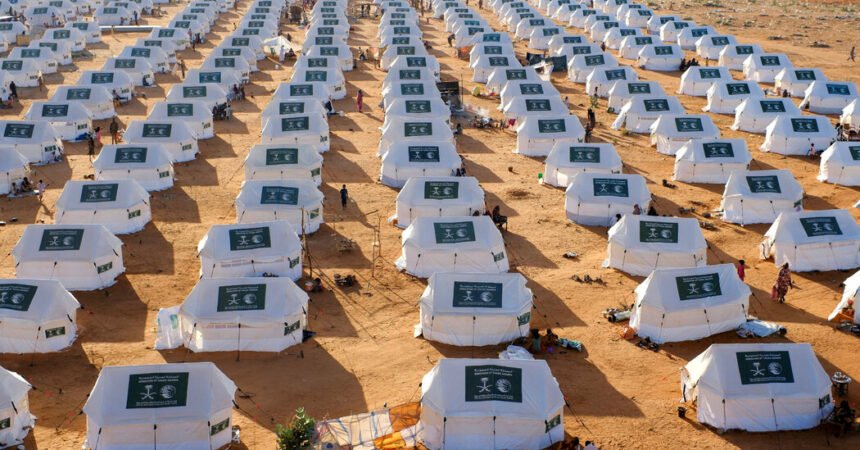
Aid agencies and the United Nations consider the crisis in Sudan to be the world’s worst because it has forced around 14 million people from their homes and pushed more than 10 million people into extreme levels of food insecurity.
The war has destroyed Sudan’s economy, collapsed its health system, prompted widespread violence against women, brought the deaths of thousands of children and left many of the young without schools, threatening the country’s future.
The health ministry puts the civilian death toll at more than 11,000, while some estimates are as high as 400,000.
The R.S.F. and Arab militias that fight alongside it have conducted ethnically targeted killings that the U.S. government has deemed to be genocide, and over the course of the war, the United States has accused both sides of war crimes.
The United Arab Emirates has run a covert operation to back the R.S.F., supplying powerful weapons and drones, and providing other support, according to officials from the United States, Europe and several African countries. The Emirates has denied this.
Turkey, Russia and Iran have supplied or sold weapons to the Sudanese military, sometimes in exchange for gold.