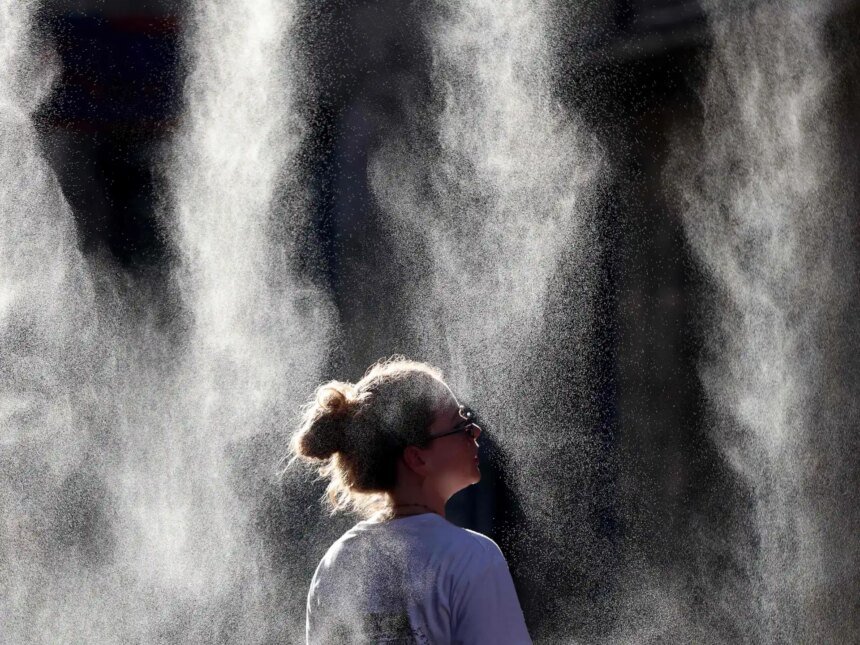
While Parisians chase the opportunity to take a dip in the Seine River, catch the spray emanating from the Eiffel Tower, or touch the cold water in fountains in order to prevent possible heat stroke, politicians are increasingly interested in pushing the worsening heat crisis on their electoral agendas, in light of growing concern about the health and economic repercussions and the confusion of services in public facilities.
As in previous years, most French people in major cities are struggling to cope with successive heat waves that drain effort at work, in transportation, and in catching their breath as well.
With the death of 3 elderly people due to health problems due to the heat, and the authorities being forced to close or modify the academic schedules of about 2,700 schools across France, the debate among politicians and even scientists has revolved around how to coexist with the seasonal heat, instead of the typical debate about limiting global warming in the medium and long term.

Political hesitation
Although the influence of the heat was not hidden from the early election campaigns of the presidential candidates, including the electoral rally of the leader of the right-wing conservative “Republican Party” Bruno Ritaio, the party does not practically place resistance to the heat as an electoral priority over the issues of housing, work, wages, and immigration. All that was included in its speech was a return to marketing a “right-wing environment,” which is an approach of the right-wing movement based on an “environment of solutions,” but the party has not presented a clear program for it yet.
Gabriel Atal, the Ennahda Party candidate, timidly presents his project to resist the effects of climate change by thermally insulating about 40,000 schools, but this project faces criticism due to logistical complications and its exhaustion for indefinite periods, which makes it an unattainable solution in the medium term.
On the other hand, Edouard Philippe, the former prime minister and declared presidential candidate, maintained the same silence, as he did not make any comment on the current heat wave. The environmental ambitions of his “Afaq” party also appear only in a brief road map that calls for “developing an effective policy to decarbonize the economy, preserve biodiversity, and increase investment in developing the energy and agricultural sectors.”
The primacy of the far right and the resilience of the Greens
In contrast to the conservative right, the far right in France, led by the National Rally party, took precedence in proposing direct solutions to the heat crisis, focusing on accelerating the rollout of air conditioning systems, similar to the neighboring countries overlooking the Mediterranean basin, specifically Italy and Spain.
In a talk show on France Info, Franck Alessio, a member of Parliament for the National Rally, defended the party’s plan presented a year ago by Marie Le Pen to air-condition public buildings, by providing air-conditioning devices to schools, hospitals, elderly care centers, and public transportation, as a first step to protect the groups most affected by extreme heat waves.

In its defense of the adaptation plan, which it believes is inevitable to confront unbearable temperatures, the party focuses on key points, including:
- HVAC systems are being implemented in many other countries, including countries in the Global South.
- It provides added value in terms of productivity, in work centers, especially in the field of health care.
- Provides energy sources in France, including nuclear energy.
- Air conditioning in the summer is similar to using heating in the winter.
- Air conditioning only accounts for 1% of greenhouse gas emissions, according to the party.
As temperatures rise, the Green Party is also showing more flexible positions towards the debate over “air conditioning”, as party leader Marine Tondillier acknowledges that there are places where air conditioning is no longer dispensable, such as schools and public buildings. But the party is still wary of the idea of spreading air conditioning to private buildings on a large scale in cities.
Instead, the party prefers to move forward with its political and social struggle to demand that workers be granted climate leave, in the latest proposal for an environmental social security system proposed by the party with the aim of covering new risks, which did not exist when the social security system was established in 1945.
Logistical obstacles
Despite the open and public political discussion of a dilemma that has remained silent for years, questions are swirling about the extent of the government’s readiness itself to adopt the air conditioning system, which has become an urgent necessity, especially in the southern provinces overlooking the Mediterranean basin, where temperatures can reach 40 degrees during heat waves.
According to data from the International Energy Agency, the European average for homes equipped with air conditioners is about 20%. While this percentage rises to between 50 and 60% in Italy, Spain and Greece, it decreases to 25% in France.
In contrast to the political enthusiasm, Le Monde newspaper points out, in its analysis, objective obstacles to the air conditioning expansion project, the most important of which are:
- The significant lack of governmental stability that France has witnessed in recent years.
- Resources have not kept pace with the demands of adapting to climate change.
- The Green Climate Fund’s budget has declined from €2.4 billion in 2024 to €837 million in 2026, with nearly 20% of it recently frozen.
In addition to a general feeling of unpreparedness, the newspaper also points to another political issue that hinders progress in the public air conditioning project, related to the disparity of interest among elected officials in municipal areas, even though they represent the front lines when heat waves break out.
Europe is sweating
The dilemma does not stop with France, as all of Europe is sweating. Until Monday, for example, temperatures were far from normal, as the average maximum temperature reached 24 degrees Celsius, an increase of 4.1 degrees Celsius over the usual average during the period from 1961 to 1990.
Experts say that with these rates, European countries face a vital challenge to enter into a new type of housing that is contrary to prevailing urban planning with the aim of adapting to climate change, despite the expected economic costs.
In this regard, Milo Bogaerts, head of the global credit insurance company Allianz Trade in Germany, Austria and Switzerland, explained that extreme heat is no longer just a short-term weather phenomenon, but has turned into a structural economic shock.
The challenge, according to the company’s president, is that Europe was historically designed to deal with cold, and to this day it is still not well prepared to face heat, even though its waves are no longer a new phenomenon in recent years.
On the other hand, the economist at Allianz Research, Hazem Krishin, stated that the United States, the Middle East, and Asia are considered more advanced in this field, given that heat has been an essential part of urban and economic planning in them for decades, and therefore air conditioning devices are widespread in them.
According to the numbers contained in a study presented by Krishin, about 90% of homes in the United States are equipped with air conditioning systems, a significant difference from Europe, in addition to the fact that many European buildings were engineered to retain heat instead of discharging it.
At the conclusion of his reading of the results of the study, Krishin stressed that the green transition and adaptation to climate change have now become pivotal issues in the economic policy of countries, and go far beyond the scope of traditional environmental issues.
He stressed that countries that will move and advance faster in the areas of infrastructure development and protect companies and workers from the consequences of heat stress will be in a better and more competitive economic position in the future.