Published on 6/22/2026
After less than two years as prime minister of the British government, Keir Starmer resigned from his position, and British and American newspapers covered this resignation, its implications, and expectations regarding his potential successor, his chances of success, and the challenges that he will face.
Writer Robert Shrimsley believes in an article in the Financial Times that Starmer’s resignation has been inevitable for months, and that the timing of his early exit reflects a deep crisis within the Labor Party more than it reflects a specific electoral result. It is considered that the increasing rise of the Reform Party, led by Nigel Farage, has created a state of panic among Labor representatives, who have come to see this party as an exceptional threat that cannot be ignored.
Read also
list of 2 itemsend of list
The article finds that Starmer relied excessively on party discipline, but lost his prestige when he appeared willing to back down under pressure. Most importantly, he did not succeed in inspiring voters or presenting an attractive political vision, and therefore his party began to lose confidence in its ability to win repeatedly.

Candidates to succeed Starmer
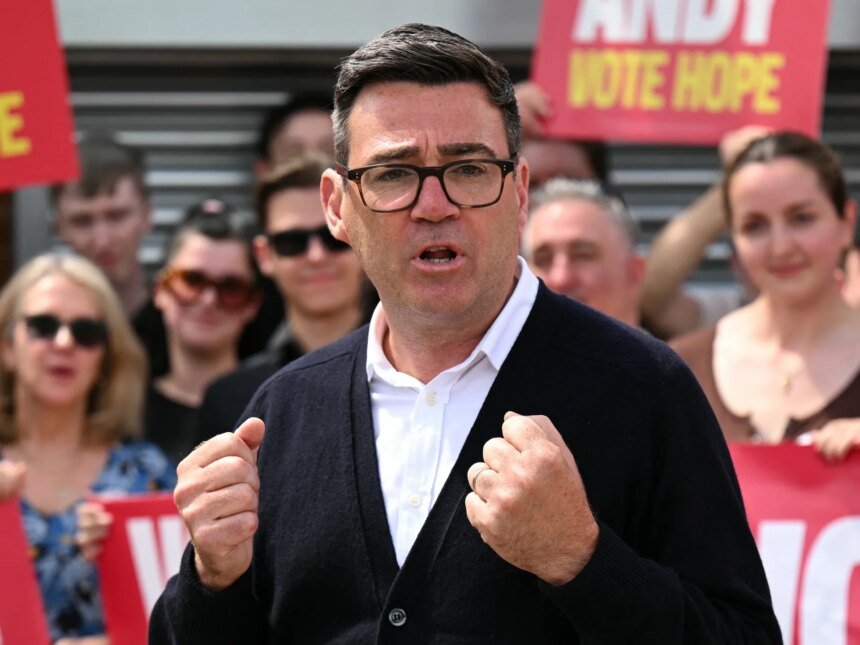
According to the writer, the most likely candidate to succeed him is Andy Burnham, in light of the decline in the chances of internal competition. It is expected that Burnham will lead the party towards a more left-wing orientation, by increasing the role of the state, imposing higher taxes, and perhaps expanding nationalization or regulatory tightening.
The article warns that this shift may re-attract left-wing voters, but it exposes the government to difficult economic challenges, especially with high borrowing and limited resources. He concludes that changing leadership does not mean solving structural problems, and that Burnham’s success, if he takes office, will test his ability to reconcile political ambitions with economic reality.
It was also reported that the most prominent potential candidates within the Labor Party, in addition to Burnham, are:
- Wesley Streeting, Starmer’s health minister and the most prominent Labor leader, resigned about a month ago, and has support from a portion of MPs who want leadership less left-wing than Burnham.
- Rachel Reeves, Minister of Finance. It represents the relatively conservative economic wing within the party, and enjoys the confidence of markets and financial institutions. But she is not a strong populist candidate within the party compared to Burnham.
- Angela Rayner, deputy party leader. It represents the traditional workers’ wing most closely linked to the unions and the popular base. She is popular within the party, but politically divisive.
- Shabana Mahmoud, Minister of Interior. She is considered a quiet, moderate figure, and is sometimes presented as a compromise solution if the party wants to avoid a conflict between the factions.
His popularity is high
Despite the presence of these names, Burnham is considered to be in a very advanced position due to his high popularity as Mayor of Manchester and his ability to communicate with voters in the north of England, an electorally crucial area.
In his article in the American New York Times, writer Stephen Castle discusses Burnham’s rise, saying that, after his decisive victory in the parliamentary by-elections in the Makerfield constituency, he has become closer than ever to achieving a goal that he had sought twice previously without success, which is to lead the party and then reach Downing Street.
The writer presents Burnham as a different character from Starmer; He says that he is a politician with charisma, the ability to communicate, and a warmer and more optimistic image, qualities that gained him wide popularity during his years as Mayor of Greater Manchester. Since assuming office in 2017, he has built the image of a politician close to the people and a defender of the areas of northern England that he believes have suffered marginalization compared to London.
Stephen Castle:
Burnham is a charismatic politician and communicator with a warm and optimistic image – qualities that won him wide popularity during his years as Mayor of Greater Manchester.
He studied English literature
Burnham was born in 1970 in Liverpool and grew up in northwest England in a middle-class family. He studied English literature at Cambridge University before starting his political career as an assistant to a number of Labor Party deputies and ministers. He was elected a member of Parliament in 2001, and rose to government positions during the eras of Tony Blair and Gordon Brown, where he handled economic, cultural, and health issues.
Castle continues to track Burnham’s rise and explains that, after Labor lost the election in 2010, he ran for the party’s leadership twice; The first ended with him finishing fourth, and the second in 2015 when he lost to Jeremy Corbyn. In 2017 he decided to leave Westminster and focus on local work as Mayor of Greater Manchester.
His supporters believe that his success in Manchester reflects his ability to combine popular discourse with practical management, and they point to his success in reorganizing the local bus network and expanding the role of local authorities, in addition to his strong presence during the Corona pandemic when he criticized the central government’s policies towards the northern regions.
Economic files
But his critics see him as an overly flexible politician, capable of adapting to different trends within the Labor Party, which raises questions about the clarity of his political orientation. He also faces skepticism about his ability to manage national economic files, especially after statements that raised concerns about his position on markets and public spending.
The article concludes that Burnham possesses political and popular skills that differ from Starmer, but if he becomes prime minister, he will face a more complex reality than managing a major city, as economic crises and governance pressures will impose on him tests that are radically different from his previous local successes.
In the British newspaper The Guardian, writer Polly Toynbee gives Burnham advice and recommends that he focus on first impressions, saying that Starmer’s failure to build an influential political image since his first days in power was one of the reasons for his government’s loss of popularity.
People’s livelihood
The author considers Burnham’s victory in the Makerfield constituency an important political moment, not only because it defeated the right-wing Reform Party led by Nigel Farage, but because it re-demonstrated the ability of progressive discourse to mobilize voters. She believes that this victory reflects voters’ desire for policies more closely linked to people’s livelihood, especially in the face of the populist right.
In an article published by the Financial Times, writer Martin Wolf discusses the economic and political challenges that Burnham will face if he becomes Prime Minister of Britain, warning that achieving economic growth requires difficult decisions that may be unpopular in the current British political system.
The writer starts from the basic idea that economic growth is a basic condition for the stability and prosperity of democracy, and that Britain has been suffering for decades from a clear weakness in productivity. It indicates that real output per capita in 2025 is 27% lower than it would have been if the economic trend between 1970 and 2007 had continued, reflecting a long-term recession.
Wolff believes that the reasons for the decline in growth are multiple, including declining rates of saving and investment, Britain’s exit from the European Union, and the aging of the population, in addition to increasing financial pressures. He also points out that the world today is more volatile, and that developments such as artificial intelligence create opportunities but also carry great risks, especially for medium-open economies such as Britain.
The writer confirms that the problem is not limited to the economy only, but extends to politics, as the political process in Britain has become unable to make difficult but necessary decisions. Tony Blair is quoted as calling for setting “the correct policy first and then convincing people of it,” indicating that the current policy does the opposite, which contributes to the decline in national performance.
Source: American press + British press