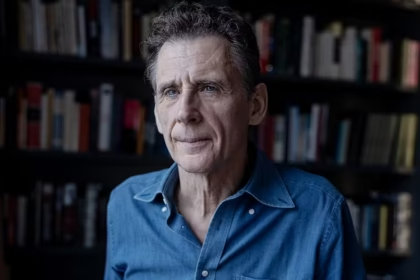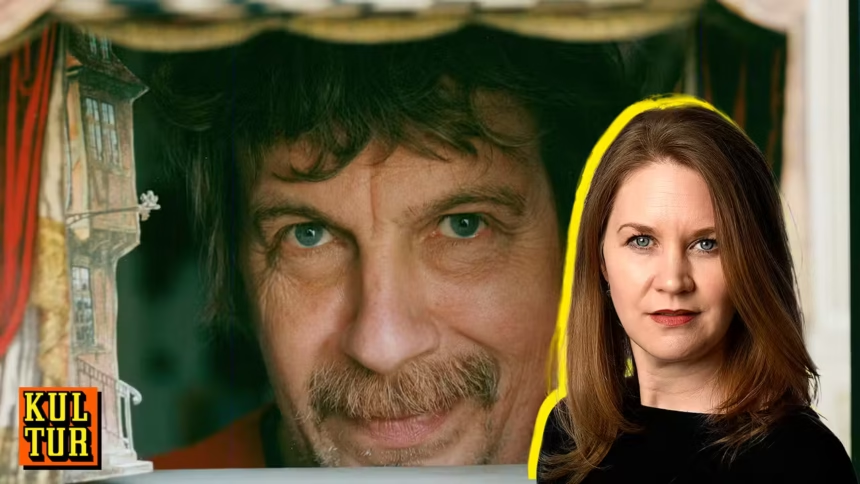
Staffan Westerberg was completely unique
As a playwright has Over the years I have become quite immune to celebrity cults. But when, in the spring of 2002, I walked down Teater Brunnsgatan four’s basement stairs to meet for the first time Staffan Westerberg my knees were all a little shaky with starstruckness. His legendary “Vilse i pannkakan” was to have a showy stage premiere and down there in the basement theater was not only the icon Staffan Westerberg but also his mythical puppets from the program.
Big for me, who is the same age as “Lost in the pancake” and grew up with Westerberg’s children’s program range. However, some of my nervousness also came from the slightly awkwardness of having to address those accusations that he would have ruined the childhood of my generation. But the question felt journalistically inevitable, when the cult pancake would make a comeback.
“Now I’m going to destroy your middle age too,” Staffan Westerberg promised raptly with his infectious laugh, but kindly let me greet the scary Big Potato.
How sad he is than had become when that unjust drive set off, his generous jest now testified that the matter was finished. At least enough that he didn’t hesitate to use it for a good story, like the phenomenal storyteller he was.
I myself also had the chance to certify that he absolutely did not destroy anything at all for me. On the contrary, I want to emphasize again. Anyone who bought into the myth that he engaged in political indoctrination of children has either never seen, or completely misunderstood his imaginative, philosophical theatrics. Those who got older became more and more cheerful, showy and often with elements of dass humor, but consistently with a wide-eyed child’s view of existence.
His rich output is difficult to overview, and I myself am too young to have experienced even a fraction. Since his stage debut at Stadsteatern Norrköping-Linköping in 1956, when Westerberg as a student at the student school played a horse’s butt in “The White Horse”, he participated in productions on stage and television beyond the 160s, as an actor, director and creator of puppets, sets, song lyrics and scripts, which he also enjoyed illustrating.
My critic colleague Malin Palmqvist once described so accurately Staffan Westerberg’s theater aesthetic as a crow’s nest: “sprawling creations of the finest the nest builder could find. Practical sticks and shiny songs. Music boxes, orange peel tiaras and colorful lanterns.” It was in the review of “Tur och retur, otur och tur” at Jämtland’s county theater in 2007, published in nummer.se.

A lot irresistibly useful, Staffan Westerberg picked from August Strindberg and reused in their own special way. “Et litet drömspel” became a milestone in theater history, which was filmed in a TV version and has been staged several times since the premiere at Stockholm’s city theater in 1981. There, Staffan Westerberg let the children laugh at the needy, whiny Strindberg pillow and raked the stage for a new generation of audiences to embrace the national dramatist – by fooling around with him.
With the same loving naivety, Westerberg has returned to Strindberg repeatedly in both text, theme and design: “Ghost Spinach”, “To Damascus and Storgatan”, which can be interpreted as a kind of Westerberg’s “Great Road”, or “Storm on Brunnsgatan”, to name a few. Perhaps in this way he also processed his first flopped attempt to play “the big” dream play at Stockholm’s city theater in 1976, which received such bad reviews that Westerberg took a two-year hiatus from the theater. In his older days, however, he revised his own history and reassessed the fiasco as “a brilliant failure”.
When I interviewed Staffan Westerberg again before the premiere of “Selma and Ågust” at Stockholm’s city theater in 2009, where he once again joined Strindberg on stage with his hair on end, in a fictional meeting with Selma Lagerlöf, he said that he recognized so much in Strindberg. Above all, in the pity for humanity that is concentrated in the winged dream game line “It’s a pity about the people”. The one that Westerberg rearranged into a more childlike and honest mantra in “A little dream game”: “It’s a pity about me.”
Once you see the connection between Westerberg and Strindberg, it is hard to forget it. Surely even “Lost in the pancake” can be seen as a Westerberg variant of “A dream game”?

But despite everyone loans and references to others, Staffan Westerberg was, without exaggeration, completely unique — as his own theater institution. Impressively prolific with endlessly recycled themes, characters and ideas and completely in his own groove, seemingly unaffected by prevailing theatrical ideals. He was his own! In addition to his characteristic object theater where everyday objects were brought to life by Staffan Westerberg’s engaging presence, or his entertaining, philosophical shows, he painted and wrote a lot.
His entire artistry is like a tribute to the dreamer, to the imagination and to the otherness, generously colored by himself. Headstrong, incomparable and with many alter egos: Vilse and Lillstrumpa, of course, and the melancholic clown Naffats, who is Staffan backwards. For, as he explained, with the support of Kierkegaard in his autobiography “Elvaåringen” (2010): “Life can only be understood backwards but must be lived forwards.”
In the adult story “The Uselessness” looms Westerberg clearly behind the aged Gunnar Renlund. Tokstollen who does everything wrong and to no avail until the end of his life when he finally meets the mythical Vitrenen, rides down the Kebnekaise and into the snow-white eternity. That a filmed documentary about Westerberg bears the title “Herr galen” is, so to speak, “spot on”.
“We’re all a bit of fools, and the biggest fool is me,” said Staffan Westerberg when I called him for an interview before the premiere of “Pite 55 – an insane show” at Norrbottensteatern in 2001. It took place at the Furunäset mental hospital in Piteå, which was called Pite 55. Which was also a local term for people who were considered a little crazy, and who could be taken care of with support in section 5:5 of the law.
For us who then recently seen Lars Noréns “Circle of people 3:1” was here an obvious point of contact in the desire to artistically investigate the people outside the norms. But where Norén dug deep into the social darkness, Westerberg continued in absurdist tracks and offered a show, which he himself saw as a new “Lost in the Pancake”. And not long after, as I said, the legendary children’s program also made a much-lauded, scenic comeback at Teater Brunnsgatan four.
In his autobiographical books “Elvaåringen” and “Girafferna” Staffan Westerberg told naked about his life as useless, wayward and searching. About how the drive and love for the theater gave him the courage to pack up his puppets, travel to Stockholm and go unannounced to Lars Forssell’s home to play his “The Fool” for the Forssell couple, who sat dumbfounded with astonishment behind the blanket that Staffan strung up on a doorpost.

He also opened the door to his secret life and wrote about nocturnal, erotic meetings with unknown men in Paris parks and bathhouses, and about growing up on Svartön outside Luleå. About how the love for theater art was awakened and took shape in the first puppet adventures he created at home in the manager’s villa, where sadness and misfortune moved in after the loss of his older brother Lasse. When Staffan Westerberg was five, his brother was hit by a car on Mother’s Day when he was riding a bicycle with cable toys on the luggage rack. Grief and death came to not only characterize Westerberg’s childhood and life, but left clear traces in his art.
Now Vitrenen has picked up by Staffan Westerberg. After a long life and artistry with death as an ever-recurring shadow player, he has now himself ridden over the edge of the pancake. Away from the circus with all the talented elephants and into the unknown eternity. Westerberg’s imagination allowed him to imagine his own death, much like when the newspaper arrives in the mailbox: “a little bang and it’s all over, but the world goes on.”
Yes, it does, and we are left sitting here on the earth’s crust with Mr. Nothing’s eternal musings. The existential questions that everyone who has had contact with Staffan Westerberg’s wonderful universe, I dare say, have become better equipped to at least approach. So generously he shared with young and old his thoughts about what it is to be a small person on the big earth, even if you happen to be as tall as a giraffe with your head in the clouds.
So rather than destroy me in the slightest, Staffan Westerberg broadened my perspectives and gave me early practice in orienting myself in the motley shades of existence. Already as a child, having tried to see the humorous in the sad – and vice versa – and as an adult again having had the chance to be reminded, through the same artist’s well-preserved childlike mind, of how one can approach both life and death with play, imagination, poetry and puzzling art. That is what Staffan Westerberg offered me, and it has been invaluable.