Since the United States lifted its naval blockade on Iran last week, the Strait of Hormuz, a critical shipping route for crude oil, has seen a notable increase in the movement of ships, many of them carrying Iranian oil. That’s even as U.S. and Iranian officials try to close major gaps in their negotiations.
The strait’s central route, long used by commercial ships, is laden with mines, forcing companies to take one of two alternative paths: the southern route close to the Omani coast or the northern route close to the Iranian shoreline.
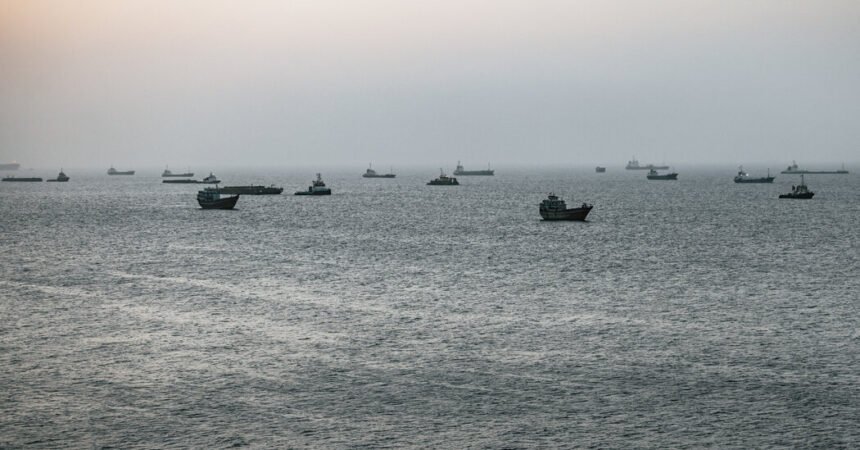
From Saturday through Monday, 109 vessels passed through the strait, the largest three-day number since the war started in late February, according to Kpler, a global maritime data firm. Traffic is a fraction of the more than 130 vessels that transited the strait every day before the start of the war. A backlog of 500 to 600 ships remained, according to the International Maritime Organization.
The overall picture of shipping conditions in the region’s waters is incomplete. Ships have transited the strait with their transponders off, making them difficult to track. This account of the current situation in the Persian Gulf is based on interviews with industry executives and analysts and an examination of ship tracking data.
Iran is “well and truly back in business.”
A major source of increased traffic came from Iran-linked ships carrying crude oil to Asia via the strait’s northern route, near Larak Island. At least 12 tankers with Iranian crude are moving toward Asia, according to an analysis by S&P Global’s Commodities at Sea, which provides data on trade flows.
“They are well and truly back in business,” Michelle Wiese Bockmann, a maritime intelligence analyst specializing in sanctioned oil flows at Windward, a maritime data company, said of Iran. Aside from Iranian vessels, ships owned by companies based in China, Pakistan and India were also observed taking the northern route, she said.
That flow of oil, and the money Iran earns from it, is likely to pick up after the Trump administration said Monday that it had temporarily lifted oil sanctions on Iran. For years, Iran has been forced to sell at a discount.
A two-track path through the strait is emerging.
It is difficult to parse the exact number of ships using the northern and southern routes. One container ship that transited on Saturday using the southern route was the MSC Qingdao, which kept its location tracker on, according to Windward, a maritime data company.
Transit along the southern route, overseen by the U.S. Navy, appears to be picking up. “U.S. forces remain present and vigilant to support freedom of navigation,” Capt. Tim Hawkins, a spokesman for the U.S. Central Command, Monday.
And crude is getting out, helping push down global prices. The volume of oil estimated to be held in the Persian Gulf has fallen to 103 million barrels, from more than 150 million barrels a week ago, according to S&P Global.
By using the southern route, operators were defying an Iranian directive issued late last week that traffic must go through its waters.
“A lot of the operators are not caring about what Iran says about how they have to transit the strait,” said Dimitris Ampatzidis, a risk manager at Kpler.
Still, recovery is fragile and will hold only as long as Iran does not attack any ships. “If we have the Iranian regime going after some vessels, instantly we can see the traffic will collapse again,” he said.
Traffic is far below prewar levels and danger persists.
The Joint Maritime Information Center, which monitors threat assessments on high-risk shipping routes, said on Sunday that the risk of sending ships through the strait was “moderate,” a level that had been lowered after the agreement between the United States and Iran to stop fighting and begin 60 day of talks.
“Ships should consider resuming normal navigational profiles and maintain prudent situational awareness during transit,” the center advised. But it added that continued interference with GPS signals and “wider regional military activity” warranted caution.
Some major companies remained cautious because of the murkiness over what routes to take and the process by which they should exit.
Harry Vafias, the chief executive of Stealth Gas, said his three vessels, stuck in the Persian Gulf for more than three months, were at a standstill. Too much was uncertain, he said, citing the risk of mines and conflicting messages about the status of the strait. “U.S.A. says it’s open while Iran says it’s closed,” he said.
The German shipping company Hapag-Lloyd, which had four vessels and about 90 seafarers stranded in the Persian Gulf as of Friday, will send its ships through when its security team deems the situation safe, Tim Seifert, a company spokesman, said Monday.
What happens after the two-month negotiating window ends is also unclear.
In a joint statement on Tuesday, Iran and Oman appeared to confirm that they were discussing imposing transit fees, emphasizing their “sovereign rights over their territorial waters in the Strait of Hormuz.”
Lisa Friedman contributed reporting from London, and Vivian Nereim contributed reporting from Riyadh.