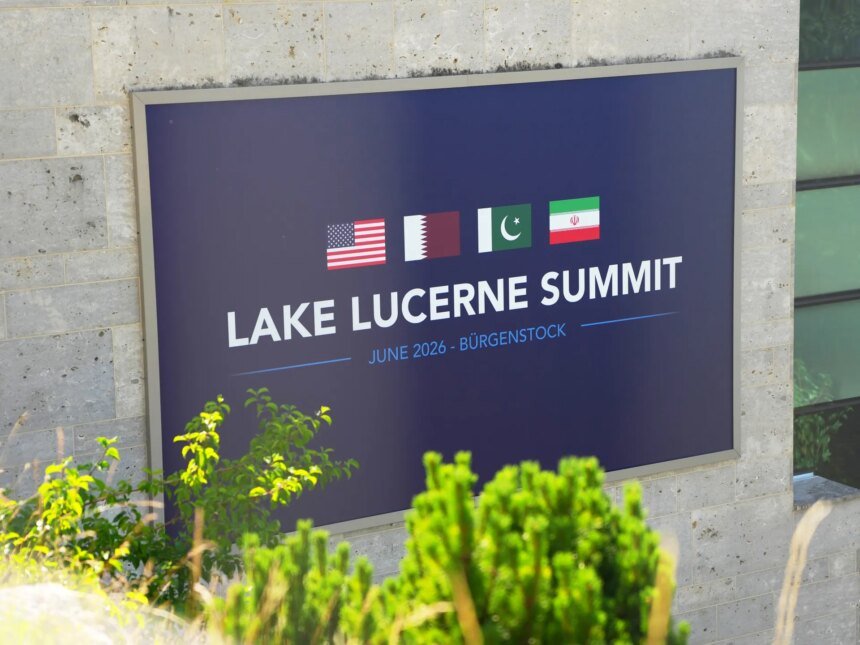
Negotiations between the United States and Iran are heading to a new technical phase in Switzerland, following the conclusion of the first round of political talks held with Qatari and Pakistani mediation, which witnessed a diplomatic push punctuated by sharp tensions against the backdrop of statements by US President Donald Trump.
CNN quoted a well-informed diplomat as saying that technical teams are currently leading the negotiations with the aim of reaching a final agreement, with the progress of implementation of the memorandum of understanding between Tehran and Washington.
The Iranian Students News Agency reported that technical talks will begin today, Monday, to discuss mechanisms for implementing the memorandum of understanding concluded between the two sides, and to form specialized working groups to follow up on the issues at hand.
The Iranian delegation to the technical talks is headed by Deputy Foreign Minister Kazem Gharibabadi, with the participation of experts in political, economic and legal affairs, and representatives of Qatar and Pakistan are attending in their capacity as mediating countries.
The Iranian Ministry of Foreign Affairs confirmed that the next stage will witness the establishment of technical committees and a supervisory committee to follow up on the implementation of the terms of the memorandum of understanding.
The Iranian Foreign Ministry indicated that the discussions addressed the issues of oil exports and related exemptions, and the release of Iranian financial assets, while taking practical measures to begin implementing some understandings.

Commitment versus commitment
Tehran stressed that the principle of “commitment in exchange for commitment” constitutes the basis for verifying the implementation of mutual pledges, stressing that forming working teams and engaging in broader negotiations remains dependent on the implementation of a number of basic provisions contained in the memorandum.
The move to the technical track came after a day of intense discussions in Switzerland, where the Qatari and Pakistani mediators announced that “encouraging progress” had been made in a number of files, including the establishment of a disengagement mechanism in Lebanon, and the establishment of arrangements aimed at ensuring the security of navigation and the continuation of transit traffic in the Strait of Hormuz.
Despite the positive atmosphere that prevailed in some parts of the talks, the negotiations suffered a temporary setback following sharp statements made by Trump against Iran, which prompted the Iranian delegation to express its protest and raise the issue during the meetings, as it conflicts with the principles organizing the negotiations, before contacts were resumed through direct mediation from Doha and Islamabad.
The American delegation included Vice President J.D. Vance, Special Envoy Steve Witkoff, and Jared Kushner, and the Iranian side was represented by Parliament Speaker Mohammad Bagher Qalibaf and Foreign Minister Abbas Araqchi.
roadmap
The two parties agreed, according to the mediators’ statement, to establish a high-level political committee and working groups specialized in the nuclear file, sanctions, and dispute settlement mechanisms.
The two sides also reached a 60-day road map with the aim of negotiating a final agreement, in addition to establishing a permanent line of communication regarding the Strait of Hormuz to avoid any accidents or miscalculation that may affect international shipping traffic.
In the Lebanese file, it was announced that a joint cell would be formed to disengage and follow up on establishing the ceasefire, in a move that Tehran and Washington see as a preliminary test of the extent to which the new understandings can achieve tangible results on the ground.
The technical teams are scheduled to continue their work in Switzerland throughout this week, where they will focus on discussing the executive details of the political, economic and security files, as part of an effort to transform the initial understandings into practical commitments that pave the way for a broader negotiating round during the next stage.

Negotiations with the region
In this context, the Qatari Prime Minister and Foreign Minister Sheikh Mohammed bin Abdul Rahman Al Thani confirmed that the memorandum of understanding concluded between the United States and Iran constituted a turning point that contributed to stopping the war, and paved the way for launching an organized negotiating path between the two sides.
The Qatari Prime Minister said, in an interview with Al Jazeera, that the discussions between Washington and Tehran include a number of bilateral files, most notably the Iranian nuclear program, in addition to discussions with countries in the region related to security, stability, and freedom of navigation in the Strait of Hormuz.
He pointed out that the memorandum of understanding established an institutional framework that regulates the negotiating process between the two parties, indicating that it is not limited to political aspects only, but also includes technical elements and executive mechanisms aimed at addressing the issues raised in a systematic manner.

“We focus on celebrating progress.”
In this context, J.D. Vance, US Vice President, confirmed that the technical talks between the United States and Iran will continue throughout this week, noting that the latest round of negotiations laid what he described as good foundations for reaching a final agreement between the two sides.
Vance said that the participating parties succeeded in achieving tangible progress on a number of key files.
He added that Washington hopes to reach a permanent settlement and a final agreement, stressing that the focus at the current stage is on building on the progress achieved, while acknowledging that the road still requires more work.
The US Vice President explained that the negotiators reached mechanisms aimed at preventing military escalation and containing any potential confrontations, in addition to making arrangements to ensure that the Strait of Hormuz remains open to international shipping traffic.
Vance denied the validity of what he described as “false reports” related to Iranian assets, without providing additional details.
Progress on pending files
Regarding the nuclear file, Vance said that the discussions had made important progress, revealing that Iran had agreed to invite international inspectors to its territory, considering this step a very important development in the course of the negotiations.
He added that the two sides also reached a mechanism to remove mines from the Strait of Hormuz, announcing that talks with International Atomic Energy Agency inspectors will begin in Bürgenstock starting today.
Regarding the Lebanese file, Vance confirmed that the discussions had achieved progress compared to what the situation was 24 hours ago, pointing to the agreement to establish a mechanism to prevent clashes and contain tensions with the aim of stopping the escalation.
He said that the United States supports Israel’s right to defend itself, but believes that this must be done within mechanisms that prevent the situation from getting out of control, stressing at the same time the importance of protecting Israel’s security and preserving Lebanon’s sovereignty.
Vance also called on Iran to exercise its influence to “restrain Hezbollah,” noting that developments in Lebanon will remain a major focus of ongoing discussions between the parties concerned during the next phase.
Sources familiar with the course of the negotiations reported that the United States and Iran, through mediation led by Pakistan and Qatar, reached an agreement on a mechanism aimed at containing the fighting between Israel and Hezbollah, following the escalation of tensions between the two negotiating delegations on Sunday, according to what was reported by the Wall Street Journal.
According to developments related to the ongoing talks in the Swiss resort of Bürgenstock, the two parties agreed to continue intensive technical talks throughout the remainder of the week, with the aim of addressing the outstanding issues and formulating a comprehensive executive framework for the initial understandings, including mechanisms for reducing the escalation in Lebanon.
For his part, Axios quoted a well-informed American diplomat as saying that the negotiation rounds continued almost continuously throughout the night, even after Iran announced the closure of the Strait of Hormuz, indicating that Representatives of the United States and Iran, along with Pakistan and Qatar, expressed a level of cautious optimism regarding the progress achieved in recent hours.

Constructive commitment
For his part, the Pakistani Prime Minister announced the successful conclusion of the first meeting of the high-level committee emanating from the memorandum of understanding between the United States and Iran, stressing that the discussions had achieved tangible progress on a number of key files.
He explained that the discussions resulted in agreement on a road map that would lead to a final agreement within 60 days, in a step he described as establishing a new phase in the negotiating path between Washington and Tehran.
The Pakistani Prime Minister praised what he considered a constructive commitment from the American and Iranian sides during the talks, expressing his appreciation to the friendly countries that supported the diplomatic efforts and contributed to the success of this process.
He also singled out the State of Qatar for special praise, stressing that its pivotal support and diplomatic efforts were decisive factors in creating the atmosphere and launching negotiations between the two parties.
He pointed out that the meetings ended with an agreement to form a high-level committee to politically supervise the negotiation process, in addition to launching specialized technical talks to follow up on the executive files and put the agreed-upon understandings into practice.