
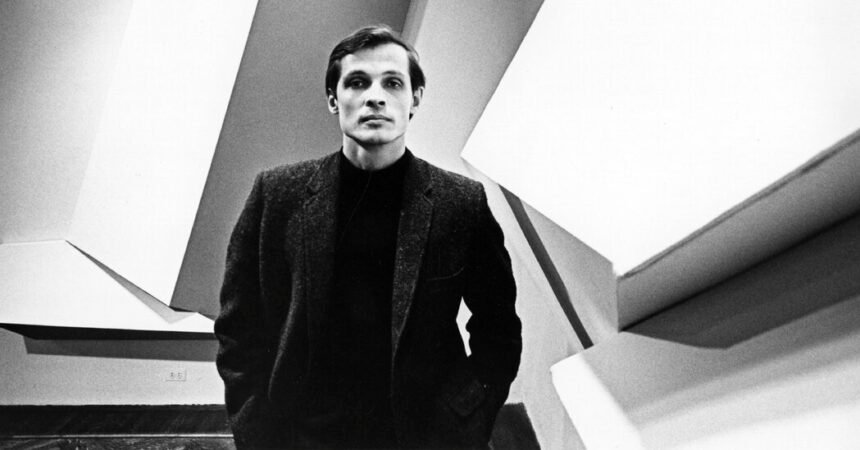
Charles Hinman, an artist who blurred the line between painting and sculpture with dramatic three-dimensional shaped canvases that were at once Minimalist and lyrical, featuring undulating curves and contours like cut gems, died on May 29 in Raleigh, N.C. He was 93.
His death, in a long-term care facility, was from complications of a fall, his daughter Delphine Hinman Zohn said.
Starting in the early 1960s, Mr. Hinman established himself as the “grand master of the shaped canvas,” as the critic John Canaday described him in The New York Times. In this, he was part of an artistic current that also included artists like Frank Stella, Leon Polk Smith and Ellsworth Kelly.
Working out of a fifth-floor studio on the Bowery that he occupied for half a century, Mr. Hinman employed his considerable carpentry skills to build armatures, or wooden skeletons, in three-dimensional, curvilinear shapes, covered in brightly colored canvas — a “skin over bones” approach, as he called it.
The resulting work was “dynamically baroque in feeling,” the Times art critic David L. Shirey wrote in 1972, “looking more like three-dimensional painted sculpture than the orthodox flat shaped canvas.” Emerging during the peak of Pop Art, Mr. Hinman was sometimes credited with creating Top — as in topographical — Art.
His 1964 work “View Down, Across to the Left and Right,” for example, measured 8 feet by 7 feet and consisted of three interconnected, brightly hued boxlike shapes, suggesting an abstracted flower. “Cascade,” from 1965, abandoned any geometric sensibility for what looked like free-flowing, bulbous drips of yellow, red, white and blue.
The goal, Mr. Hinman said, was to explore the “real space” of sculpture with the “illusory space” of painting. As he put it, “I think of my paintings as occupying a six-dimensional space: the three dimensions of space, one each of time, light and color.”
Mr. Hinman had a breakthrough in 1964 with a solo exhibition at the Richard Feigen Gallery in New York, where he displayed what became perhaps his most famous work, “Poltergeist.”
A “constructed painting resembling a large, somewhat threatening hairpin,” as the artist and critic Robert C. Morgan wrote in a 2012 essay on Mr. Hinman in The Brooklyn Rail, the piece was featured in The Times when the Museum of Modern Art acquired it in 1965. With its vivid pink and red elements, Mr. Hinman later said that he was using color as if he were “painting a hot rod.”
While often associated with the Minimalists, who were ascendant during that period, Mr. Hinman’s work also had elements of whimsy, even exuberance.
“He tightly stretches canvas across complex, meticulously crafted frames,” the critic Robert Pincus-Witten wrote in Artforum in 1966, “which results in eccentric and tight drums. These relief membranes have something of the buoyancy and snap of a balloon or tent, the elegance of a sand dune and the sweetness of a mound of whipped cream.”
Charles Baldwin Hinman was born on Dec. 29, 1932, in Syracuse, N.Y., the younger of two sons of Donald Hinman, a hotel bookkeeper, and Grace (Baldwin) Hinman.
He showed early talent at painting and baseball, earning multiple art awards while a student at Syracuse Central High School, and also excelling as a left-handed pitcher. He eventually made a handful of appearances in the Milwaukee Braves’ farm system.
After graduating from high school in 1951, he enrolled at Syracuse University, where he received a Bachelor of Fine Arts in 1955, before moving to New York City to study at the Art Students League.
He served two years in the Army, returned to the city and settled in Coenties Slip, a one-time maritime hub in Lower Manhattan that had evolved into a flourishing colony for groundbreaking artists like Agnes Martin, James Rosenquist, Lenore Tawney and Robert Indiana.
Like the Minimalists, Mr. Hinman eschewed the psychological and emotional layers of, for example, Jackson Pollock’s action painting. He favored clean lines and a tightly controlled color palette to create works that reflected Mr. Stella’s Minimalist mantra: “What you see is what you see.”
In 1959, Mr. Hinman married Christy Park, a photographer; they divorced in 1973. In 1978, he married Janice Bireline, a physicist, who died in 2024.
In addition to his daughter Delphine, Mr. Hinman is survived by a son from his first marriage, Ted; two stepdaughters, Alexandria and Lise Bireline; a stepson, Marek Bireline; and two grandchildren.
Mr. Hinman’s work continued to evolve over the years. In 1975, he exhibited an all-white series, intended to emphasize the size and shadows of the pieces. In the early 2010s, he scored a late-career triumph with his “Gems” series, which suggested the intricate angles of cut diamonds.
“Inspiration is a lightning bolt that comes down from the clouds,” he said in 2014 video interview. “You embark on a path and you think, ‘I’m going to the conclusion,’ but partway there, a surprise comes. That’s part of the quest, to offer something that is new for me to do and for them to see.”