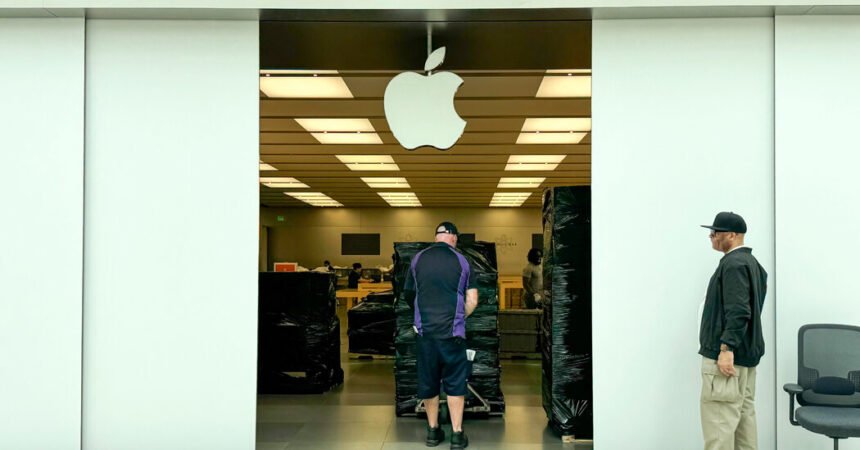
Four years ago, Apple employees in Towson, Md., voted to become the first unionized Apple Store in the United States. On Saturday, the company closed the location, citing “declining conditions” at the mall that houses it.
The union representing the workers accuses Apple of retaliating against the Towson employees because they unionized.
The closure was announced in April, and Apple also shuttered two nonunionized stores on Saturday. The union, the International Association of Machinists and Aerospace Workers, noted in filings to the National Labor Relations Board that employees in the nonunion stores had been given the option to take similar positions at nearby stores. But Apple required the Towson workers to apply for jobs the way typical applicants would, without an easy transfer to another location.
Partly because of this, more than half of the Towson store’s roughly 70 unionized employees will be terminated on Wednesday. “I’m really sad,” said Billy Jarboe, an operations lead at the store who also served as its chief union steward. “I’m in the grieving and mourning phase now.”
Apple said in a statement that it was following the collective bargaining agreement it had reached with the union in 2024, which doesn’t automatically entitle workers to a similar position at a nearby store under such circumstances, but does grant workers up to 12 weeks of severance pay. The company acknowledged that workers at the two other closed locations had been offered transfers.
The company strongly denied the union’s claims of retaliation and said it would “continue to abide by the agreement that was negotiated and agreed with the union.” In recent years, other prominent retailers have also closed locations at the mall, known as Towson Town Center.
Workers at the Towson store voted to unionize in June 2022, frustrated over safety concerns related to the Covid-19 pandemic. Many also complained about a longer-term decline in the quality of their jobs as the company took steps to generate more revenue through its retail locations. Some employees who had not been directly involved in sales said that they had been increasingly drawn into sales work.
When the two sides agreed on a labor contract in the summer of 2024, many of the most concrete gains appeared modest at best: Towson employees largely received the same benefits as those in nonunion stores, along with raises of roughly 10 percent over three years for the typical worker. Apple appeared to match or exceed the union wage increase at nonunion locations last year.
But the contract also brought certain protections that had not been available in nonunion stores — like a cap on the number of temporary workers — and, perhaps more important, appeared to demonstrate that employees could unionize without risking their livelihoods. Some employees and union officials expressed confidence that the contract could prompt other stores to follow suit.
But labor experts say the closure of a unionized store and the termination of its employees typically have the opposite effect. “How could they not have a chilling effect?” said Wilma Liebman, a chair of the National Labor Relations Board under President Barack Obama. “It’s an awful lot of work to get a union, and then this happens.”
Ms. Liebman said that while it was legal for employers to shut down unionized locations for economic reasons, it was illegal if the purpose was to discourage unionization at other locations. She said that such a motivation could be difficult to prove, but that allowing nonunion employees to transfer while denying that right to union employees could help the union prove its case.
There are nearly 300 Apple Stores in the United States, and workers at several other locations have explored unionizing over the past few years. One other store, in Oklahoma City, has also unionized.
Eric Brown, a sales lead at the Towson store who was also a union steward there, said many employees from the store had applied for jobs at other Apple locations but had not been hired.
Mr. Brown, who has not yet landed another job, added that this was occurring even as nearby Apple locations continued to make outside hires. (Apple Stores generally start hiring new batches of workers in late spring.)
“They’re not transferring us, but they’re still hiring seasonal people,” he said. “They clearly need help.”