
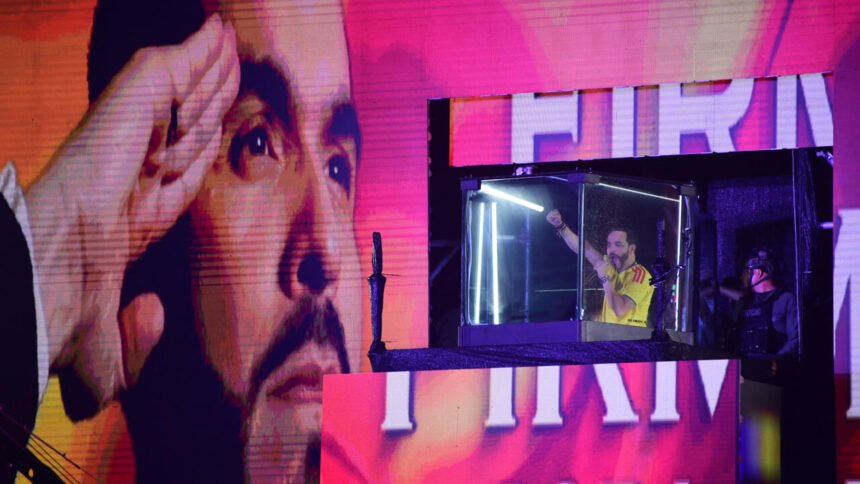
Right-wing hardliner Abelardo de la Espriella, or “El Tigre” (The Tiger) as he calls himself, won a majority vote on Sunday to become Colombia’s next president at the age of 47. De la Espriella celebrated his victory the same way he ran the bulk of his campaign: waving to his supporters from behind thick bulletproof glass in the bright yellow national football jersey of Colombia (even after a judge ordered him to stop).
With a neatly groomed beard and slicked back hair, the millionaire lawyer managed to win 49.7 percent of the votes to defeat leftist rival Ivan Cepeda by a razor-thin margin despite having no prior political experience.
De la Espriella’s win is the latest in a wave of right-wing leadership across Latin America, from El Salvador’s Nayib Bukele to Chile’s José Antonio Kast and Argentina’s Javier Milei. Even Peru seems to be following suit, with Keiko Fujimori on Monday leading that country’s presidential leadership contest.
One of your browser extensions seems to be blocking the video player from loading. To watch this content, you may need to disable it on this site.

Abelardo de la Espriella is expected to overturn several policies launched by outgoing President Gustavo Petro – and the promise of that change was one of the primary reasons he won. Mathilde Allain, a lecturer and researcher at the Institut des Hautes Etudes de l’Amérique Latine at France’s Sorbonne Nouvelle university, says that, “beyond a vote of support for Abelardo de la Espriella, there is a sanction vote against Gustavo Petro, but the phenomenon is deeper: it is a rejection of the left in general.”
The president-elect’s policies are undeniably far right. He plans to end Colombia’s decades-long armed civil conflict with a military offensive in just 90 days by returning to full-scale military confrontation with armed groups. He has also promised to build ten “mega prisons” and pledged to permit fracking.
However, de la Espriella’s victory isn’t just a signal of Colombians’ distrust in their political left. “We are witnessing the collapse of the traditional Colombian right, which has been unable to impose a candidate,” Allain says. “The vote for Abelardo de la Espriella is also a vote against the political parties, against the elites and against the ‘established establishment’, as we have seen elsewhere on the continent.”
Read moreHow armed groups in Colombia are using TikTok to recruit young people
De la Espriella does not fit in the frameworks of either Colombia’s traditional right or left wings; his votes come from those wanting change and from skeptics on either side. Despite his win and an endorsement from US President Donald Trump, Abelardo de la Espriella’s will have to overcome his position as an outsider with only a small political presence in his home country.
‘Almost no presence in Colombia’
Tom Long, a professor with the Department of Politics and International Studies at the University of Warwick, says de la Espriella’s political base – or lack thereof – is going to be a significant impediment to him once he is in office. “He’s going to have to expand very quickly. The main question is whether he can mobilise his supporters online and outside the country – and frankly, I’m sceptical about whether he’s able to move more local provinces and municipalities, because it’s difficult to build something if you lack the grassroots.”
“His party has 0 out of 32 governors and 4 out of 1000 mayors. This is a party that has almost no presence in Colombia.”
Allain echoes the sentiment. “Abelardo de la Espriella is described as an anti-system outsider, but it should not be forgotten that he has neither a political party nor a majority in Congress. To govern, he will have to rely on the traditional Colombian elite and the political parties of former president Alvaro Uribe, who immediately rallied to him.”
This, however, doesn’t mean that de la Espriella will necessarily lack power – “the worry is that he’ll govern more autocratically”, Long says.
Divided loyalty
De la Espriella styled himself as a “defender of the homeland” during his campaign, often posing in front of the red, yellow and blue colours of the Colombian national flag with an sharp military salute. He is, however, also a naturalised US citizen (meaning he has pledged allegiance to the United States) and a registered Republican who previously lived in Miami.

“He’s well networked within the transnational far right,” says Long. “This is important for the US: Colombia has for a century been crucial to the position of the US in Latin America.”
“De la Espriella will support the White House’s domestic priorities – its position on drugs, immigration and more. Petro was the loudest voice in criticising Trump’s strikes on small ships supposedly carrying drugs. De la Espriella will support that.”
“US security strategy is to enlist and expand by building a coalition of politically aligned leaders across Latin America who are deferential towards the US – and specifically Trump. Whether they behave like the puppets of his administration is yet to be seen.”