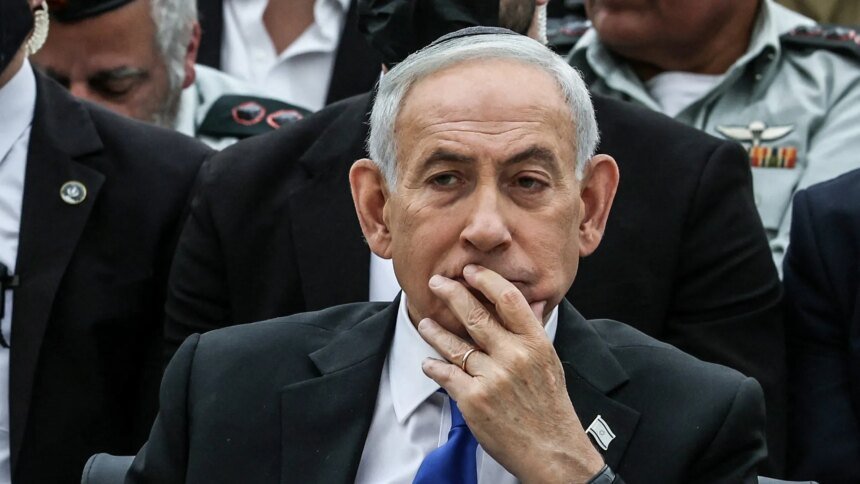
Israeli Prime Minister Benjamin Netanyahu is facing the most complex and complex crises. The Haredi recruitment crisis, the negotiations to dissolve the Knesset, and the attempt to control the Likud list intersect with a constitutional crisis over the appointment of lawyer Michael Rabelo as state comptroller.
The crisis does not stop at home, but coincides with American hints from Donald Trump that his support for Netanyahu is no longer guaranteed, and that he is considering alternative names such as Naftali Bennett and Gadi Eisenkot. As for the state comptroller file, the crisis is no longer a procedural dispute over a secret vote, but rather has become a test of the relationship between the Knesset and the Supreme Court.
Read also
list of 2 itemsend of list
Amit Segal, a political commentator on Channel 12, revealed that Knesset Speaker Amir Ohana rejected the Supreme Court’s proposal to re-vote, and wrote on the X platform, “The Knesset has said its word,” declaring that a new vote would not be held.
A report by Anna Barsky and Gilad Morag in Maariv explained that the Supreme Court issued a conditional order requiring the Knesset to provide legal reasons justifying not canceling Rabelo’s election, and set a session for June 28.
Haredi trap
But the Rabelo crisis did not remain confined to the court; The possibility of a re-vote put Netanyahu in a direct coalition dilemma with the Haredim, and in a Yedioth Ahronoth report by Moran Azoulay, the newspaper quoted those close to Netanyahu as their estimates that the Haredim “will not support him for free,” but rather will demand political compensation in exchange for voting with the coalition.
This meaning goes deeper in another Yedioth Ahronoth report written by Amir Ettinger about the coalition leaders meeting on June 23 to discuss the demands of the Haredim.

Ettinger explains that Likud and Religious Zionism are reluctant to pass the laws demanded by the Haredim before the elections, especially the nursery law and the “Basic Law: Torah Study,” for fear of the public’s reaction, while Netanyahu is trying to “preserve the bloc at all costs” until the coalition parties enter the election campaign unified.
The report reveals that the Knesset dissolution law passed preliminary reading on May 20, then the first reading on June 2, and that expectations are that the second and third readings will be completed before the end of the Knesset’s summer session on July 17.
The Yedioth Ahronoth report indicates that the nursery law has turned into an electoral blackmail card. Moshe Gafni, head of Degel HaTorah, insists on its passage, while Cabinet Secretary Yossi Fuchs is discussing a temporary alternative that includes freezing the arrests of yeshiva students for those proven to be studying the Torah.
According to Ettinger, the dispute does not revolve around a single law, but rather around a Haredi attempt to replace the failure of the military exemption law with a basket of sectarian achievements before the elections. Therefore, some Likud representatives and religious Zionists believe, according to Yedioth, that a Knesset solution is better than paying a high popular price for legislation granting the Haredim new privileges at the height of the war and the crisis of the shortage of soldiers.
Likud rebellion
Within Likud, a parallel crisis erupted over the primary elections. In a report published by Channel 12 on June 21, Amit Segal wrote that David Bitan, acting head of the Likud Secretariat, submitted an urgent petition to the party court to prevent the cancellation of the primary elections and replace them with an “organizational committee.”
Bitan described the move as a “constitutional hijack” aimed at changing the rules of the game one month before the primary elections, warning: “The rules of the game cannot be changed while it is underway. I believe in Likud members and their right to make decisions, not in a specific committee.”

In an interview with Radio 103FM, published by Maariv, Bitan warned that canceling the primaries would lead to the end of the party’s “vitality” after the general elections, and that parties based on a non-democratic structure have disappeared over the years. When asked if Likud might disappear without the system of primaries, he replied: “Within 8 years, I think yes.”
Season of discord
The crisis expands further when it moves from organizational rebellion to political dissent. The Yedioth Ahronoth report indicated that representatives Dan Illouz of Likud and Moshe Solomon of Religious Zionism had communicated with the “Reserves” party led by Yoaz Hendel, and revealed that Bezalel Smotrich’s decision to dismiss Solomon from the Knesset committees was ostensibly due to his vote against the “Basic Law: Study of the Torah,” but it was also linked to information about his contacts with the Reserves Party.
Hendel told his party activists that he seeks to include Solomon and Eloz, because they “do not accept that a right-wing alliance means supporting draft evasion,” and he went further when he said that “the current coalition has sold its conscience to the devil by allying itself with Haredi parties that encourage mass evasion during the war.”
Externally, the heaviest blow came from Trump. On June 20, 2026, Maariv published a translated report from news agencies about Trump re-sharing an article saying that he was “holding the cards” in Netanyahu’s faltering re-election chances. The report indicates that Trump’s support has become conditional on the extent of Israel’s commitment to the US-Iranian agreement.

The danger of the statement lies in the fact that it strips Netanyahu of his monopoly on the personal relationship with Trump, and turns American support from a guaranteed asset into a conditional card.
Channel 12 confirms the same meaning in a report published on June 20, pointing out that the article shared by Trump spoke explicitly about alternative candidates such as Bennett and Eisenkot, and that any Israeli steps that hinder regional stability may prompt him to withdraw his support for Netanyahu.
Bitan, from within Likud, gave this angle a direct partisan resonance, as he said in an interview with 103 FM, “Trump is harming Likud, and this is quite clear from his actions,” adding: “It is harm, and we have no help in it, first to the State of Israel, then to the Likud Party.” Thus, Trump is no longer a net electoral asset for Netanyahu, but rather a factor of confusion recognized by leaders in the party.
The rise of Eisenkot
Internally, Trump’s insinuations coincided with the sudden rise of Gadi Eisenkot. In an opinion article published by Maariv on June 20, lawyer Sophie Ron Moriah wrote that the Kan 11 poll caused a “political earthquake,” after raising Eisenkot’s non-existent party to 21 seats, while the Bennett-Lapid list declined to 17 seats.
The writer highlights that the Yashar Party in its current form includes only Eizenkot, Matan Kahane and Yoram Cohen, yet it exceeds a list that includes former prime ministers and ministers.
The bottom line is that Netanyahu is no longer managing a single crisis, but rather a network of simultaneous crises: a state comptroller threatening to open a constitutional confrontation, the Haredim blackmailing the coalition at a sensitive electoral moment, Likud rebelling against the engineering of lists, a reserve right searching for a moral and political alternative, and Trump hinting that Netanyahu’s survival is no longer an absolute American interest.
Therefore, the date of October 20 does not seem to be just a potential electoral date, but rather a moment to test whether Israel will truly enter the “post-magic” phase, or whether Netanyahu will succeed once again in turning all his crises into electoral campaign material. However, the difference this time is that some warnings do not come from the court, the opposition, or Washington, but from within the Likud House itself.