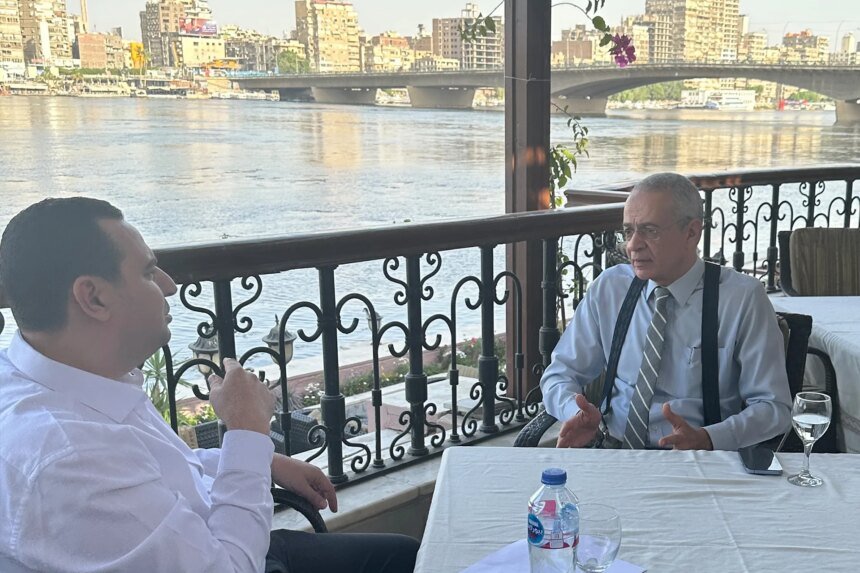
Cairo- Ambassador Moataz Ahmadin Khalil, Egypt’s former representative to the United Nations and the Security Council, presented a vision that addresses the most dangerous issues at hand, from the premise that overthrowing the Iranian regime is still an existing goal agreed upon between the West and the United States, through the influence of the pressure cards that Tehran possesses that amount to the effect of nuclear bombs, all the way to the indications of the American crowds that suggest that resuming the war may be a matter of time.
In an interview with Al Jazeera Net, the Egyptian diplomat discussed the roles of regional and international parties, including the Gulf states, which he said may rearrange their priorities away from the traditional Arab role, in light of an international system that he sees as disintegrating due to the policies of US President Donald Trump.
Regarding Egypt’s role, he explained that it does not reject alliances, but deals with them from the perspective of interests, and linked the Arab League crisis to the absence of political will.
Below is the text of the dialogue:
-
How do you evaluate the stage that the American-Israeli war on Iran has reached in terms of the point of no agreement and no war? Do you think there will be a new round of war in the coming days?
It is very possible that we will be facing a new round, but not in the near future. What is meant by the immediate future is that this round will not take place after a week or two, because the United States was forced to stop the war because it had exhausted the precision munitions that were in the possession of the American army, and this is what forced it to stop it.
This was clear in the last week before the truce was reached, when Iran’s missiles were reaching deeper points inside Israel. Here it must be noted that the issue of the exhaustion of American missiles demonstrates the extent of firepower and criminality, to the point of depleting the ammunition stock of the most powerful army in the world in a period of only two or three weeks, which was evident in the demand of the US War Department for a huge additional budget.
advertisement
The continuing American build-up in the region also suggests that the resumption of the war is a matter of time. The situation now is: neither war nor peace, but some may try to move Trump towards a ground invasion, which is the step he may consider when the conditions are complete in terms of mobilizing the necessary forces and opening the necessary borders.
Here my attention is drawn and I am surprised by Trump’s insistence on contacting Pakistani Army Chief of Staff Asim Munir more than once. I do not understand or am convinced that the goal is to mediate a military man whose experience in negotiations may be limited, and what I think is that he may be preparing for some action.
-
You mean that America might push Pakistan to participate in military action against Iran?
Perhaps Trump dreams of this, or thinks that getting closer to the Pakistani army commander or maximizing his role may contribute to achieving this mission, and this does not necessarily mean that Islamabad agrees, accepts it, or participates. This action may not be actual military engagement, as much as, for example, opening the Pakistani border to troops or providing logistical support.

-
Is the goal of overthrowing the Iranian regime still valid for Washington and Israel?
The idea of regime change in Iran is still more valid, especially since it is an idea agreed upon by supporters and opponents of the war inside the United States and in the Western camp in Europe, because it now seems to them that Tehran can hurt them and use the Strait of Hormuz card. This point of view may also be held by some Gulf countries, as some reports said.
-
Will the coming period witness the formation of new axes and alliances, or will we see the revival of old alliances in a different form?
There were movements that preceded the current war with the aim of forming alliances in the region, and they were mainly carried out for interim goals for the countries of the region, and the Egyptian-Saudi-Turkish-Pakistani axis was in the face of the UAE’s audacity against Saudi Arabia in Yemen, its audacity against Saudi Arabia and Egypt in Somalia, and coordination with Israel regarding Somaliland. Therefore, it is possible for new alliances to occur or the alliances that were prior to the war to be strengthened, with the emphasis being that they are all temporary alliances that can change as interests change.
-
Is Egyptian foreign policy fundamentally not inclined to the idea of axes and alliances?
On the contrary, Egypt historically does not reject alliances. It only rejects international alliances that affect its interests, as we refused to enter into alliances with Western countries in the 1950s at the time of the Cold War. It does not reject the idea of alliances, but deals with it from the perspective of interests.
For example, the saying “the distance of the railway” that Egyptian President Abdel Fattah al-Sisi said in 2014 regarding Yemen was within the framework of an alliance, even if the distance that was fought in this path was not of the size and level of expectation and evaluation of some, but it was accomplished.
-
You clearly mean that Egypt applied the principle of “track distance” with the Yemeni crisis file?
Of course, there was intelligence cooperation, and Egypt also paid with naval vessels. It is true that no fighting took place, but there was logistical support.
advertisement
-
Did Egypt, on the other hand, apply common rail ties with the Gulf in the recent war in the face of Iranian targeting of Gulf lands?
Officially, Egypt says that it has not been asked to do so, but it is ready to provide everything the Gulf countries ask for. But my personal assessment is that the Gulf countries need experience different from Egypt’s experience in what they are exposed to, and the evidence for this is resorting to Ukraine, given that it has long and proven experience in resisting Russian projectiles, drones, and missiles in practice.
This issue does not apply to Egypt. The fact that she has confirmed more than once that she is ready to provide what is asked of her does not negate the fact that she has already provided or will provide in the future.
The Gulf states also have the United States, which of course has much greater military capabilities than Egypt. The question here must be: Do the Gulf states really need Egypt, or are what is being presented merely justifications in order to feed the Gulf public opinion that is wary of the Egyptian public opinion that is sympathetic to Iran, by accusing Cairo of something that is not in it, that it did not provide support to the Gulf?
-
If Egypt has provided support to the Gulf, or confirmed its full readiness to provide whatever support is requested, in your estimation, what is the real reason behind the attack by some Gulf social media activists?
There are several reasons; The first is that some Gulf states believe that other countries should adopt the same positions as them and follow their example and follow them, and therefore they do not even accept Egypt’s demand to stop the war, and they want Cairo’s position to be only to condemn Tehran and not to demand that the war be stopped.
The other reason is the widespread sympathy on the part of Egyptian influencers towards Iran.
-
Who initiated the recent war on Iran, and who was the decision maker?
The war was based on Netanyahu’s push and decision, through which he moved the United States in a way that made Trump believe that he was the one making the decision, but in the end the interest was shared, because overthrowing the regime in Iran is a shared interest for the entire Western community.
The fact that Netanyahu comes out in a press conference to say that he is following in the steps of the American President and walking behind him is known in politics to confirm the opposite. Trump believes that he is the one who made the decision, but Netanyahu is the one who is moving him, perhaps by providing inaccurate information, and informing him that he has a historic mission that no one has been able to accomplish before, which is to overthrow the Iranian regime, a goal that has existed since the emergence of the Islamic Revolution.
With Tehran’s steadfastness and use of the economic nuclear bomb represented by the Strait of Hormuz, and the presence of the other nuclear bomb in the drawer, which is the Bab al-Mandab Strait, it makes overthrowing the Iranian regime a permanent and ongoing goal.
-
When will mediations bear fruit and contribute to ending the war?
In my opinion, mediation and stopping the war will not succeed unless countries like Russia and China enter, who can put pressure on the United States and deter it if necessary, because in the end, Pakistan is moving into Washington’s orbit. Therefore, the current mediation roles are more about calling on Iran to exercise restraint than influencing the behavior of the United States, including Egyptian or Turkish mediation. Tehran must try to effectively include Beijing and Moscow in the mediation.
-
Do you think that if the situation in front of Washington becomes more complicated, we might witness the use of tactical nuclear weapons?
It is completely unlikely, because the United States and Israel do not need nuclear weapons to strike Iran in light of the high-quality weapons and ammunition they possess, especially since nuclear weapons are a weapon of deterrence and not for use, regardless of what happened in Hiroshima and Nagasaki in the past, because the use at that time may have come as a matter of experimentation to prove that this is a real weapon and not an imaginary one.
In my opinion, with almost certainty, if Trump decides to use nuclear weapons, the US military will not respond to him.
advertisement
-
Does Arab diplomacy have tools that enable it to influence the course of the conflict, or do Arabs only stand in the position of observers?
Arab diplomacy is not out of the picture; Egypt is present in the mediation, and there are extensive and intense Egyptian contacts. Cairo previously succeeded in mediating between the International Atomic Energy Agency and Iran, an agreement that was thwarted by the European powers after the re-imposition of sanctions on Tehran. There are also communications to the Sultanate of Oman and Saudi Arabia.
But at the level of the Arab League, the most it can reach is to condemn Iran and target the Gulf states, and it cannot go beyond this role.
-
Does the role of the university that you referred to come about because of the absence of political will of its members, or because it lacks mechanisms and tools that allow it to play an effective role in crises?
The mechanisms exist, whether in the League’s charter or its institutional structure. The matter is not a defect in its structure and mechanisms, but it is centered in the absence of the political will of the member states, which limits their ability to make a decision and implement it. This is the main problem, because international organizations are the sum of the wills of their members, and if they do not dare to make a decision, the organization is not to blame in this case.
-
Is it possible to see a structural change in the Arab League within the repercussions and effects of the war?
No, because a number of Gulf countries at the present moment say that the university is not necessary, and therefore an important part of its members who bear the bulk of its budget do not want it to play any role. Even the Gulf Cooperation Council itself faces obstacles as a result of the division between its two main states.
-
Do you mean that after the war there may be further marginalization of the Arab League?
This is the declared intention of some Gulf countries through their senior officials.
-
There is widespread post-war debate regarding the role of US bases in the region. Do you think the war would be the reason for ending its existence?
American bases serve common interests, including those of the United States, but they participate in protecting the Gulf states. It is true that it attracted an Iranian reaction, and I think that there is a kind of exaggeration in saying that these bases do not protect the Gulf states, and that the Gulf states are the ones that protect the bases, because in essence those bases were there, perhaps because of the historical enmity between Tehran and these countries.
-
You were Egypt’s representative to the United Nations and the Security Council. Do you think that the institutions of the international system, led by the United Nations and the Security Council, have lost their usefulness, and that we are in need of a new international order?
The international system as we know it disintegrated as a result of the policies of the American administration. From the beginning, Trump believes that this regime is profiting from the United States and working at its expense and not for its benefit, and the opposite is true. In his second term, he came to take revenge on the international system. Before the war on Iran, the kidnapping of Venezuelan President Nicolas Maduro from his bedroom and his trial in another country, all of this undermined the international order. The international system in its current and accepted form has ended.