Published on 6/22/2026
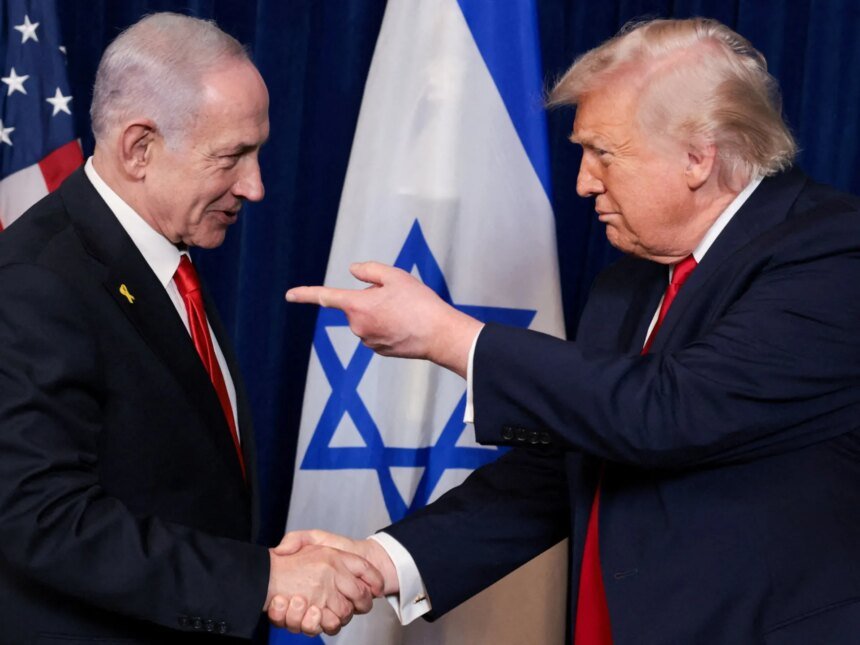
The British newspapers The Guardian and The Independent believe that the agreement recently concluded by America with Iran revealed a strategic shift that may redraw the relationship between Washington and Tel Aviv, and put Israeli Prime Minister Benjamin Netanyahu facing the most dangerous political crisis of his career.
In an article in The Guardian, foreign affairs commentator Simon Teasdale considered that Netanyahu is the “biggest loser” from the agreement, and that its repercussions may not be limited to ending his political future, but may herald the end of an entire phase of unconditional American support for Israel.
Read also
list of 2 itemsend of list
The writer describes Netanyahu as the man who “put the Middle East under the sword,” considering that his dealings with various files in the region, from Gaza and Lebanon to Iran, were based on one principle, which is “excessive and illegal violence that always led to aggravation of the situation.”
Tisdale believes that the war on Iran was the ultimate expression of this doctrine, but it ended in failure after it was unable to achieve its main goals of overthrowing the Iranian regime or eliminating its nuclear and missile program.
Netanyahu and the price of the bet
He adds that Netanyahu is paying the price for his bet on dragging the United States into a comprehensive war against Iran, as the White House and a growing sector of American public opinion hold the Israeli government responsible for involvement in a war built on promises of a rapid collapse of the Iranian regime that were not fulfilled.
The writer points out that the American-Israeli relationship has entered an unprecedented stage of tension, after the traditional consensus supporting Israel within the United States eroded. The roots of this shift go back to 2015, when Netanyahu led a massive campaign to thwart former President Barack Obama’s efforts to reach a nuclear agreement with Iran.
Tisdale believes that Netanyahu’s subsequent policies, most notably the expansion of settlements, the alliance with the extreme right, and successive wars in Gaza, Lebanon, and Iran, contributed to accelerating this transformation, until Americans became, for the first time, more sympathetic to the Palestinians than the Israelis, amid growing demands to stop or restrict American military aid to Tel Aviv.
Deep-rooted influence
On the other hand, Sam Kelly, international affairs editor at The Independent newspaper, offers a broader reading of the roots of the current crisis, considering that the apparent disagreement between the Trump administration and Netanyahu does not necessarily mean Washington’s separation from the Israeli right, because the influence of this movement has been rooted for decades within American decision-making circles.
He refers to two documents that played a pivotal role in shaping American policy towards the Middle East. The first is the document “Complete Disengagement: A New Strategy for Securing the Kingdom,” prepared in 1996 by a team of neoconservatives led by Richard Perle for Netanyahu during his first term.
The document called for adopting the principle of “preemptive strikes” and overthrowing the regime of the late Iraqi President Saddam Hussein as a step to enhance Israel’s security.
The second document is “Israel 2048: A Blueprint for a Rising Geopolitical Power,” which calls for support for a war to overthrow the Iranian regime and strengthen Israel’s position as “the civilizational pillar of the West.”
Kelly says that this vision has become widely spread within Washington, because it coincides with the ideas of Christian nationalists and evangelicals, who represent one of Trump’s most loyal electoral bases. But the writer warns that the project itself is threatened by Israel’s military policies.
Despite Trump’s adherence to the ceasefire agreement with Iran, Israel continues its military operations in Lebanon, which threatens to undermine the entire settlement.
The decline of the dream of “Greater Israel”
In this context, Kelly quotes US Vice President J.D. Vance, criticizing some members of the Israeli government, noting that this position reflects the increasing level of tension between Washington and Tel Aviv, but it does not necessarily mean the end of Israeli influence within the United States.
In conclusion, the two writers agree that the Iran agreement represents a historic turning point. Netanyahu, who bet on a comprehensive victory, found himself trapped between two bitter choices: either challenge Trump and risk igniting a new war, or submit to American demands and lose what remains of his political capital.
The current rift may also mark the beginning of the demise of the dream of “Greater Israel,” and Iran will gradually be reintegrated into the regional system, while the American-Israeli relationship enters a stage of uncertainty that it has not witnessed in decades.