Al Jazeera correspondents
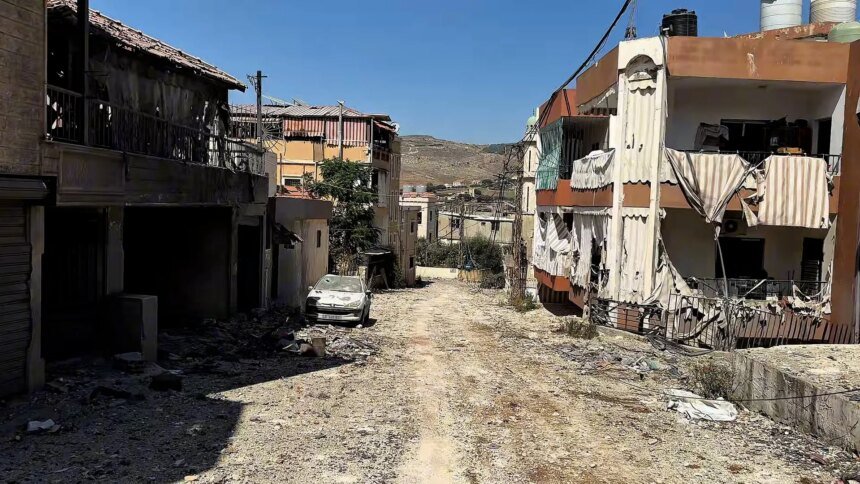
Nabatieh- On the morning of our return, Nabatieh was more like a city emerging from the ashes than a city coming back to life. Roads that were once bustling with traffic seemed almost empty, commercial facades were closed or destroyed, while residential neighborhoods bore the effects of repeated raids that retargeted the same sites more than once, doubling the extent of the destruction and postponing any real sense of a new beginning.
Ahmed Fakih arrived in Nabatieh Al-Fawqa, burdened beyond exhaustion. He did not stop at his house, which had turned into rubble, nor did he contemplate what remained of its walls. Rather, he headed directly to the cemetery where his son lay. He drove slowly through the damaged alleys, past collapsed houses and burned walls, until he stopped in front of the gate.
He remained inside the car for a few moments, staring at the place in intense silence, as if searching for a small certainty in the midst of this devastation, or making sure that the path to his son was still open, then he got off slowly, with steps heavy with loss, as if each step recalled a new moment of absence, heading towards the grave that seemed to be his first and last destination at the same time.

Sad return
Inside, a jurist stood for a long time in front of the grave without uttering a word. The scene did not need explanation. Silence alone was enough to carry what was not said. There, between the dirt and the stone monument, it seemed as if he was trying to piece together a memory that had been shattered all at once since the first moment of displacement.
He told Al Jazeera Net that his longing for his son was prior to any other feeling, even his desire to return, explaining: “The house can be built again, but the son will not return,” and he added in a faint voice: “I only came to recite Al-Fatihah and tell him that I have returned.”
But even this postponed meeting was not completed, as the cemetery itself was not spared the effects of the war, as some evidence was damaged, and the effects of the Israeli bombing remained clear in its surroundings.
Fakih recalls a number of those he lost during the war: two sons, a brother, and a nephew, accumulated losses that made his return to the city a visit more open to loss than a return to a life that can be resumed. As he points to the graves, it seems clear that what he lost goes far beyond the demolished homes and property, and that the war left a deeper impact than can be seen with the eye.

Huge destruction
In another scene inside Nabatieh, Umm Hussein stands in front of her house, staring at the facade that no longer resembles what it used to be. Glass is scattered at the entrance, and the walls are laden with cracks extending like an incomplete map, while the rooms inside appear to be exposed to a vast void left by the last strike. This house, which had withstood previous rounds of targeting, is collapsing this time with broader damage left by the recent escalation.
Wander between the rooms, feeling what remains of the details of the place that was once a space for daily life. The scene intersects with signs of sadness and unhidden frustration, while the image of the house as it was recedes in favor of a new reality that imposes itself harshly. Despite this complete exposure of the destruction, there remains in the audience what resembles a deferred desire to rebuild, commenting on conditions that are still absent from any actual stability.
Speaking to Al Jazeera Net, Umm Hussein’s voice comes out heavy with details of the experience, and she came to inspect what was left of her home before returning again to the path of displacement, in light of the absence of the basic necessities of life in the region. Cut off water, absent electricity, and non-existent services, a situation summarized by the interruption of the infrastructure that was destroyed, after the Israeli targeting eliminated the necessities of life, leaving the place facing a vast vacuum that does not allow for actual stability or permanent return.

From the demolished homes to the heart of the city, Lelandi Café is trying to regain its pulse again. The place, which has been restored for the third time, bears witness to a recurring cycle of destruction and rebuilding. Its owner, Jalal Nasser, moves between the dusted tables, recalling the series of setbacks that the place has experienced since the beginning of the war.
Nasser tells Al Jazeera Net that this is the third restoration of the café; It was completely destroyed in a previous war, then it was rebuilt before the war affected it again. With the recent ceasefire, he returned in the morning to clean and rearrange the place, in an attempt to reopen it, even if partially.
He pointed out that reopening it is not only about work, but about trying to restore life to a city exhausted by war. Shops have been closed, markets have been damaged, and economic activity has declined dramatically, while any attempt to return seems like a daily act of resistance against stagnation and fear. But he does not hide his anxiety about the next stage in light of a fragile calm that is still capable of being shaken at any moment. Between one ceasefire and another, Nabatieh remains a city rebuilding itself on a land that has not yet healed, and a memory that has not stopped receiving loss.

A fragile truce
Life is returning to Nabatieh remarkably slowly, after a new ceasefire ended a round of violent escalation that made it one of the hottest squares in southern Lebanon over the past week. However, this return seems closer to a cautious resumption than actual stability, in a city exhausted by war and left by the conflict burdened by rubble and absence.
This understanding, which is seen locally as the sixth truce since the beginning of the confrontations on the southern front, comes after a massive bombing wave that affected residential neighborhoods and vital facilities, and forced thousands of families to flee, leaving behind a tired city searching for a fragile balance between what was destroyed and what can be restored.
The city was among the most prominent areas that were targeted, along with surrounding towns such as Nabatieh Al-Fawqa, Kafr Rumman, and Harouf. The raids included neighborhoods within the city and its popular markets, which constitute a basic economic pillar, resulting in significant damage to residential buildings, shops, and infrastructure networks. The escalation also extended to areas in the south and western Bekaa.

In light of continued targeting, the south finds itself facing a very complex equation: delayed reconstruction, an economy under pressure, and a civilian return that remains conditional on unguaranteed calm. Thus, the city appears to be moving within a truce open to possibility, as political understandings alone are not sufficient to restore life, unless they are transformed into actual stability that breaks the cycle of escalation and redefines the meaning of return in southern Lebanon.