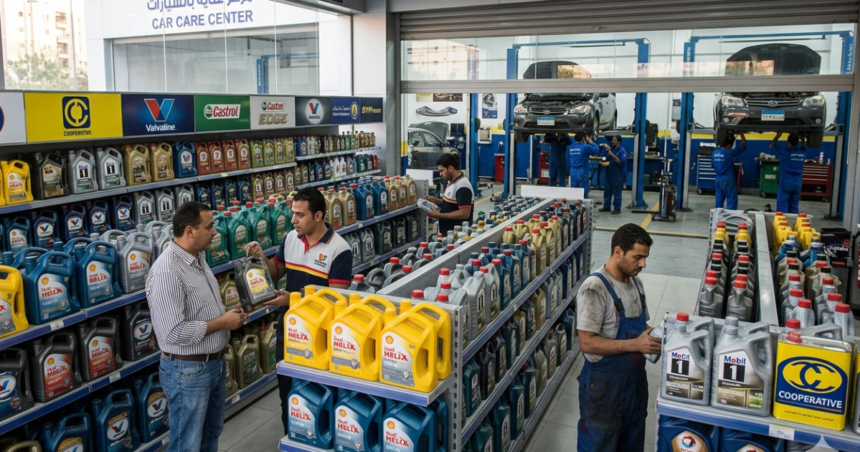
The facades of maintenance centers and gas stations in Egypt today face a completely different scene than in past years. Talking about “changing the car’s oil” is no longer just a passing maintenance routine, but rather has turned into a precise calculation process that car owners perform before heading to the nearest service center.
With every passing month, before the wave of rising prices subsides, international and local oil companies surprise the Egyptian market with new price lists, pushing the prices of one liter of some types of oils to a barrier of 700 pounds (about 13.5 dollars), and forcing cars to wait longer periods and think long before they get their regular injections of engine oil.

Successive waves of highs
Since the beginning of 2026, the motor oils market in Egypt has witnessed a state of unprecedented instability, with successive waves of rise affecting the price lists of the major companies operating in the market, led by Shell, Castrol, ExxonMobil, Total, and Misr Petroleum.
Shell revealed a new price list for its products, which was implemented as of May 1, as the prices of the Helix series of gasoline engine oils rose, bringing the price of a liter of Helix Ultra (5W30 / 5W40) to 690 pounds (about 13.3 dollars), while a 4-liter package reached 2,570 pounds (about 49.4 dollars) and a 5-liter package reached 2,995 pounds (about 13.3 dollars). 57.6 dollars), while Helix Extra City 10W40 oil recorded 410 pounds (about 7.9 dollars) per liter and 1740 pounds (about 33.5 dollars) for a 5-liter can.
On May 5, Total Energies approved new increases in the prices of motor oils in the Egyptian market, including several categories of Quartz, Rubia, and Hi-Perf oils, in addition to gear oils and various fluids.
The rise also included Misr Petroleum Company, which announced on March 3, 2026, a new update to its price lists, affecting motor oils and greases. The value of the increase in some items ranged between 10 pounds (about 0.2 dollars) and 50 pounds (about 1 dollar) per liter, as Misr Alfa oil recorded 240 pounds (about 4.6 dollars) per liter and 920 pounds (about 1 dollar). 17.7 dollars) for a package of 4 liters, and Misr Super oil is 155 pounds (about 3 dollars) per liter and 575 pounds (about 11.1 dollars) for a package of 4 liters.
Castrol was not immune to this wave, as the brand announced the update of the prices of the Edge and Magnatec groups, recording the price of a liter of Castrol Edge (5W30 / 5W40) at 675 pounds (about 13 dollars), and a 4-liter package at 2,485 pounds (about 47.8 dollars).
As for Mobil, a subsidiary of ExxonMobil, it revealed a new price list that included Mobil 1 (5W30/5W40) oils at a price of 665 pounds (about 12.8 dollars) per liter and 2440 pounds (about 46.9 dollars) for a 4-liter package, while Mobil Super 10W40 recorded 390 pounds (about 7.5 dollars) per liter. Mobil Special 20W50 is 200 pounds (about 3.8 dollars) per liter and 720 pounds (about 13.8 dollars) for a 4-liter package.

Why are prices rising so quickly?
The rise in car oil prices in Egypt is due to a group of intertwined factors, most prominent of which are the repercussions of global geopolitical tensions, most notably the escalation between the United States and Iran, which cast a direct shadow on the prices of crude oil and its derivatives.
The oil market is also directly affected by any disturbances in the global energy market, due to its close connection to oil prices, which explains the price movements during the recent period.
However, the biggest surprise came from within the Egyptian market itself, where the rise in oil prices far exceeded the increases witnessed by other petroleum products. Although the increase in raw material prices did not exceed 5%, oil prices jumped by rates reaching 15%.
This is due to the fact that the oils depend mainly on concentrated chemical additives that are completely imported from abroad and are directly affected by fluctuations in the exchange rate and sea freight costs, in addition to the desire of companies to hedge in advance against any sudden jumps in cost.
It was expected that this wave of rises would not begin before this June, given that the impact of increases in petroleum prices does not appear in the markets until later. However, the reality was different. Oil companies raised their prices within a short period, exceeding all expectations, which confirms that the market is in a state of constant anticipation of the next rise, especially since any disruptions in supply chains or an increase in shipping and transportation costs are quickly reflected in the retail prices of the Egyptian consumer.
According to the latest Mordor Intelligence reports, the volume of the motor oils market in Egypt is expected to reach 209.01 million liters during the year 2026, with a compound annual growth rate of 3.03% until 2031. The same data indicates that passenger cars account for 54.70% of the market share, while light transport vehicles are growing at a compound annual growth rate of 3.47%.
The numbers also show that mineral oils still dominate 59.80% of the market, while fully synthetic oils are ahead at a CAGR of 3.55%. This distribution reflects the state of “division” experienced by the Egyptian consumer between the need for high-quality oils that maintain the engine, and the limited purchasing power that pushes him towards more economical, albeit lower-quality, choices.

High prices and prioritization
The successive rises in oil prices did not go unnoticed by the behavior of car owners in Egypt. In light of this upward wave, new features began to take shape in the way of daily maintenance, including:
- Extending oil change intervals: With the rise in car oil prices, many car owners resort to extending the period between oil changes, ignoring manufacturers’ technical recommendations, which exposes engines to the risk of premature wear, poor performance, and increased fuel consumption.
Instead of committing to changing the oil every 5,000 kilometers (for conventional oils), some prefer to wait until 7,500 or 10,000 kilometers, in an attempt to reduce the monthly financial burden. - Switching to economical oils: In 2025, the price of Egypt Super 7500 oil was 355 pounds (about $6.8), then it jumped to 555 pounds (about $10.7). As of May 2026, Misr Super Oil recorded 155 pounds (about 3 dollars) per liter (620 pounds (about 11.9 dollars) for a 4-liter package). This wide disparity between the prices of international brands and the prices of local oils has made a wide segment of consumers move towards cheaper alternatives, abandoning some international standards of quality in favor of reducing direct costs.
- Postponing comprehensive maintenance operations: The rise in oil prices did not affect oil alone, but also affected filters, coolants, and brake fluids, all of which increased in price according to the latest lists. As a result, an increasing number of drivers prefer to postpone comprehensive maintenance entirely, settling for minimal measures to keep the car moving.
- Dangers of adulterated oils: The price gap has opened the door to the spread of the phenomenon of trade in “counterfeit oils” or of unknown origin, as some consumers search for the cheapest prices without awareness of the danger this poses to the life of the engine.

What do the coming days hold?
During this June, attention is turning to when the impact of petroleum price increases will begin. If this scenario is achieved, we may witness a new wave of rise added to the price lists witnessed in the period from January to May.
Meanwhile, exchange rate fluctuations and higher international shipping costs may keep pressure on listing prices through the second half of the year.
While companies continue to update their lists on an almost monthly basis, the biggest concern for every Egyptian driver has become the current cost of changing the oil. This constant fluctuation has turned car maintenance into a financial burden no less important than the daily cost of fuel in the family budget.