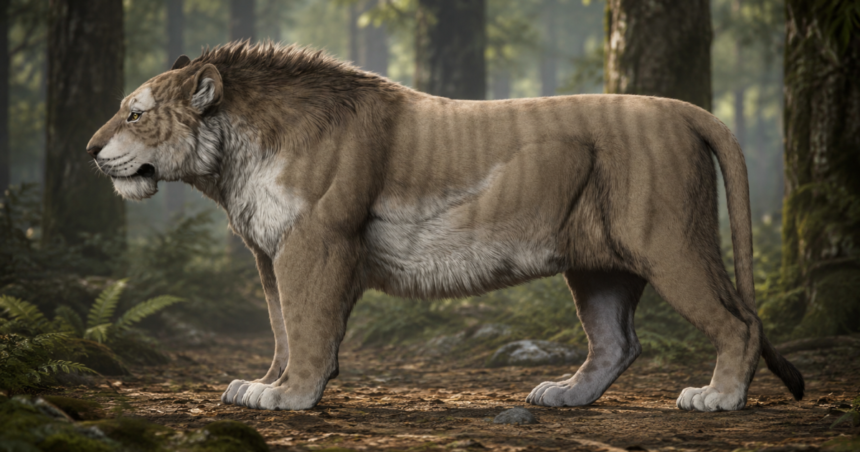
About 20,000 years ago, a huge lion roamed the cold steppes of Asia, in a snow-covered world where mammoths, wild horses and woolly rhinos lived. This lion was not like the lions we know today in Africa or India. Rather, it was larger in size, perhaps without a visible mane, and belonged to an extinct breed known as “cave lions.”
For decades, scientists have wondered about the nature of these animals. Were cave lions just an ancient image of modern lions, or were they a completely different breed? Did they live with the descendants of current lions in overlapping areas, or did they remain isolated from each other?
In a new genomic study published on June 3 in the journal Cell, an international research team sought to answer these questions by analyzing the genomes of 12 cave lions, whose ages extend back to more than 100,000 years, and whose samples came from Europe, Siberia, Central Asia, and North America. The team then compared these genomes to the genomes of modern and extinct lions, including lions from North Africa, South Africa, and southwest Asia.

Two separate lineages… but not completely isolated
The results reveal that cave lions and modern lions were not one group, but rather two separate subspecies, each with its own population and genetic history. The lead author of the study, David Stanton, a lecturer in biology at Cardiff University in the United Kingdom, says that the separation between the two subspecies may have begun a long time ago, perhaps more than a million years ago, “although determining this exact date remains complex, because the two subspecies did not remain completely separate all the time.”
Stanton explains in statements to Al Jazeera Net that the most important surprise in the study is that the team found evidence of gene flow between cave lions and modern lions during the last ice age.
Gene flow means mating between individuals of two lineages, and the transfer of part of the genetic material from one to the other. This indicates that cave lions were not completely isolated, but rather, in some periods, they met lions close to modern subspecies.
The study indicates that one of the cave lions, who lived about 20,000 years ago in eastern Central Asia, carried between 3.2 and 4.4% of its genetic origins from modern lions. Researchers believe that the closest source of these genes was Southwest Asian lions, a group of modern lions that became extinct in the twentieth century.
The team links this mating to climate changes in the Ice Age, when glaciers expanded and cave lions moved southward, away from the extreme cold, and their range approached areas where modern lions lived in southwest Asia.
“And with this overlap, there was limited mating between the two lineages,” Stanton adds. “So the genes become like a little record of the animals’ movement under the pressure of ice and climate.”

The vast world of ancient lions
The study also reveals that cave lions were genetically related over large areas of Eurasia. Although their range extended from Europe to Siberia and Central Asia, the genomes show that interbreeding and the transfer of genetic origins occurred across distant regions over relatively short periods, which means that these animals were not small, completely isolated groups, but rather were part of a wide network of populations that moved and overlapped across the Ice Age steppes.
But North American lions seemed more distinct genetically, according to the researcher, who indicates that they may have deep ancestry from an extinct cat lineage whose genes have not yet been sequenced, and it may be related to what is known as the American lion. “But this hypothesis still needs additional data, especially from confirmed genomes of the American lion itself,” Stanton said.
The results were not limited to tracing lineage only, as researchers found distinct genetic mutations in cave lions, some of which are linked to functions in the brain, nervous system, vision, growth, and blood circulation. The team believes that these signals may help in the future to understand how these animals adapted to the harsh environments of the Ice Age, with extreme cold, wide distances, and huge prey.
Limitations of the study
Despite the power of genomic analysis, researchers have several limitations to the study. The number of ancient genomes is still limited, and some of them have low coverage, meaning that the genetic material extracted from them is not complete enough to allow definitive answers to all questions. Therefore some conclusions need additional samples from different regions and time periods.
The relationship between ancient mating and ice expansion appears strong in the analysis, but it is not statistically conclusive compared to the time factor alone. The researcher explains that the glacial climate may have actually helped bring the lions’ ranges closer together, but proving this conclusively requires more data. The current sample is also not sufficient to test whether the discovered genetic mutations represent direct adaptation to the environment, or are merely genetic differences that have accumulated over time.
In terms of funding, the work was supported by the European Union’s Horizon 2020 programme, the Swedish Research Council, the European Research Council, the Vienna Foundation for Science and Technology, and the La Caixa Foundation, in addition to support from laboratories and research facilities in Cardiff and Sweden. The researchers declared that there was no conflict of interest.