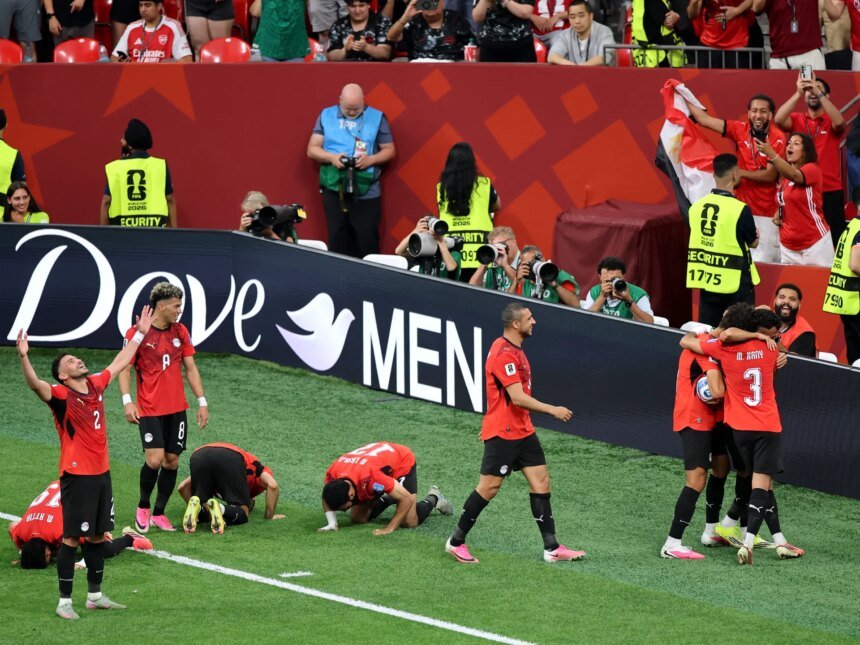
The Egyptian national team achieved what its fans had been waiting for since its first participation in the World Cup in 1934, after recording its first victory in the history of its participation in the World Cup, after defeating New Zealand with a score of 3-1 in the seventh group competitions.
The victory came after a strong comeback in the second half, as the “Pharaohs” finished the first half of the match 1-0 down, before they succeeded in overturning the result and achieving a historic victory that strengthened their chances of reaching the next round.
Read also
list of 2 itemsend of list
The Egyptian team raised its score to 4 points at the top of the group, ahead of Iran and Belgium, which have two points each, giving coach Hossam Hassan’s squad a great advantage before facing Iran in the third and final round.
The following are the most important factors that contributed to the Egyptian team’s return against New Zealand:
1- Decisive tactical adjustments
The changes made by coach Hossam Hassan played a pivotal role in turning the tide of the match, after the Egyptian team switched to a 4-1-3-2 style during the second half.
The technical staff also granted greater freedom to Mohamed Salah and Omar Marmoush in the attacking third, while reducing their defensive roles, with the aim of exploiting the relative slowness of the New Zealand team’s defense and searching for the depth that was absent from the Egyptian team’s performance in the first half.
2- Physical superiority in the second half
The Egyptian team appeared physically better after the break, as it raised the pace of play and put more pressure on the opponent, and succeeded in recovering the ball quickly and imposing its control over the course of the match.
The high tempo also contributed to giving the midfielders a clear advantage when building attacks and applying advanced pressure on New Zealand players.
3- The effect of the bench
The bench emerged as one of the keys to the Egyptian victory, as the entry of Mahmoud Hassan “Trezeguet” and Hamza Abdel Karim gave the team additional offensive momentum.
The two players contributed to revitalizing the front line and creating new offensive solutions, while Trezeguet was able to score the third goal that decided the match and gave Egypt its first victory in its history in the World Cup.
4- Defensive solidity and Schubert’s brilliance
Goalkeeper Mustafa Schubert gave a remarkable performance, after repelling a number of dangerous attempts by the New Zealand team, and keeping his team in the match atmosphere during the difficult periods.
The defense line, consisting of Ahmed Fattouh, Mohamed Abdel Moneim, Hossam Abdel Majeed and Mohamed Hani, also appeared strong, especially in dealing with air balls, which constituted one of the most prominent weapons of the New Zealand national team.

Thanks to these tactical, physical and technical factors, the Egyptian team succeeded in achieving a historic victory that may open the door to qualifying for the knockout rounds for the first time in its history.
5- Mohamed Salah’s awakening…the turning point
The second half of the match witnessed a remarkable awakening for the captain of the Egyptian national team, Mohamed Salah, after he was more liberated from defensive roles and switched to playing in the attacking depth, which gave him more space to receive the ball between the lines and create danger to the New Zealand defense.
This change contributed to increasing the effectiveness of the front line, as Salah became more closely linked to Omar Marmoush in the final third of the field, which created a numerical superiority in the offensive areas and confused the opponent’s defensive organization, and opened the way for the Egyptian team to return in the result.
This historic victory gives the Egyptian national team a great morale boost before facing Iran in the third and final round of the group stage, as the “Pharaohs” are close to achieving a new achievement of reaching the knockout rounds for the first time in the history of their participation in the World Cup.
Maintaining tactical balance and physical readiness, in addition to the continued effectiveness of the offensive elements, will be among the most important factors that may lead the Egyptian team to write a new page in its World Cup history.