Throughout its long history, the FIFA World Cup was not just a stage for displaying skills and winning the most expensive title, but rather it has always represented the game’s largest legislative laboratory.
Behind every radical amendment to the laws of football, there lies a “World Cup incident” that sparked controversy and stirred stagnant waters in the corridors of the International Federation of Association Football (FIFA) and the International Football Association Board (IFAB), to move the game from randomness and roughness to more fair and enjoyable horizons.
Read also
list of 2 itemsend of list
This report documents three historical turning points that changed the face of football forever, all of which were born out of the World Cup crises.
Law prohibiting the goalkeeper from catching the ball returning from his teammate (1992)
The 1992 European Championship is often wrongly cited as the reason behind the back pass law, but the FIFA Board had signed the necessary papers before the tournament began.
Denmark’s excessive use of the back pass, which culminated in the 1990 World Cup in Italy, and the Ireland-Egypt match in particular, was the epitome of this rule.
Background and backstage
Evab’s decision to ban goalkeepers from touching the ball with their hands when it is passed to them by their teammates is, from a tactical standpoint, one of the most important changes to the laws of the game in history, as it made football faster and more exciting overnight.
Many consider the World Cup in Italy in 1990 to be one of the most goal-poor and tactically boring tournaments. It witnessed players repeatedly returning the ball to their goalkeeper, who then caught it in his hand without any restrictions, which contributed to killing time and thwarting the opponent’s offensive pressure.
This crisis was clearly evident in the match between Egypt and Ireland (which ended in a goalless draw). The players of both teams, especially the Egyptian side through goalkeeper Ahmed Schubert, deliberately returned the ball, caught it, and threw it on the ground to spend minutes, amid sharp booing whistles from the fans in the stands.
The Pharaohs relied on a tight defensive style, as they constantly passed the ball to the goalkeeper, who would receive it, move a little, and then quickly send it to the penalty area.
There was no stopping them from doing this again and again, so Ireland went the same way for long periods, knowing that a draw would likely be enough for them to qualify.
Many reports claim that Ireland goalkeeper, Packy Bonner, held the ball for a full 6 minutes throughout the 90 minutes.
It seems that FIFA realized that the continuation of this situation threatened the commercial and marketing value of the game, and in 1992, FIFA passed a revolutionary law that prevents the goalkeeper from touching the ball with his hand if it was deliberately returned to him by a teammate’s foot.
This modification completely changed football tactics, forced goalkeepers to develop their foot skills, and significantly increased the number of actual minutes played.
Introduction of yellow and red cards (1970)
Before 1970, referees issued warnings and expulsions verbally, which caused a major problem at Wembley Stadium in 1966 in the home team’s match against Argentina, which was characterized by excessive roughness.
At that time, English referee Rudolf Kreitlin decided to expel the captain of the Argentine national team, Antonio Rattin, but the latter refused to leave the field on the grounds that he did not understand the referee’s English language.
The match was stopped for more than 9 minutes amid massive chaos and protests that required officials to intervene. Also, the England players (Bobby and Jack Charlton) did not know that they had received a warning until they read the newspapers the next day.
English referee Ken Aston (then Chairman of the Referees Committee) took on the task of finding a solution to the problem of different languages, and while standing at a traffic light, he was inspired by the idea of colored cards.
The experiment was applied with great success at the World Cup in 1970, and yellow and red cards became a unified visual language that players and fans around the world understood as soon as they were raised, which strengthened the authority of the referee and protected the stars from excessive roughness.
Introduction of goal-line technology (2014)
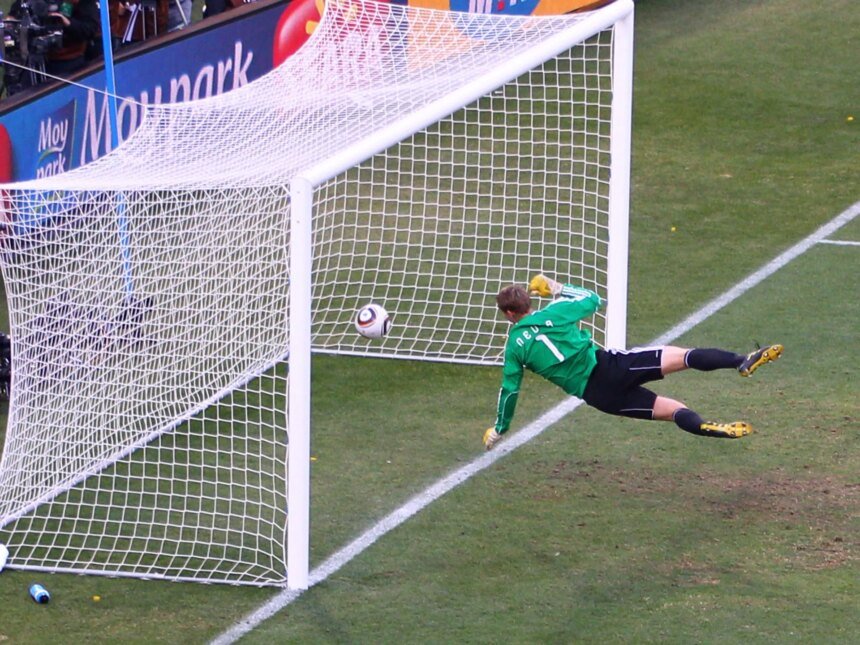
FIFA has always resisted the introduction of technology into stadiums, clinging to “the humanity of the game and its errors as part of the excitement,” until the shot that shook the credibility of the World Cup refereeing came in the 2010 Bloemfontein match between the giants England and Germany.
While Germany was leading 2-1, English star Frank Lampard shot a falling ball that hit the crossbar and crossed the German goal line by more than half a meter before bouncing out.
Despite the clarity of the shot to hundreds of millions of followers behind the screens, the referee and his assistant indicated that play should continue, which deprived England of a legitimate draw, and the match ended in their loss (4-1).
This incident caused great embarrassment to the then FIFA president, who issued an official apology to the English side and announced the immediate opening of the goal-line technique test.
By the World Cup in Brazil in 2014, systems such as “Hawk Eye” were adopted, ending forever the dilemma of “ghost goals,” and this step later paves the way for the introduction of video assistant technology (VAR).
Historical evidence proves that the current laws governing the 2026 World Cup competitions, with their technological and tactical strictness, are nothing but the cumulative product of mistakes and clashes witnessed in the old World Cup stadiums.
Every loophole that appears in the green rectangle turns, over time, into a legal substance that formulates the fairness of the game and ensures the flow of visual enjoyment for successive generations.