Published on 6/18/2026
A new astronomical study based on data from NASA’s Chandra
Supernovas are among the most violent cosmic explosions known, and humans have observed them for thousands of years as stars that suddenly appear and then disappear. After the explosion, it leaves behind clouds of very hot gas and debris that glow in different wavelengths before gradually fading over time. However, long-term monitoring of the Messier 83 galaxy revealed that some of these remnants do not follow this usual scenario.
Read also
list of 2 itemsend of list
An active galaxy reveals unexpected surprises
The Messier 83 galaxy, also known as the Southern Pinwheel Galaxy, is located about 15 million light-years from Earth and is one of the most active star-forming galaxies.

The researchers relied on observations collected by the Chandra Observatory between 2000 and 2014, when they studied a number of supernova remnants within the galaxy. It was expected that its X-ray emissions would decrease over time, but the results showed large and unexpected variations in brightness levels.
Andrea Prestwich, the lead researcher on the study from the Catholic University of America, said that scientists knew that some sources of
Cosmic collisions or stars that survived the explosion?
Researchers were able to explain at least one case: the remnants of the supernova SN 1957D, which was first seen about 70 years ago. Data indicate that the debris resulting from the explosion is currently colliding with surrounding materials, leading to increased X-ray emission.
As for the rest of the cases, they are still an open mystery. Scientists raise the possibility of the existence of binary star systems, where one of the two stars survived the explosion while the other turned into stellar remains. In this case, what is known as a high-mass X-ray binary is formed, a system that can produce noticeable changes in X-rays.
Although these systems have been known for decades, linking them to this number of supernova remnants is unusual and deserves further study.
Cosmic recycling around black holes
Researchers are also considering another explanation, which is a kind of “cosmic recycling.” In some cases, the explosion of a star may leave behind a black hole or a neutron star.
Over time, these objects may attract part of the material they ejected during the explosion, so the material falls back toward the central body, releasing additional amounts of X-rays in the process.

The researchers believe that some of the remnants may be the result of this scenario, while others may arise due to binary stars, which means that more than one mechanism may be responsible for the phenomenon.
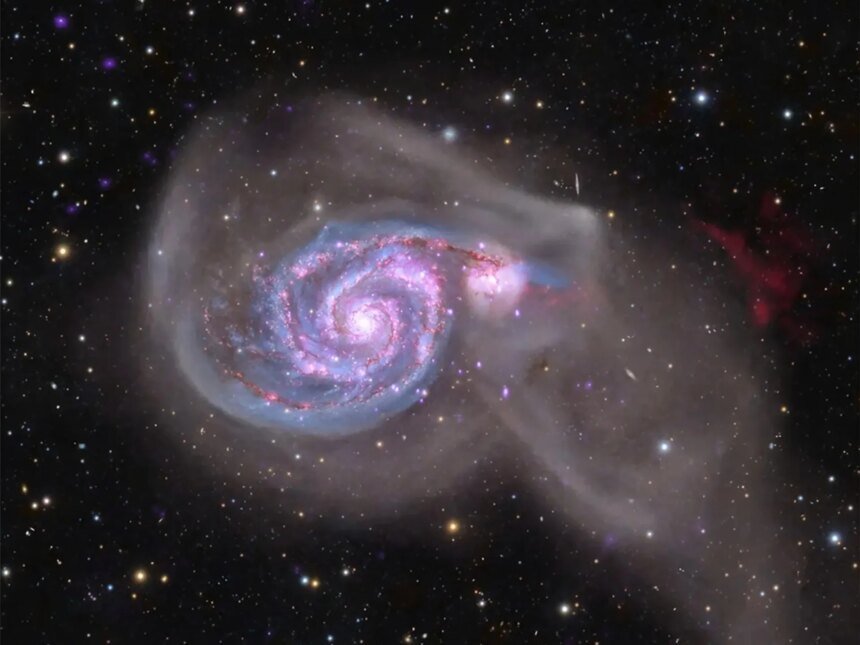
Scientists point out that a later study observed similar behavior in the Messier 51 galaxy, known as the Whirlpool Galaxy, which suggests that this phenomenon may be more widespread than previously thought.
A new window to understanding the life cycle of stars
These results are a reminder that the universe still holds many secrets, even in phenomena that scientists thought they understood well. The remnants of exploding stars are not merely inert relics of past events; they may continue to evolve and interact in complex ways for decades or even centuries.
As space observatories develop and observation periods extend, scientists become more able to track these subtle transformations and understand the life cycle of stars more deeply. This discovery confirms that scientific research is not just a collection of knowledge, but rather a continuous journey to discover the unknown, as a small observation in light coming from the depths of space can change our understanding of the entire universe.