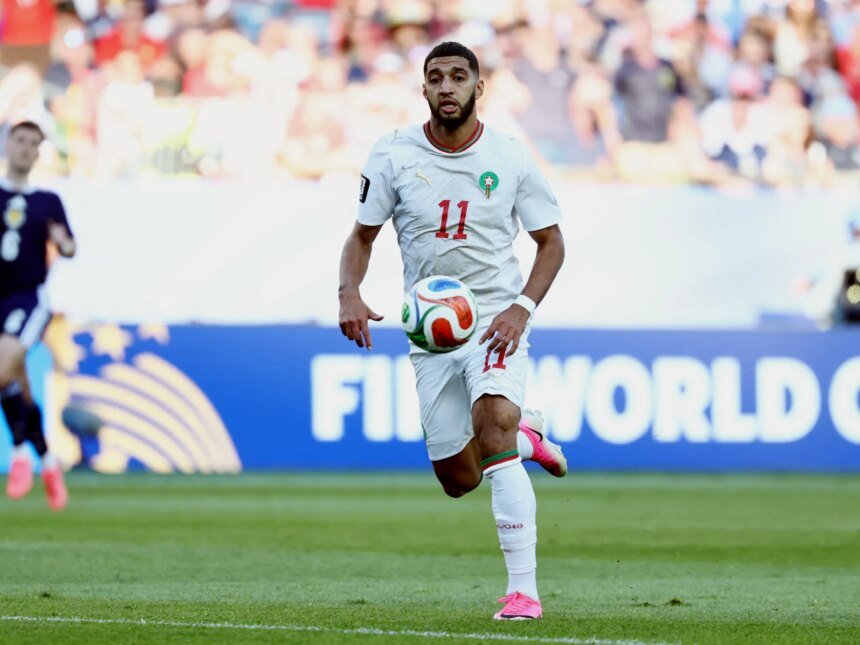
With the start of the 2026 World Cup, the name of Moroccan striker Ismail Sibari has become one of the most prominent faces of the tournament. After stealing the spotlight with his goal against Brazil in the opening match of the Atlas Lions, the player once again confirmed his place among the World Cup stars by registering his name in the annals of Arab history.
And against Scotland in the second round of the group stage, Saibari only needed 71 seconds to score, taking advantage of a perfect pass from Brahim Diaz before launching a powerful shot into the goal. That goal not only gave Morocco an early advantage, but it also carried historical value, as it became the fastest goal scored by an Arab player in the history of the World Cup Finals.
Read also
list of 2 itemsend of list
Between a goal against Brazil and a record against Scotland, Saibari continues to write an exceptional story in the United States, Canada and Mexico, confirming that he is one of the most prominent winners of the current edition, and one of the names that Moroccan fans have come to place high hopes on in the “Atlas Lions” journey towards the advanced stages.
Wehbe rediscovers Saibari
Ismail Sibari had never played as a striker for the Moroccan national team before the FIFA World Cup, but he took advantage of the opportunity wonderfully and scored two goals in the tournament.
The PSV Eindhoven star won the best player award in the match in which Morocco won 1-0 over Scotland, bringing the team from North Africa closer to reaching the round of 32.
The decisive goal scored by Saibari against Scotland, 71 seconds after the start, made him the second African player after Egyptian Mohamed Salah to score in his first two matches in the World Cup.
The credit for Sibari’s recent goal-scoring boom goes to coach Mohamed Wehbe, who made him occupy the position of outright striker after he was playing as a playmaker or winger with Walid Regragui, the former Moroccan coach.
Saibari (25 years old), who won the title of best player in the Dutch League last season, scored only seven goals in the first 28 international matches he played, but he scored four goals in the last four matches.
Wehbe took advantage of Saibari’s speed and ability to run behind the defence, as he did when he scored in Brazil after running into the penalty area and calmly putting the ball over goalkeeper Alisson.
“I will score a goal”
Saibari failed to score during his first season in the Eredivisie with PSV Eindhoven, as he played 17 matches in the 2022-2023 season during which he suffered from injuries. However, this experience helped him gain more calm in front of goal.
Saibari said in an interview broadcast on Eindhoven’s YouTube channel in 2023, “At first, I was thinking: ‘I must not waste this opportunity.’ But now I am thinking: ‘I will score a goal’.”
This progress was reflected in his statistics, as he scored 15 goals in 27 matches in the Dutch League last season, which helped Eindhoven win the title for the third time in a row.

Saibari spent a large part of his career adapting to new societies. He was born in Terrassa, Spain, and moved with his family to Belgium when he was six years old. He graduated through local clubs before joining the Anderlecht academy in 2013.
Although his time at Anderlecht only lasted two years after he was dismissed due to a decline in his level days before the start of the new season, it was an important period in the formation of his character. “It motivated me to work harder,” he later said.
Representing Morocco and the call of the heart
Saibari was eligible to represent Spain, where he was born, Belgium, where he holds citizenship, and Morocco. However, he never thought of playing for any team other than the Atlas Lions.
“When you choose a national team, it should come from the heart. It should not be a decision about where you will have more chances. You represent an entire country, so you should play with your heart,” Saibari said.
He also revealed that former Belgium coach Roberto Martinez tried to convince him to play for the national team, but he did not think much about his commitment to Morocco.
Sibari now hopes to repeat Morocco’s achievement by reaching the semi-finals, like the 2022 finals, driven by the spirit that prevails within the team.
He said, “We all have the same goal, and the same dream. Even off the field, we laugh together, talk together, and work together. We are like a family.”
A special place with the “Atlas Lions”
The Moroccan national team players celebrated their colleague Ismail Saibari in a remarkable scene after the end of the Scotland match, after he scored the winning goal, this Saturday morning, in the second round of the 2026 World Cup.
A video clip published by the official account of the Moroccan national team, via Instagram, showed the “Atlas Lions” players gathered in a circle with technical director Mohamed Wehbe in the middle, before they gathered around Saibari and celebrated with him the goal that gave Morocco three valuable points.
Sibari…a new expected shift
Even before competing in the World Cup, Ismail Saibari was one of the most prominent stars in the Dutch Premier League last season, where he attracted attention with his distinguished performance, which made him the subject of interest from major European clubs.
According to reports, Bayern Munich is preparing to complete a landmark deal during the transfer market, by including PSV Eindhoven winger, Moroccan player Ismail Saibari, who initially agreed to a transfer contract worth 55 million euros (about 59.4 million dollars).
The 25-year-old player is expected to sign a long-term contract with Bayern Munich that extends until the summer of 2031, according to what was reported by the “Football International” website, in light of rapid movement by the Bavarian club’s management to settle the deal before competing parties enter.
It was also agreed that the player would undergo a medical examination in the United States of America, which was confirmed by journalist Fabrizio Romano, noting that the presence of the Bayern Munich doctor with the German national team in the United States facilitated these arrangements, allowing the final procedures to be completed without the need for the player to travel to Munich at the present time.