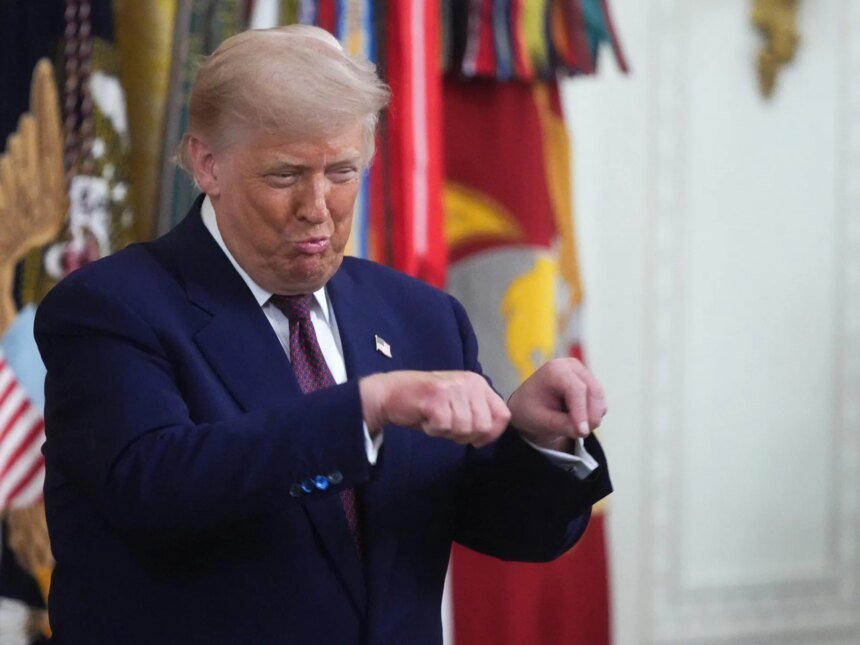
“I never thought about sending it. It didn’t even cross my mind, but I will send it to Congress. I like the idea.” With these words that President Donald Trump said to reporters, and in his usual confident tone, he responded to the desire of some Republican lawmakers to send the Iranian nuclear agreement to Congress for review, waving a step that, on its face, appears to be a diplomatic “gesture of good faith” and democratic coordination between the White House and the Capitol.
But behind the scenes of Washington, and in the books of American law, this step is not just a luxury political option owned by the president, but rather it is the beginning of entering a legal minefield that was specifically created to restrict the hand of the American administration vis-à-vis Tehran.
Specifically here, an effective legislation has returned to the fore, acting as a strict gatekeeper lurking for any US presidential move towards Iran, which is the Iranian Nuclear Agreement Review Act (INARA).
The roots of the story
The chapters of this story began to intertwine in 2015, when Congress drafted the “INRA” law to prevent the then Barack Obama administration from being alone in the detailed file, and required that lawmakers be the “gatekeepers” for any lifting of sanctions.
In his first term, Trump did not care much about “INRA,” and in 2018, he fulfilled his famous promise and unilaterally withdrew from the old nuclear agreement, imposing a “maximum pressure” strategy on Tehran. Years passed, and the equations changed, and Trump returned today with a completely different vision: seeking a “quick and historic deal” to end the war with Iran.
When examining the operative part of Article 2 of the law, the extent of the constitutional restriction imposed on the White House becomes clear. The text does not merely require a routine notification from Trump, but rather sets an hourglass that begins to rotate for only 5 days from the moment of signing, during which the president is obligated to transfer the full text and all secret annexes of the agreement to the congressional committees.
What is more dangerous than that is forcing the president personally to sign very complex “security and legal certificates” in which he guarantees to lawmakers that the deal meets Washington’s goals in “preventing nuclear proliferation” and that it does not pose a threat to national security, while providing an accurate inventory of every financial obstacle or penalty they intend to lift or freeze, whether American or international.

Lawmakers are more powerful than the president
Until this law was passed, the White House had complete freedom: There were no restrictions on the president’s use of waivers to suspend sanctions, no requirements for him to brief lawmakers on the details of the agreements or provide certifications confirming Iran’s compliance, and no quick way to reimpose sanctions if Tehran cheated.
But returning to the background of this legislation, we find that Congress decided to turn the tables and strip the president of these absolute powers. Since 2010, lawmakers have overwhelmingly passed a series of strong sanctions on the Iranian economy aimed at pushing Tehran to the negotiating table.
Because these sanctions include a “national security waiver authority” provision that any president intends to use to suspend sanctions as part of any deal, Congress moved to block the White House.
Specifically here, the legislative power of legislators, which exceeds the power of the president, appears through two provisions imposed by law:
- The law disarms the president of “immediate relief,” as he is strictly prohibited from waiving or suspending legal sanctions during the period of congressional review of the agreement.
- The law gives Congress the opportunity to pass a “joint resolution of disapproval,” which has the power to permanently prevent the president from suspending sanctions, and even allows lawmakers to completely revoke presidential waiver powers if they succeed in overriding a presidential veto. The law also explicitly states that permanently lifting sanctions requires a separate vote from Congress that the president does not have.
Which means that the legislators fortified themselves with a force that was evident in the first moment of the birth of this legislation, as it was not just a passing partisan desire, but rather enjoyed absolute and historic consensus within the Senate Foreign Relations Committee.
“Strict time blockade”
The restriction of the “INRA” law does not stop at the limits of submitting security documents and certificates, but rather extends to impose a strict time blockade calculated in days, legally prohibiting the president from providing any relief, suspension, or exemption from the sanctions imposed on Iran, or even refraining from implementing them, throughout the review period.
When we dismantle the time structure of the law based on its official texts, we find that the first 30-day period allocated for foreign relations committees to hold hearings and briefings is only the first half of a time blockade that is obligatorily extended through two paths:
- The first path: If the agreement is presented in normal times, the White House will be subject to a ban that extends for 52 days, and the calculation includes the initial review period (30 days), in addition to 12 days in which the president is prevented from lifting the sanctions following the approval of the House of Representatives and the Senate of a joint resolution of disapproval, followed by an additional 10 days of ban until Congress decides on the “presidential veto” and attempts to overturn it.
- The second path: If the administration chooses to time the transmission in the period between July 10 and September 7 (which is the period of Congress’s summer recess), the law gives legislators an upper hand and extends the basic review period to 60 days instead of 30 days. When adding the 12-day veto ban periods and the 10 days following it, the total time blockade reaches 82 full days, during which the weapon of presidential exemptions is completely paralyzed.
This digital impasse brings us directly to the dilemma, as experts believe that this blockade puts Trump in a dilemma, because adhering to the law and refraining from providing funds or exemptions to Iran throughout the period of 52 or 82 days is an “anti-peace” option, and here the question arises: Will Tehran wait for months without financial compensation?
What is the solution?
Trump finds himself in a spiral, especially in light of the conflicting signals about whether he plans to send the agreement to Congress, but several lawmakers, including Republican Senator Lindsey Graham of South Carolina, a close ally of the administration, said it should be sent to the Capitol.
However, Trump has three paths left before him. The first is to ignore the law and the constitutional clash by proceeding with the “Islamabad Memorandum of Understanding” and refusing to send it to Congress at all, ignoring the “INARA” law. This option is considered by legal scholars to represent “a blow to the rule of law.”
In a similar option, the Trump administration could sign the final agreement and consider it executive without the approval of Congress, as the Obama administration did in 2015, but this agreement would be subject to cancellation by future administrations.
As for the second scenario, in circumventing the financial embargo period, Trump sends the memorandum to Congress out of respect for the law, but he ignores the clause that prevents him from providing financial exemptions to Iran during the review period, so he gives Tehran money to save the calm. This is also considered a “violation of the rule of law,” because the president here is violating a legislative text that explicitly prevents him from temporarily lifting the sanctions.
The third and final scenario is in which Trump adheres to the law and sends the agreement to Congress, complies with the embargo, and does not provide any dollars or lift sanctions to Iran throughout the long review period, and this option may “eliminate the chances for peace and calm.”
The only way out that experts propose to save Trump’s current understandings is for Congress to completely repeal the law, or at least amend it to allow the temporary lifting of sanctions during the review period.
In the end, it has often been said that “the devil is in the details,” but in the case of the recent “memorandum of understanding” between Trump and Iran, the devil is in the “legal texts” inside the American capital.