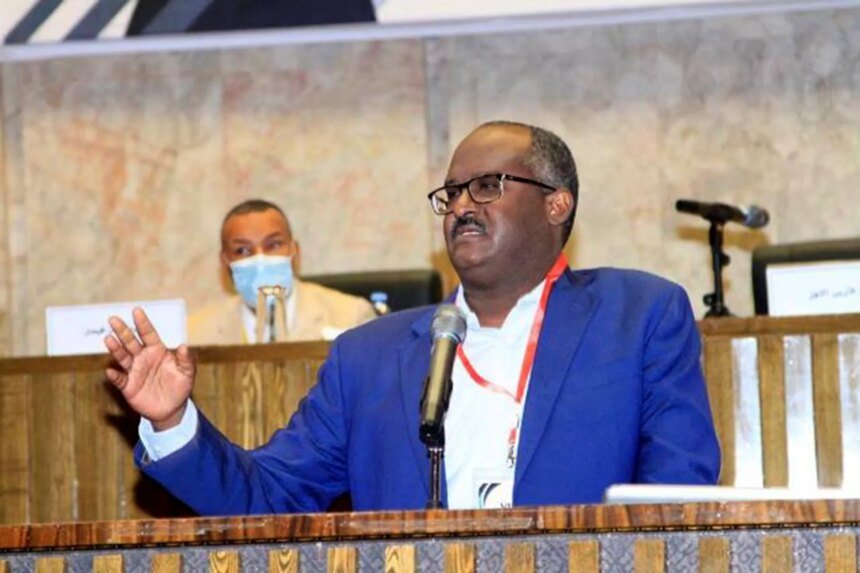
Khartoum- Weeks after the defection of influential field leaders in the Rapid Support Forces, Fares Al-Nour, one of the most prominent political and civil figures in the Sudanese founding coalition “Tassis” led by these forces, announced his departure from the coalition.
Observers considered Al-Nour’s move a setback for the political project that coalition leader Mohamed Hamdan Dagalo “Hemedti” is trying to build to ensure a seat at the Sudanese dialogue table to shape the country’s future after the war.
The dissident politician is seen as one of the prominent civil figures associated with Rapid Support over the past years, as he played a role in humanitarian files and community initiatives, benefiting from his background in civil and development work.
Reasons for resignation
Al-Nour served as advisor to the Rapid Support Commander when he was Vice-President of the Sudanese Transitional Sovereignty Council after joining the forces in 2020, before he was appointed to Hemedti’s advisory council after the outbreak of war more than 3 years ago.
After the war, he became the chief negotiator of the Rapid Support Forces during the Jeddah-Saudi Arabia negotiations with the Sudanese army in 2023 before resigning from the negotiating team and his advisory position. He was later appointed a member of the Presidential Council of the “Establishment” coalition, which formed a parallel government in the Darfur region last year, and he was chosen from the coalition as governor of Khartoum State.
In mid-June, Fares Al-Nour announced his resignation from membership in the Council and from his position as governor of Khartoum, saying that the scene had shifted from searching for stability to targeting Sudan, its unity and sovereignty. He explained in a recording obtained by Al Jazeera Net that his resignation “came after a deep review of the course of action during the last period, and after a careful assessment of his moral responsibility towards the Sudanese people and the future of the nation.”
He added that he supported the idea of “establishing” as a temporary transitional step to serve citizens, preserve what remains of national institutions, contribute to creating a climate for peace, and provide a responsible administrative model that helps move from the reality of war to the horizon of statehood and stability. He continued, “But unfortunately, the scene has turned to targeting Sudan’s unity, sovereignty and independence.”
The past weeks have witnessed increasing defections from the Rapid Support, the most prominent of whom is Ali Abdullah Rizkallah, known as “Al-Safna,” Al-Nur Adam, known as “The Dome,” who is one of its founders and prominent field commanders, and the commander of the Bara axis in the Kordofan region, Bishara Al-Hawira, and they were preceded by the commander of the forces in Al-Jazira State, Abu Aqla Kikel, in 2024.
Officials in the forces and the “Tawass” coalition – whom Al Jazeera Net spoke to – avoided commenting on Al-Nour’s resignation, but writers and activists associated with the Rapid Support downplayed – via social media – his defection and saw that “he was not influential and did not play important roles, and that he was moody and could not stand pressure.”
Hard hit
On the other hand, Khartoum did not celebrate Al-Nour’s resignation in the media and politics as it did with the military leaders who defected from the Rapid Support, and the official media treated this development with caution.
Platforms close to the government revealed that there was another aspect to his resignation, as he entered into disputes with influential leaders in the Rapid Support because of his refusal to reside in Nyala, which hosts the parallel authority, which led to a reduction in his financial allocations and a feeling of marginalization due to his removal from the circle close to “Hemedti” after he was one of his most prominent confidants, and “an attempt to restrict his movements until it reached the point of not approving his travel to a Gulf country to return to his small family residing there.”
For his part, writer and political analyst Othman Mirghani believes that political divisions are more influential because they strike at the head of the political project that the Rapid Support Forces are trying to raise to the platform of legitimacy.
According to what writer Mirghani told Al Jazeera Net, Al-Nur is a member of the Presidential Council for the establishment and governor of the most important region, which is Khartoum, and therefore he is an important pillar in the hierarchical structure of the parallel government in Darfur, which is considered “the nucleus of a separatist state.”
He added that the defection of the first politician from the coalition deals a strong blow to him, and confirms that his “establishment” project “carries its death in its seed, but the investment of the step depends on managing the media discourse of the Sudanese government.”
According to the analyst, this development can be seen as a green signal that enhances political openness towards other political forces and components, “which will deepen the hole in which the “establishment” project will be buried, and this requires taking into consideration the issue of Sudanese-Sudanese dialogue.”
Appointment surprise
Al-Nour (53 years old) comes from the White Nile state in central Sudan. He had no interest in politics, as he focused his activities after his university studies on voluntary and humanitarian work. His organization “Mujaddidun” – which was founded in 2010 – found support from leaders in the regime of former President Omar Al-Bashir.
In 2018, he received the “Hope Makers” Award in the Emirate of Dubai for his “Food for Education” initiative, in which he distributed 40 million meals to fight hunger among schoolchildren in poor areas, feed children and teenagers scattered on the streets, reintegrate them into society, and provide them with educational programs.
With the outbreak of the Sudanese revolution, which began in December 2018 and ended with the fall of the Bashir regime in April 2019, Al-Nour appeared at the heart of the scene, as he was one of the most prominent owners of youth initiatives that provided food, services, and logistical support to the protesters.
In a move that surprised many in March 2020, Hemedti, then Vice President of the Sovereignty Council, announced the appointment of Al-Nur as his political advisor. The surprise came due to the large gap between his image as a humanitarian activist and the nature of the institution he joined, especially since he was among those who held the Rapid Support Forces responsible for dispersing the rebel sit-in in June 2019.
The man tried to justify his acceptance of the position by saying that it came after lengthy dialogues with the commander of the Rapid Support, and he reached the conviction of the possibility of influencing the course of events from within decision-making circles.
Al-Nour said in statements following his appointment to the position: “I know that I am putting all of my history on fire by assuming this position, but my reputation does not represent a single drop of blood from the blood of the martyrs who died for the state of freedom, justice and democracy.”