Published on 6/19/2026
Belgian Defense Minister Theo Franken said on Friday that “Europe will need 5 to 10 years to be able to assume full responsibility for the continent’s conventional defense,” a day after his American counterpart, Pete Hegseth, announced that Washington is “conducting a serious review of the deployment of its forces in Europe.”
Franken added – in an interview with Reuters – “I think we will be largely independent in the traditional field within 5 to 10 years,” calling for more dialogue between Europe and the United States.
The Belgian minister continued, “When they withdraw further – which will most likely be the end of the current deployment review process – we will have to intensify our efforts. The problem is that purchasing military equipment takes a long time.”

Yesterday, Thursday, Hegseth said that the United States was conducting a new review of the deployment of its forces in Europe, and threatened not to pay some American dues to NATO if the “free-riding” allies did not fulfill their obligations related to defense spending.
He added – in a speech he delivered before the defense ministers of member states at NATO headquarters in Brussels – “There is no doubt that it will be a real review, and it will focus on ensuring that the Alliance moves quickly and irreversibly towards leading Europe and assuming primary responsibility for its defense.”
Franken’s statements in response to Hegseth’s speech raise questions about the size and distribution of the American deployment in Europe, especially since Washington informed its allies last month that it had decided to reduce the size of the American military capabilities available to the alliance in the event of any crisis, which raised urgent questions at a time when the leaders are preparing to hold an alliance summit in Ankara on the 7th and 8th of July.
Deployment of American forces in Europe
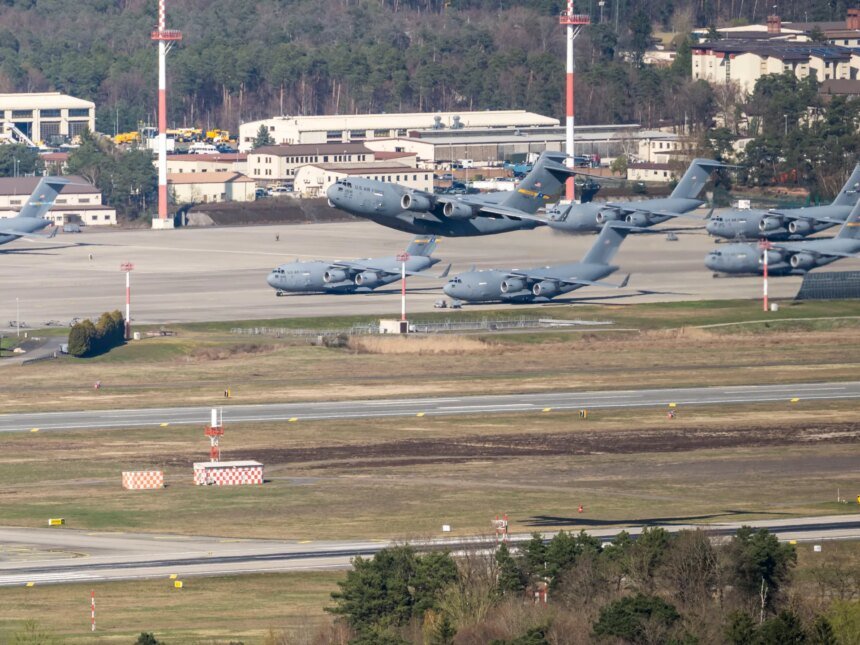
Germany is the most important center for the American presence, as it includes major military bases and installations, including the Ramstein Air Base and command and training centers in Bavaria and Stuttgart. It is also a command and logistics center for American operations in Europe and beyond.
Italy hosts several bases in the cities of Vicenza, Naples, Aviano and Sicily, serving US and NATO operations in the Mediterranean, Balkans, North Africa and the Middle East.
Britain also hosts an important air and intelligence presence distributed among major bases and installations used by American forces, within a broader network of British defense and intelligence sites used by the United States.
While Spain, especially the Rota base, constitutes an essential sea and air point near the Mediterranean and the Atlantic.
The American presence is centered in Eastern Europe, in Poland, Romania, Hungary, the Baltic states, Bulgaria, and Slovakia, often through rotating forces or units within NATO arrangements, and not through huge, permanent American bases such as those found in Germany or Italy.
This deployment comes within the framework of strengthening the eastern wing of the alliance after Russia’s annexation of the Crimean Peninsula in 2014, and then the outbreak of the Russian-Ukrainian war in 2022.
Number of American soldiers
According to data reported by Reuters based on the Pentagon’s Manpower Data Center, the United States had about 68,000 permanent military personnel in Europe as of December 2025, without counting rotating or temporary forces.
Germany hosts the largest number, with 36,436 military personnel, followed by Italy with 12,662, Britain with 10,156, then Spain with 3,814 military personnel.
Poland also hosts 369 active-duty personnel stationed permanently, in addition to about 10,000 members of rotating forces funded under the European Deterrence Initiative, according to information from the Center and the Congressional Research Service. These individuals are stationed at 4 bases that allow the United States temporary entry.

Romania also hosts a rotating presence of US forces, in addition to 153 active-duty personnel stationed permanently, according to information from the Center and the Congressional Research Service.
The bases that the United States has the ability to use include the Mihail Kogalniciano air base, Campia Torzi, and Divisello.
These numbers do not reflect the entire actual American presence on the continent, because Washington also maintains rotational forces (units that are sent for specific periods as part of training or missions to deter and reassure allies, and then are replaced by other units) that participate in training and deterrence missions, especially in the Baltic states.
After the outbreak of the Russian-Ukrainian war, the American presence in Europe rose to about 100,000 military personnel in some periods, before Washington later began reducing some temporary deployments.
The American military presence in Europe began after World War II, then became established during the Cold War as part of a strategy to deter the Soviet Union and protect Western Europe.
After the collapse of the Soviet Union, the number of American forces decreased significantly, but it did not disappear, because European bases turned into command, transportation, training, and support platforms for American operations in several regions, including the Balkans, the Middle East, and Africa.
The US European Command says its role includes supporting NATO, deterrence, coordination with allies, and carrying out military, humanitarian and security operations.
Since 2014, “deterrence against Russia” has returned to the forefront of the goals of the American presence in Europe.