In two incidents thousands of kilometers apart and only a few hours apart, the United States and Russia lost two long-range bombers on June 15, during two non-combat missions.
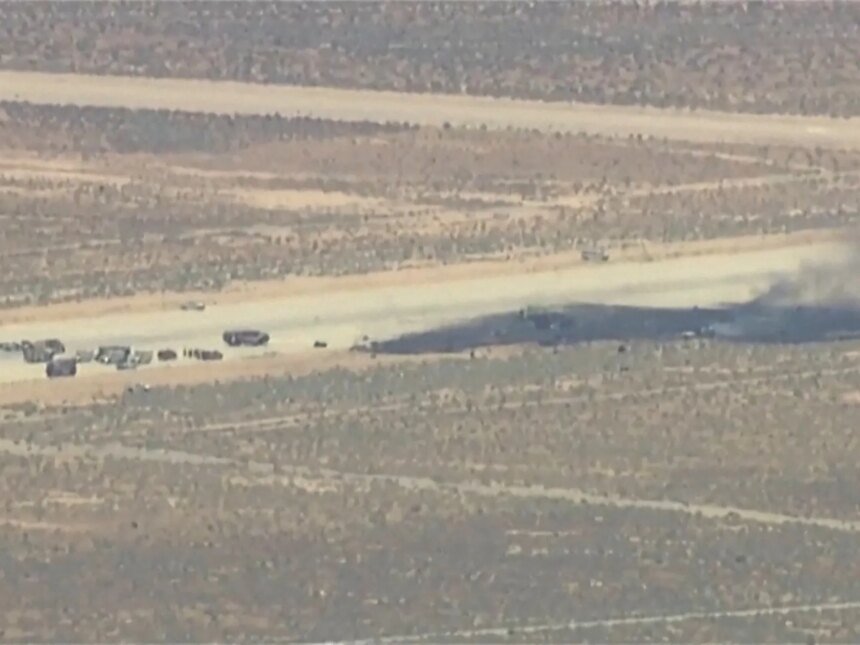
In California, an American B-52H bomber crashed after taking off from Edwards Air Force Base, killing the eight people on board.
Read also
list of 2 itemsend of list
In Siberia, a Russian Tu-22M3 bomber crashed during a training flight in the Irkutsk region, and its four crew members were able to jump and survive.
Satellite images – analyzed by the Al Jazeera Network’s Open Source Unit – showed the effects of the two accidents at the US Edwards Air Force Base and the vicinity of the Russian village of Kamenka, where clear signs of burning appeared at both sites.
B-52 crashes after take-off
A comparison between photos taken during the days from June 8 to 16 of this year reveals the appearance of a large dark area on the runway of Edwards Base, consistent with the effects of burning resulting from the crash of the American bomber, while photos from the Russian site showed the effects of fire and debris in the area where the plane fell.
The US Air Force’s Edwards Air Force Base announced that a B-52 Stratofortress bomber, carrying 8 people, crashed at approximately 11:20 a.m. on June 15, local time, shortly after take-off.
The plane, a B-52H, was carrying out a routine test mission in support of the radar modernization program for the US bomber fleet, before it crashed and caught fire near the runway.
Base officials later confirmed that all those on board the plane had been killed, including military personnel, government civilian employees, and contractors who participated in the test mission.
Edwards Base Deputy Commander, Colonel James Hayes, said that the plane crashed immediately after take-off, and that a review of the accident recordings showed that it was not possible to survive it.
The runway was closed following the accident, and the US Air Force began a technical investigation to determine its causes. At the time of preparing the material, the base had not announced final results regarding the cause of the crash.
America’s oldest bomber
The B-52 Stratofortress entered service with the US Air Force during the 1950s, and remains a pillar of the United States’ strategic air power.
The aircraft can carry out long-range conventional and nuclear missions, and is currently undergoing modernization programs that include radar, engines, communications and electronic warfare systems, with the aim of keeping it in service during the coming decades.
This context gives the incident additional importance, as it occurred during a mission related to the modernization program of one of the oldest operating bomber fleets in the world, and not during a combat operation.
Tu-22M3 crashes in Siberia
On the same day, the Russian Defense Ministry announced the crash of a Tu-22M3 bomber during a training flight in the Irkutsk region of Siberia.
The ministry said that the plane was approaching landing at Belaya Air Base when it fell near the village of Kamenka, stressing that it was not carrying ammunition or combat load.
Satellite images from the Russian website showed traces of fire and debris in the area where the plane crashed, consistent with the account of the crash near a limited populated area.
The four crew members were able to eject using life preservers, and were taken to hospital with injuries described as non-life-threatening.
The Ministry confirmed that no injuries were recorded among residents or damage to facilities on the ground.
The governor of the Irkutsk region, Igor Kobzev, said that emergency and firefighting teams arrived at the site of the fall and controlled the fire, noting that preliminary information suggests a malfunction in one of the engines, but this hypothesis remains preliminary pending the completion of the technical investigation.
Russian hypersonic bomber
The Tu-22M3 is a Soviet-made long-range hypersonic bomber, used to launch long-range missiles. Its design dates back to the Soviet era, but it has undergone successive updates that include navigation, armament, and electronics systems.
The Russian fleet of this type has recorded operational accidents and combat losses in recent years, making the Irkutsk accident a new episode in a long record of technical and operational pressures on this type of bomber.
Two accidents, two different outcomes
Although the two incidents occurred on the same day and during two non-combat missions, their results were widely different.
In the American accident, a routine test mission turned into a disaster that resulted in the death of everyone on board the bomber, while in the Russian accident, the crew members survived after jumping from the plane before it crashed near the village of Kamenka.
Satellite images reveal traces of burning and debris at the two sites, but they do not provide evidence of the causes of the crash, so the final conclusions remain linked to the two technical investigations opened by the military authorities in the United States and Russia.