Published on 6/17/2026
When we hear the word “silk,” that soft fabric used in luxury clothes immediately comes to mind, but what many people do not know is that silk is also one of the most complex natural materials at the molecular level, to the point that has prompted scientists today to transform it into an advanced material that may be used in the future in sixth generation networks, aircraft, and medical devices.
The recent study, published in the journal Nature Sustainability and led by researchers from Imperial College London, Michigan and Tufts Universities in America, did not rely on manufacturing a completely new chemical substance, but rather on reshaping natural silk itself in a different way that preserves its unique properties and gives it additional functions.

Why choose silk?
Scientists chose silk because its natural composition is exceptional compared to most other biological materials. At the microscopic level, it consists of very organized crystalline regions that give it strength, and irregular regions that give it flexibility. This combination of “order” and “randomness” is the secret of the ability of a very thin silk thread to bear large weights without breaking easily.
Previous attempts to convert silk into solid materials relied on completely dissolving the silk in chemical solvents, then drying it and turning it into a powder, before re-compressing and shaping it.
Although this method was partially successful, it was destroying an important part of the natural crystal structure responsible for the strength of silk, so the new idea seeks to preserve the original silk structure, and instead of destroying the silk threads and then rebuilding them, the researchers tried to preserve the natural structure as much as possible.
To achieve this, the process began with a relatively simple step, which was boiling the silk threads to remove a natural substance known as “sericin,” which is the protein that binds the fibers together inside the silkworm cocoons. After removing this substance, the fibers were ready for the most important stage, which is “tremendous heat and pressure.”
During this stage, the scientists heated the silk to temperatures ranging between approximately 125 and 215 degrees Celsius, then subjected it to extremely intense pressure that reached thousands of atmospheric pressures. At this stage, three very important transformations occur: The first is “water evaporation.” Natural silk contains small amounts of water within its microscopic structure, and upon heating this water gradually evaporates. The second transformation is “merging of random areas.” Irregular areas within the fibers begin to fuse together, and the separate threads turn into A cohesive plastic-like sheet.
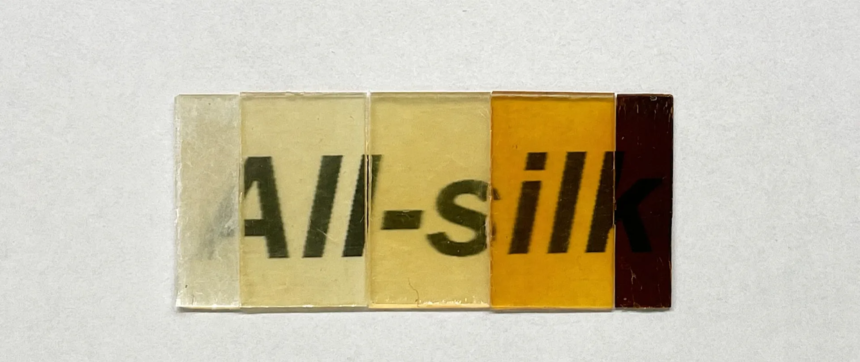
The third transformation is “preserving the crystalline areas,” and here lies the secret of the real achievement. Despite the heat and pressure, the scientists succeeded in preserving the fine crystalline structure inside the silk, which is responsible for the mechanical strength, flexibility, and distinctive optical properties. Thus, they obtained a material that is solid but flexible, light yet strong, in addition to being transparent and capable of controlling light waves.

Why does the material look like plastic?
The researchers say in an official statement published on the official website of the University of Michigan that their new material looks like industrial plastic in shape, but it has industrial and environmental advantages that far exceed it.
The researchers explain, “After pressure and heating, the traditional filamentous structure of silk disappears, and it turns into smooth, transparent sheets that resemble industrial plastic, but the main difference is that the new material is derived from a natural source, is biodegradable, and does not depend on fossil fuels like traditional plastic.”
They add that their material is able to control light, because while rearranging the internal structure of the silk, the fibers maintained their coiled and organized shape at the nanoscale level, and this precise organization allows the material to interact with “terahertz” waves, which are high-frequency light waves that are expected to be the basis of future communications technologies.
Most importantly, the material can rotate the direction of light vibration, or what is known as “light polarization,” which is a very important property in increasing data transmission capacity, improving the efficiency of sixth generation networks, and developing advanced optical sensors.
Better than bioplastic
Regarding the comparison between the new material and traditional types of bioplastics, the researchers explain that most of the current types of “bioplastics” are less strong than industrial plastics and require many chemical additives, in addition to being difficult to recycle.
The new material combines high strength, light weight, sustainability, and advanced optical properties. Indeed, penetration tests have shown that its resistance is close to that of carbon fiber-reinforced materials used in aircraft structures, cars, and military applications.
Researchers are currently working on manufacturing the material in larger sizes, producing complex geometric shapes, integrating it into electronic devices and sensors, and evaluating its commercial and environmental feasibility.