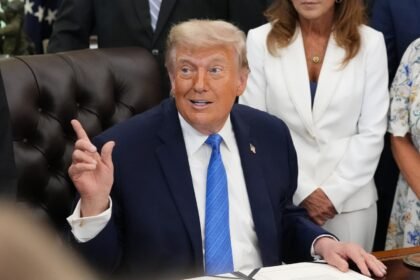
US President Donald Trump’s announcement of the agreement with Iran was not met with the warmth he expected.
It was announced on Sunday that an agreement had been reached to extend the ceasefire between the United States and Iran for a period of 60 days, which includes gradually reopening the Strait of Hormuz and starting negotiations on the nuclear file in exchange for easing sanctions.
The agreement that Trump seeks to market as a major political achievement actually reflects the limits of military power
Analyzes continued in newspapers around the world, some of them trying to refute the roots of the widespread dissatisfaction with the agreement, while others added their voice to the critics, stressing that the new understanding does not address the basic causes of the conflict, and that the possibilities of a return to confrontation still exist.
Read also
list of 2 itemsend of list
In this context, two British writers approached the agreement from two different angles: The first focused on the fact that the war ended without a clear victor, and the second went further by saying that the real beneficiary of the crisis may be a party that did not participate directly in it, which is China.

The parties involved did not win
Gideon Rachman, chief foreign affairs commentator for the British newspaper the Financial Times, believes that the agreement that Trump seeks to market as a major political achievement actually reflects the limits of military power and the failure of the warring parties to achieve their ultimate goals.
Israel is not satisfied with the announcement, and believes that Tehran has succeeded in linking the opening of the Strait of Hormuz to a ceasefire in Lebanon, which has tied the hand of the Israeli army against Hezbollah.
With the Israeli elections approaching, and in light of the Israelis’ dissatisfaction with the ceasefire, Prime Minister Benjamin Netanyahu may return to the offensive, according to the writer’s opinion.
Hardliners in the United States also expressed their dissatisfaction with the agreement, as they aspired to change the government in Tehran or at least completely dismantle the Iranian nuclear program, but neither of these goals was achieved.

Rachman says that the agreement reflects a growing American awareness that the military option is no longer able to achieve the desired results, or impose a reality consistent with Washington’s vision.
On the other hand – the author continues – the hard-liners in Iran reject the peace framework, and many of them doubt the feasibility of making concessions to America in exchange for promises to lift sanctions, especially since Congress may ultimately reject the proposal.
Rachman points out that the anger of extremists on various sides is the clearest evidence of the true nature of the agreement: a forced settlement imposed by the absence of a clear victor.
The war did not achieve Washington’s goals, did not give Israel a decisive victory, and did not allow Iran to fully impose its conditions. That is why the temporary conflict ended in a compromise with which neither party was fully satisfied, according to the article.
The real victor
But if almost everyone emerged from the war with completely unsatisfactory results, who benefited from it?
Here Sean O’Grady, associate editor at The Independent newspaper, offers a different answer, as he believes that the biggest winner in this crisis is not the United States, nor Israel, nor even Iran, but rather China.
While the United States seemed mired in escalation, threats, and retreat, Beijing was able to present itself as a force seeking stability and economic cooperation.
O’Grady believes that the war revealed to the world the limits of American military and diplomatic power, as Washington entered the conflict talking about “changing the Iranian regime” and forcing it to surrender, but it ended in a temporary agreement that did not achieve those goals.
From his point of view, this weakened the image of the United States as a force capable of imposing its will in the Middle East.

On the other hand, China emerged in a completely different way. While the United States seemed immersed in escalation and threats and retreating from them, Beijing was able to present itself as a force seeking stability and economic cooperation.
The writer says that an increasing number of world leaders have come to view China as a more reliable partner compared to the United States, and thus one of the results of the war was the acceleration of the rise of Chinese influence and the decline of American hegemony.
O’Grady also believes that Iran itself emerged from the war more than its opponents expected, not because it won militarily, but because it demonstrated its ability to influence the global economy by threatening to close the Strait of Hormuz.
It is believed that this card has become a strategic deterrent element that is no less important than the nuclear program itself.
The writer concludes that the Trump agreement may have succeeded in stopping the fighting temporarily, but it did not change a deeper truth that emerged during the war, which is that the balance of international influence is witnessing a gradual shift.
In the end, the two articles converge on a basic conclusion: the current agreement does not represent an American victory nor an Iranian defeat.
While the conflicting parties argue about whether they won or lost, China appears to be the hidden winner, which has strengthened its international standing without directly participating in the battle.