Published on 6/14/2026
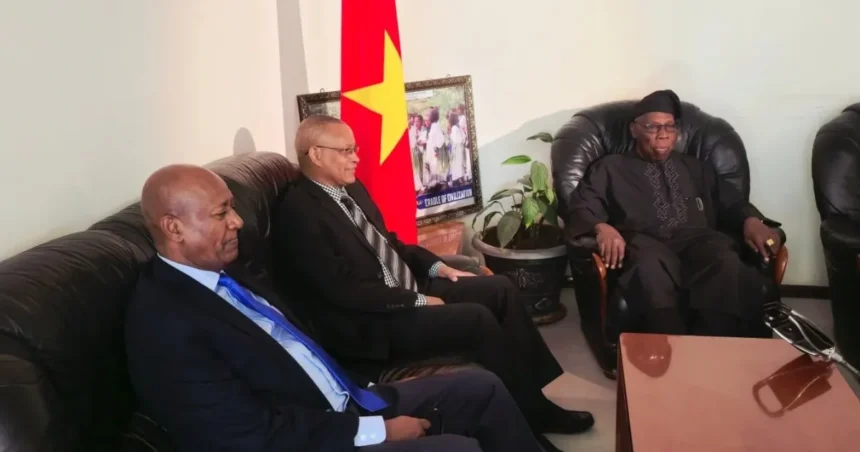
Former Nigerian President Olusegun Obasanjo, High Representative of the African Union for the Horn of Africa, arrived last Thursday in the city of Mekele, the capital of the Tigray region in northern Ethiopia, at the head of an international delegation that included envoys from Australia and the United Kingdom. He met with the head of the Tigray People’s Liberation Front, Debretsion Gebremichael, where the talks focused on two main priorities: preventing a return to war, and evaluating the implementation of the Pretoria Agreement signed in November 2022 between the federal government and the Front, which ended a two-year conflict in the north of the country.
The visit coincided with an atmosphere of renewed tension, as residents and local officials reported a drone strike near the town of Sheraro, northwest of Tigray, last week, targeting an area known as “Tekimati.” The regional authorities accused the federal government of responsibility, stressing that it resulted in deaths and injuries among Tigray forces and property damage, describing it as a violation of the Pretoria Agreement and a warning of preparations for new military action.

On the third of this month, days before the visit, the Tigray People’s Liberation Front sent a letter to diplomatic missions and the African Union calling for international action to address its differences with the federal government. The Front’s spokesman, Michele Asjdom, explained that the restrictions imposed on fuel supplies and commercial activities exacerbated the economic burdens on the region’s residents, while the Front accused the government of not fulfilling some of its obligations under the Pretoria Agreement, and questioned the effectiveness of the institutions supervising its implementation.
In parallel with Obasanjo’s visit, the Director of the Ethiopian National Intelligence and Security Service, Redwan Hussein, and the Prime Minister’s Advisor for East African Affairs, Getachew Reda, published a joint article on the Al Jazeera English website, claiming that the Tigray People’s Liberation Front is preparing to launch a new attack on federal forces. The article referred to meetings held by regional bodies in Asmara, Mekelle and Sudan to coordinate military and political activities that went beyond discussion to actual preparedness through recruitment, training and arming, while accusing Eritrea of providing logistical support for these efforts, despite the refusal of large sectors of citizens to return to war.
After his meeting with the leaders of the region, Obasanjo described the talks as “constructive,” affirming the African Union’s commitment to supporting peace and stability in northern Ethiopia, and stressing that lasting peace is a basic condition for the country’s long-term development. He explained that the delegation would continue its consultations in Addis Ababa with federal officials. For his part, the leader of the Tigray Front, Ambassador Adis Alem Balema, who participated in the talks, said that the regional authorities stressed the need to take practical measures to protect civilians and maintain peace, while local officials pointed out the continued suffering of large numbers of internally displaced people who were unable to return to their homes.
The visit comes in light of the escalation of political tension between the regional leadership and the federal government regarding issues of governance, administration, and implementation of the peace agreement, which was reflected in Tigray’s non-participation in the elections held in Ethiopia at the beginning of this June. Debrecen Gebremichael announced last May that elections would not be held in the region, explaining that large areas of Tigray were still outside the control of the local administration due to unresolved border disputes. A few weeks ago, Debrecen was sworn in as president of the region after a vote to reactivate the Tigray Council, which Addis Ababa does not recognize, at a time when the interim administration stipulated in the Pretoria Agreement is still in place, which explains his reception of Obasanjo in Mekele.