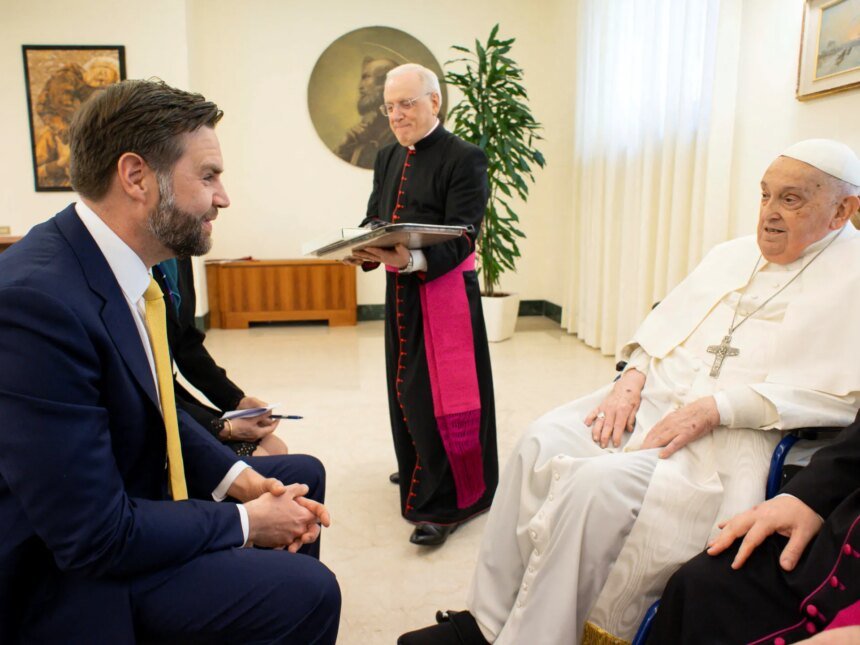
The short meeting between J.D. Vance – US Vice President – and the late Pope Francesco, hours before his death, was not just a passing meeting during his visit to the Vatican in April 2025.
The words that Vance later revealed in his new memoirs about his meeting with Vatican officials before his meeting with the Pope revealed a deeper tension between the American right and the moral vision of the Catholic Church on the issues of immigration and wars.
Read also
list of 2 itemsend of list
Vance’s new book, entitled “The Sacrament… My Journey Back to Faith,” narrates his intellectual and religious journey, from his upbringing in evangelical Christianity during his childhood to his adoption of atheism in his youth, before he converted to Roman Catholicism in 2019.
The memoirs also address De Vance’s political journey from a fierce opponent of US President Donald Trump to his deputy in the White House, to becoming one of the most prominent potential candidates to succeed him, in a shift that is seen as reflecting broader changes witnessed by the American conservative right.
Criticism of the Vatican
In his new book, the US Vice President criticized Vatican officials, while expressing positive opinions towards both the late Pope Francis and the current Pope Leo XIV, according to what was reported by the Washington Post.
These memorandums came in the wake of efforts made by American and Vatican officials to reduce tensions between the two sides, following ongoing disputes between them over the past year and a half.
Vance believed – as the report explains – that Vatican officials were too diplomatic during the meeting, and avoided directly addressing the details of the controversial issues between the United States and the Vatican.
The Vice President noted that Vatican officials recognized the United States’ right to secure its borders, but at the same time called on the Trump administration to treat migrants humanely, according to the Washington Post.

“I was there as the highest-ranking Catholic official in the United States government, and yet the Vatican seemed unwilling to extend its moral guidance beyond cliches,” Vance continued, adding that diplomats “never specified” what specifically they objected to in US immigration policies.
He added, “I was astonished that one of the few institutions with the moral authority and global vision to address the issue of immigration seemed so afraid of making any position that might raise controversy, that it actually chose to say nothing at all.”
Regarding the late Pope Francesco and the sometimes public disagreements their relationship witnessed, Vance wrote: “Each of us had different responsibilities, but I preferred his direct sermons to the ambiguity I encountered during our meeting (with officials) in the Vatican.”
However, the Vatican’s position later became a more direct point of tension during the reign of Pope Leo

Return to faith
In an analytical article in the magazine, journalist Vivian Salama points out that the book traces Vance’s path from a state of gradual distancing from religion and doubt about faith during his early years, to his eventual embrace of the Catholic doctrine, whose teachings he believes began to interest him on an intellectual level as he grew older.
But Vance does not limit himself to narrating his own faith journey, but rather goes beyond it to provide comments about the spiritual health of the United States, in a proposal that is largely consistent – according to the author – with common assessments among the religious right.
The Vice President describes the United States as a nation that has lost its Christian foundations, considering Christianity “America’s faith,” while acknowledging that one does not have to be a Christian to be an American, adding that the Republican and Democratic parties are “guilty of abandoning the Christian legacy of our civilization.”
He added that this shift had an impact on issues such as marriage and birth rates, saying: “Our abandonment of Christian culture coincided with a clear decline in our collective will to live.”
Potential heir
The book also deals with – as the journalist explains – another transformation in Vance from a fierce opponent of Trump to his deputy, a transformation that he justifies by saying that it was not motivated by political ambition, but rather the result of a conviction that Trump has proven his competence as president, but at the same time he acknowledges that he does not expect everyone to believe this interpretation.
A large part of the book is reflections on moral and spiritual issues, in what appears to be an indirect attempt to highlight his difference from the current president, a position for which Vance is widely expected to seek candidacy in two years, according to the magazine.
Although the book does not directly address whether the Vice President intends to run in the 2028 elections, it provides some indications, as he adopts a calmer tone compared to the style he often adopted in his digital debates against his opponents on social media.
Vance points out that he was criticizing Trump – about 10 years ago – from a conservative perspective while defending his voters, considering that criticizing Trump constituted a kind of “social immunity.”
By the time he ran for the Senate in 2022, Vance had fully integrated into the trend of Trump supporters, and thanks to his support, he was able to win the seat. He mentions in his book how he was astonished when, just two years later, he found himself on Trump’s short list of vice-presidential nominees.
Salama believes that if the Vice President runs in the 2028 elections, he will have to confront how he will implement his principles during his period of service with Trump. Courting the current president once seemed like an appropriate political bet, but it no longer seems that way as his popularity declines.
The article concludes that the Vice President will soon have to determine how much loyalty he can afford, as these transformations may not be the last in his political career.