Published on 6/16/2026
|
Last update: 22:28 (Mecca time)
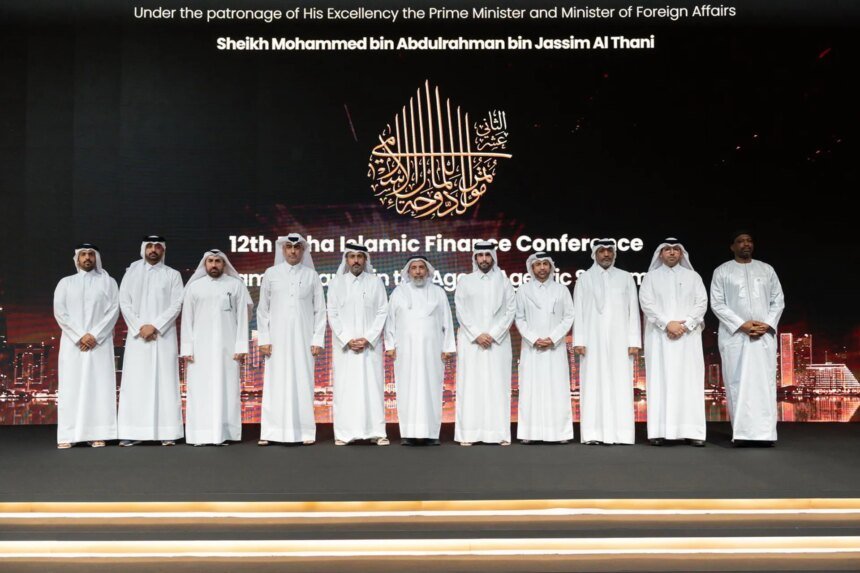
The Twelfth Conference on Islamic Finance, which concluded its work in Doha today, Tuesday, concluded with a jurisprudential description of intelligent agent systems (agent artificial intelligence) as being consistent with an “agency contract” whose provisions vary depending on its forms, and whose cases are not organized under a single jurisprudential condition.
The recommendations of the conference – whose slogan this year was ““Islamic Finance in the Era of Proxy Systems” – that the decisions of the jurisprudence councils, the Sharia standards, and the general provisions for the applications of proxy systems contain the decisions of the councils and the Sharia standards, the general provisions for the applications of proxy systems, and that smart contracts contain “the pillars of the Sharia contract, and the Sharia ruling for these contracts varies according to the diversity of their uses and the technical platforms and means through which smart contracts are implemented.”
Read also
list of 4 itemsend of list
Conference participants stressed the importance of accelerating digital transformation in sukuk markets by adopting smart sukuks, blockchain technologies, and solutions supported by artificial intelligence in accordance with Sharia controls, in a way that enhances efficiency and transparency, reduces costs and expands access to markets.
Standard frameworks
The conference called on Islamic institutions, regulators, Sharia scholars, and artificial intelligence researchers to “develop unified and interpretable standard frameworks for governance and auditing, ensuring the combination of self-decision-making capabilities, continuous compliance with the provisions of Sharia, and achieving transparency, flexibility, accountability, self-decision making, and continuous compliance with Islamic Sharia.”
The recommendations of the Islamic Finance Conference in the Qatari capital extended to the field of endowments, as conference participants proposed adopting models of supervised smart agents to develop the endowment sector, by integrating interpretable artificial intelligence techniques with blockchain records to enhance transparency and trust, and drafting software governance charters that transfer the donor’s condition to solid, unmodifiable algorithms, while the human overseer remains the one with final legal responsibility and legitimacy, in a way that achieves a balance between technical efficiency and jurisprudential purposes, and protects endowment assets from cyber or computer risks. Algorithmic deviations.”
The conference was held under the patronage of Qatari Deputy Prime Minister and Foreign Minister Sheikh Mohammed bin Abdulrahman Al Thani, and organized by Bait Al Mashura Financial Consulting Company in a strategic partnership with Qatari Dukhan Bank. The conference witnessed the announcement of the launch of the Doha Islamic Finance Conference Award, which is a global initiative aimed at honoring exceptional achievements in the Islamic economics and finance sector.

Accelerated transformations
Khalid bin Ibrahim Al-Sulaiti, Chairman of the Organizing Committee and Vice Chairman of the Board of Directors of Bait Al-Mashura Financial Consulting Company, said that the conference comes at a time when the world and the region are witnessing rapid transformations in which the economic, technical and geopolitical dimensions overlap in an unprecedented way.
Al-Sulaiti added that recent events have shown how limited developments in their geographical scope can quickly extend their effects to global markets and the movement of trade and energy, pointing to the role of proxy systems as one of the most prominent tools relied upon to accelerate response to changes, as they are capable of analyzing a huge amount of data and data, interacting with them, and making decisions in record times.
On the other hand, Sheikh Abdullah bin Fahd bin Jassim Al Thani, Chairman of the Board of Directors of Dukhan Bank, warned that the world today is witnessing a qualitative shift in the nature of smart technologies, as digital systems are moving towards advanced levels of analysis, interaction and decision-making, making proxy systems one of the most prominent driving forces of the next stage.
He pointed out that these transformations are viewed “as an opportunity to strengthen the leadership of Islamic banking by employing modern technologies in line with its principles and values.”

Anticipating the effects
Hassan Al Marzouqi, Director General of the General Department of Endowments at the Qatari Ministry of Endowments and Islamic Affairs, said during the conference, “In light of the rapid technological boom and the emergence of smart agent systems capable of independent decision-making, we find ourselves facing a new phase of transformations that affect various areas of Islamic finance and development and institutional work.”
Al Marzouqi added, “These transformations impose on us the responsibility of anticipating their legal, legal and regulatory implications, and governing these technologies and employing them in a way that achieves the interest and promotes sustainable development, within a disciplined legal framework that carefully balances the requirements of innovation and commitment to our established values.”