Published on 6/16/2026
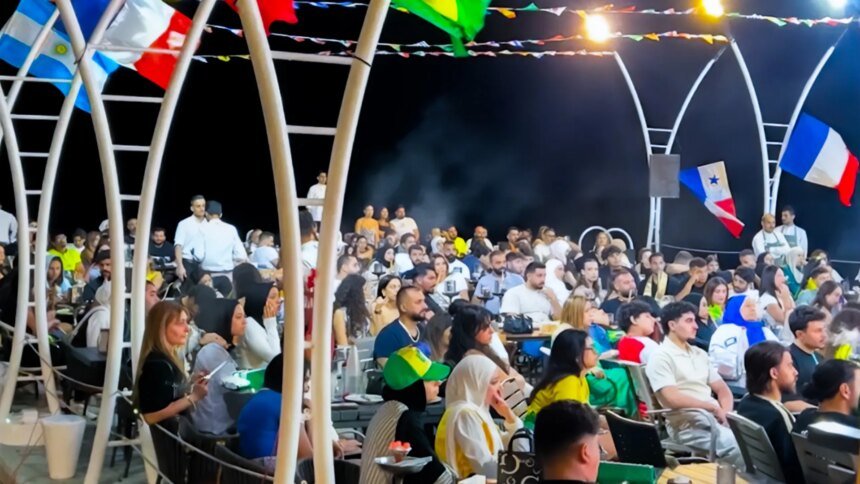
At a time when news platforms are busy reporting updates on the ongoing war and images of destruction, the screens of cafes in the Lebanese capital, Beirut, are filled with completely different colors. Where the flags of Brazil, Germany and other countries are intertwined, and the cheers of the masses are mixed with a muffled sorrow that the Lebanese are trying to hide behind an interrupted football passion.
The World Cup comes in exceptional circumstances that bring together the residents of the capital, the displaced, and expatriates under one roof, in a collective step to seize moments of joy and cling to life.
Madness of passion
Perhaps the most prominent irony of the World Cup in Beirut is embodied in the story of the Lebanese expatriate Farouk Shaheen, who appeared in a short video on the Al Jazeera Lebanon platform.
At a time when diplomatic missions were leaving Lebanon due to the situation, Farouk chose to return from France on a precisely timed vacation to be in his country during the tournament. He says: “I live in France and came on vacation to Lebanon for the World Cup. The Lebanese street has a state of magic during this occasion, which is an opportunity to change the atmosphere and challenge fear.”
Farouk has supported the German national team since childhood, and believes that the atmosphere of traditional competition with Brazilian fans gives Beirut markets a unique vitality and spontaneity that European capitals do not possess.
Psychological truce: when the displaced person takes refuge in the green rectangle
On the benches of the same Beirut café, sits Muhammad Atwi, a displaced person from southern Lebanon, summarizing the situation of thousands of families who were forcibly left their homes.
For Muhammad, who lived 15 months of suffering and under the weight of bombing in his town before facing the bitterness of displacement for more than 100 days, football matches do not seem like just passing entertainment, but rather serve as a psychological defense mechanism to mentally survive.
Atwi confirms that feelings remain mixed with sadness due to the loss of martyrs and loved ones, adding: “We are required to preserve our spirit and be happy.. Life will go on and we want to relieve ourselves, even if for a short time.”
In the same context, Muhammad Saadeh, a displaced person from the town of Bednayel in the Bekaa, points out that the crowding and enthusiasm in cafes prove the Lebanese people’s intense need for any occasion that brings them together and gives them hope.

A sport that brings together the diaspora
In the attached video clip broadcast by the Lebanon Island platform, Yasmine Fawaz, a café manager in Beirut, expressed the nature of this psychological paradox by saying: “We receive the World Cup today with heartbreak, but the people need a change in the atmosphere, and the Lebanese have a love of life and creating joy despite all the difficulties.”
Fan Anthony Sayida supports her in this, stressing that this sporting event represents a special situation that people wait for to break the monotony of the difficult situation.

For his part, Najib Fakih, the Lebanese padel champion and an expatriate in Ivory Coast, believes that the tournament represents an ideal opportunity to catch his breath and meet new companions after the war drove him from his home. He says: “I support Brazil and follow African teams, especially Morocco, due to my previous presence in Abidjan. Despite the presence of fear, everyone is looking for a normal space for life.”
Ibrahim Al-Taweel summarizes the feeling of the Lebanese street by emphasizing that people rely on God, and are trying in various ways to create an atmosphere that makes them forget their worries for a while.
Between a displaced person watching the news of his town on his phone screen during the halftime break, and an expatriate who came to defy travel warnings to live the football madness in his homeland, the Beirut World Cup proves that it goes beyond the idea of a regular sports competition; It is a document of survival that proves that football can bring people together around one screen to create hope out of the tragedies of war.