Published on 6/14/2026
|
Last update: 20:03 (Mecca time)
Some of the most important scientific achievements are not achieved by their authors, but they appear by chance, while working on the original project, as if they were rewarded for their efforts.
Researchers from the Ministry of Environment and Climate Change in Qatar were in for a treat with this type of reward. While they were continuing their efforts to protect, restore and preserve coral reefs in Qatari waters and the marine biodiversity associated with them, the “Sea Pen” surprised them with its presence in Qatari waters, during one of the field missions.
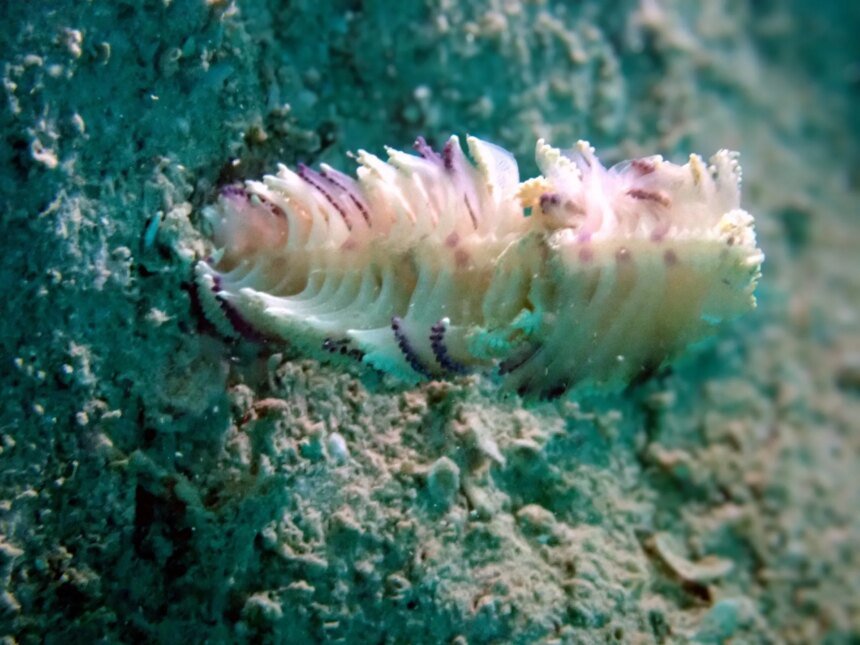
This organism belongs to the group of soft corals, and takes a shape resembling a feather or an old pen used for writing, so it is called the “sea pen.” It consists of a colony that includes hundreds or thousands of small growths (polyps), which all work together as if it were one organism.
This species is found in other parts of the Arabian Gulf, especially off the coast of Iran and Kuwait, and has not been officially recorded in Qatari waters, so its discovery for the first time in Qatar means a lot, as explains Dr. Charan Kumar Baidi, a marine biologist at the Ministry of Environment and Climate Change in Qatar, and the corresponding researcher in the study published in the journal “Regional Studies in Marine Science,” which documented this discovery.

He said in exclusive statements to Al Jazeera Net, “The presence of the sea pen in Qatari waters expands the known regional distribution of this species, and reveals that its suitable habitats may be more widespread throughout the Arabian Gulf than previously thought.”
He stresses that there is a need to conduct additional surveys in various Gulf countries and their environments to determine the full scope of the distribution of this organism, and to know whether its populations are connected or exist in the form of isolated spots.
Charan does not attribute the absence of this organism from the records documenting marine creatures living in Qatari waters to a deficiency in exploratory field mission trips, as much as it is due to the nature of the organism itself.
“Sea pens are often associated with soft-sediment habitats that receive less scientific interest, compared to coral reefs, seagrass meadows, and mangrove ecosystems,” he says. “In addition, sea pen species are relatively inconspicuous, can remain partially buried in sediment, and may be overlooked during traditional benthic surveys.”
The discovery awaits further confirmation
Scientifically, sea pens are known as “Vergularia gustaviana,” but the research team in its study added “CF” to the name, so it becomes “Vergularia CF gustaviana.” This does not mean that scientists have discovered a new species, but rather it means that they have found an organism that is strongly likely to belong to the species, but they were unable to confirm this definitively.
Charan says: “Normally, there is no doubt that what we found is the sea pen organism ‘Vergularia gustaviana’, in terms of its general appearance, the shape of the main feather-like part, the way the small appendages are distributed on it, and the part that it embeds in the sea floor, in addition to its overall size, but final confirmation requires further examinations.”
The tests he means are genetic analysis, where the use of genetic coding and molecular comparison with reference sequences will provide additional confirmation of the species’ identity.
He added, “During a field survey conducted on June 8 on Sharawah Island, a physical sample was successfully collected for further examination. Detailed laboratory analyzes are scheduled to be conducted, including a comprehensive morphological evaluation and molecular genetic studies, to confirm the taxonomic identity of the sample. The results of these analyzes will be incorporated into future research publications, and will contribute to improving our understanding of the presence and distribution of the ‘sea pen’ species in Qatari waters.”

Important roles in the marine ecosystem
This organism plays important roles in the marine ecosystem, enumerated by Charan. It creates three-dimensional structures in relatively simple sedimentary environments, providing refuge, settlement surfaces, and feeding opportunities for various invertebrates and fish. In addition, sea pens contribute to enhancing local biodiversity, increasing habitat complexity, supporting food webs on the seafloor, nutrient exchange processes between sediments and water, and providing a potential nursery environment for small organisms.
“Because fine-sediment habitats dominate large areas of the Arabian Gulf floor, habitat-forming species, such as the sea pen, play a critical ecological role,” he says.
Although Charan is pleased with this discovery, he admits that it clearly shows that there are large knowledge gaps in the field of biodiversity.
He adds, “This discovery, along with similar recent discoveries of new regional records of corals, macroalgae, invertebrates, and fish throughout the Gulf, reinforces the view that the region’s marine biodiversity has not yet been fully documented, which means continued biodiversity assessments, habitat mapping, and taxonomic studies are necessary to improve understanding of the Gulf’s ecosystems and support conservation planning.”