Published on 6/15/2026
|
Last update: 17:55 (Mecca time)
Major sports tournaments are no longer just competitions within the green rectangle, but have turned into global platforms for testing the latest security and digital technologies. In this context, it seems that this year’s World Cup, which began a few days ago and is hosted by the United States, Canada and Mexico, will be a turning point in the history of sports event management, with an unprecedented reliance on robots and artificial intelligence to monitor stadiums and secure fans.
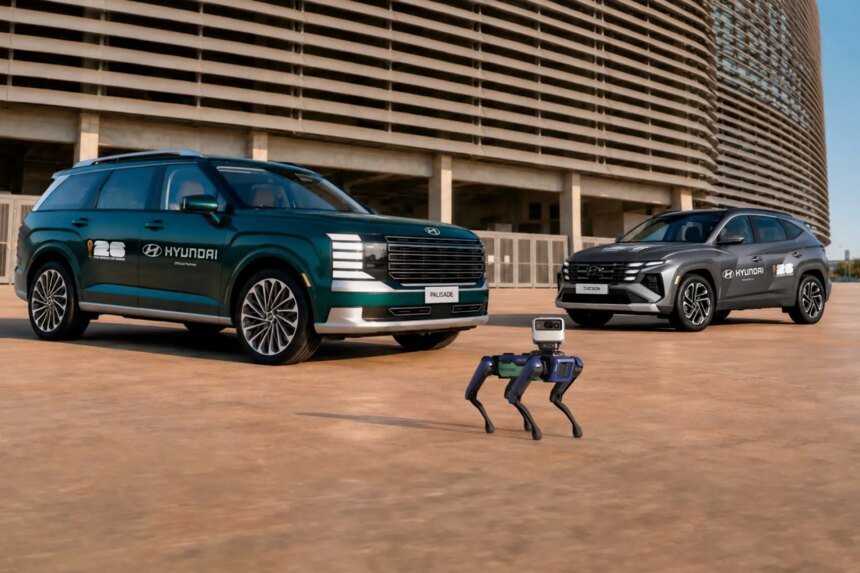
Hyundai Motor Company, the tournament’s official movement and robotics partner, announced the deployment of Boston Dynamics Spot robotic dogs for the first time in the history of the World Cup as part of the tournament’s operational and security operations.
Read also
list of 2 itemsend of list
From traditional guards to intelligent robots
Sports tournaments have long relied on human security personnel and traditional surveillance cameras, but increasing security challenges, rising crowd numbers, and the expansion of the tournament to 16 host cities have prompted organizers to search for more advanced solutions.
According to official data, 4 Spot robots will undertake the tasks of autonomous patrolling, field monitoring and continuous site inspection, especially in sensitive areas such as the International Broadcast Center in Dallas and the New York-New Jersey stadium.

These robots are equipped with advanced sensor systems and real-time inspection and monitoring capabilities that allow them to move independently within complex and crowded environments.
These robots rely on a combination of cameras, sensors and artificial intelligence to analyze the surrounding environment and detect potential dangers, which makes them capable of carrying out tasks that previously required entire human teams.
Why robotic dogs?
The Spot robot was developed by Boston Dynamics to operate in hazardous or complex environments that are difficult for humans to access quickly and safely.
Its most prominent advantages are the ability to walk over stairs and uneven surfaces, work continuously for long hours, collect data and send it instantly to command centers, carry out automated inspection tours without direct human intervention, and reach restricted or crowded areas safely.
Hyundai believes that the deployment of these robots during the World Cup represents the first large-scale application of the company’s strategy in the field of “service robots” within a huge global event.
Artificial intelligence cameras…the eye that never sleeps
The technical transformation in the 2026 World Cup is not limited to robots only, but extends to smart monitoring systems based on artificial intelligence.
Instead of just recording video, as is the case in traditional surveillance systems, modern cameras can analyze scenes in real time and extract useful information from them.
These capabilities include analyzing crowd density, detecting congestion before it becomes dangerous, identifying unusual behaviour, monitoring abandoned or suspicious objects, and sending immediate alerts to security teams.
These capabilities reflect a global trend toward what is known as “proactive monitoring,” where systems do not wait for a problem to occur, but rather try to predict it before it occurs. Recent research in the field of crowd management indicates that artificial intelligence models have become able to analyze crowd movement, predict congestion areas, and improve the distribution of security and emergency response personnel in real time.
Data-driven tournament
This year’s World Cup will be the largest in the tournament’s history in terms of the number of teams and host cities, which means that the volume of data generated from security and logistical operations will be enormous.
Therefore, data from robots, cameras and sensors are being integrated into central command and control centers that allow events across several cities to be monitored at the same time. This integration aims to improve decision-making, speed up incident response, and reduce reliance on direct human intervention.

Artificial intelligence goes beyond security
It is noteworthy that the presence of artificial intelligence in the World Cup is not limited to security only, as recent reports indicate the use of artificial intelligence techniques in arbitration, analyzing sports performance, reconstructing three-dimensional matches, and analyzing player data in an unprecedented way. Smart balls equipped with advanced sensors and technologies will also be used to improve the accuracy of refereeing decisions and provide real-time data to spectators and sports teams.
Thus, this year’s World Cup becomes a global laboratory for applications of artificial intelligence in sports, whether on or off the field.
New challenges and growing concerns
Although these technologies are widely welcomed, their use raises increasing questions about privacy and digital surveillance.
The more systems are able to analyze human behavior and collect data, the greater the concerns about how that data will be stored and used after the tournament. Some experts also warn that overreliance on smart surveillance may open the door to more expansive models of surveillance in public spaces.
In addition, the tournament faces other security challenges related to technology, most notably drones and cyber threats targeting audiences and the event’s digital infrastructure, which prompts organizers to build a multi-layered security system that combines artificial intelligence, robotics, anti-drone systems, and cybersecurity.