
Published on 6/15/2026
|
Last update: 21:41 (Mecca time)
Sudan- For the second day in a row, the Rapid Support Forces continue to burn villages and loot property in the Orshi reservoir area in Ambro locality in North Darfur, amid a mass exodus of thousands of families to neighboring areas.
The official spokesman for the Popular Resistance in North Darfur, Abu Bakr Ahmed Imam, told Al Jazeera Net that the Rapid Support Forces launched a massive attack on the region yesterday morning, using military vehicles and fighters on horses and camels.
The attack resulted in the complete burning of 8 villages, the looting and burning of the Orchi market, in addition to the looting of large numbers of livestock and household possessions.
This attack comes days after an unprecedented intensification of drone attacks on the border areas of Al-Tineh and Karnoy and their surroundings.

Operations continue
The Rapid Support Forces are still present inside the area until now, and continue to burn homes on a large scale. According to Abu Bakr Imam, andThe area is completely devoid of any military presence protecting its people.
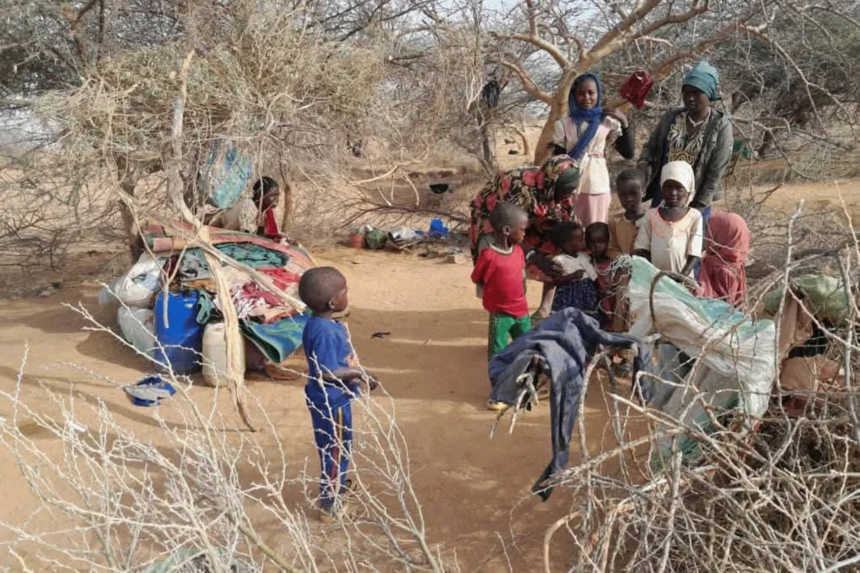
Imam pointed out that at least 5 civilians were killed as an initial toll, with others kidnapped, and thousands of families displaced to valleys and neighboring areas, living in the open under trees.
In this context, the governor of the Darfur region, Minni Arko Minawi, confirmed in a post on his Facebook page that the new crime comes as part of a “systematic strategy to change the population map in Darfur.”
On May 24, the Rapid Support marches targeted the crowded Al-Tineh market, killing 14 civilians, most of them women and children, and wounding dozens. The next day, the massacre was repeated in Krenoy, where 7 people were killed and more than 20 others were injured. The attacks also affected the areas of Ambro and its surroundings, within the framework of a gradual escalation.
On May 26, the Rapid Support Forces targeted the Baso water tank, west of Al-Tineh, killing 3 civilians and destroying the lifeline of more than 100,000 displaced and indigenous residents.
According to observers, the repeated targeting of civilian infrastructure confirms a systematic pattern aimed at destroying the necessities of life and forcing civilians to displace, which is the same pattern that was repeated in the regions of Al-Tineh, Karnoi and Ambro.
The official spokesman for the Joint Force of Armed Struggle Movements, Major Mutawakkil Ali, the agent of Abuja, told Al Jazeera Net that the targeting of water sources was not limited to the Baso reservoir, but also affected the Orchi reservoir and other areas in Ambro and Al-Tineh.

Forced displacement
The official spokesman for the Popular Resistance in North Darfur, Abu Bakr Ahmed Imam, had said in previous statements that what is happening is not random. He explained that “the destruction of water sources and the bombing of mosques did not happen by chance, but rather was a deliberate plan to dry up the sources of life and push the population towards forced displacement and demographic change.”
Over the past weeks, the regions of Al-Tineh, Karnoi, Ambro, and Orchi have witnessed successive waves of displacement, and as the Rapid Support Forces continue their incursion, citizens are living in extremely difficult conditions, in light of the absence of protection and continuing security threats.
The newly displaced people join thousands of families living in the open under trees, without shelter, food, or medicine. Also, the area that was attacked does not have a field hospital capable of accommodating the wounded, and there is no water in the burned villages, while displaced families search for any safe place under the trees of the valley, as happened in Al-Tineh, Karnoy, and Ambro previously.
War crime
This escalation comes days after the Rapid Support Forces targeted the Basso Water Reservoir, which legal experts described as a “full-fledged war crime,” under Article 54 of the Geneva Protocol 1, which prohibits the destruction of vital water facilities for civilians.
The former official spokesman for the National Forces Coordination, Musa Dawoud, described the targeting of the Orchi area and its reservoir as “ethnic cleansing and forced population displacement,” stressing to Al Jazeera Net that it was “a full-fledged war crime that was repeated in a number of regions.”
Today, the same crime is repeated in Orchi, in the same pattern as that witnessed by Al-Tina, Kernoy and Ambro, and in a more brutal manner by burning entire villages, looting markets, and forcibly displacing residents.
Al Jazeera Net tried to contact the Rapid Support Forces to comment on these accusations of targeting civilians, burning villages, and displacing residents in the areas of Al-Tineh, Karnoi, Ambro, and Orchi, and did not receive a response until the moment of preparing this report.
From Al-Tineh to Kornoui, from Kornoui to Ambro, and from Ambro to Orshi, the pattern of targeting is repeated: bombing with marches, then burning of villages, then looting of markets, and finally the displacement of the population.
While thousands of displaced people continue to sleep under trees in the open, and the bodies of the dead are left under the rubble without burial, the question remains: How many more villages will be burned? How many families will be forced to flee before the international community takes action to stop these serial crimes?