The state of political and racial polarization is escalating in the United Kingdom, against the backdrop of developments in the case of the murder of young Henry Novak, amid warnings that the far right will exploit the incident to promote its anti-minority and anti-immigrant rhetoric.
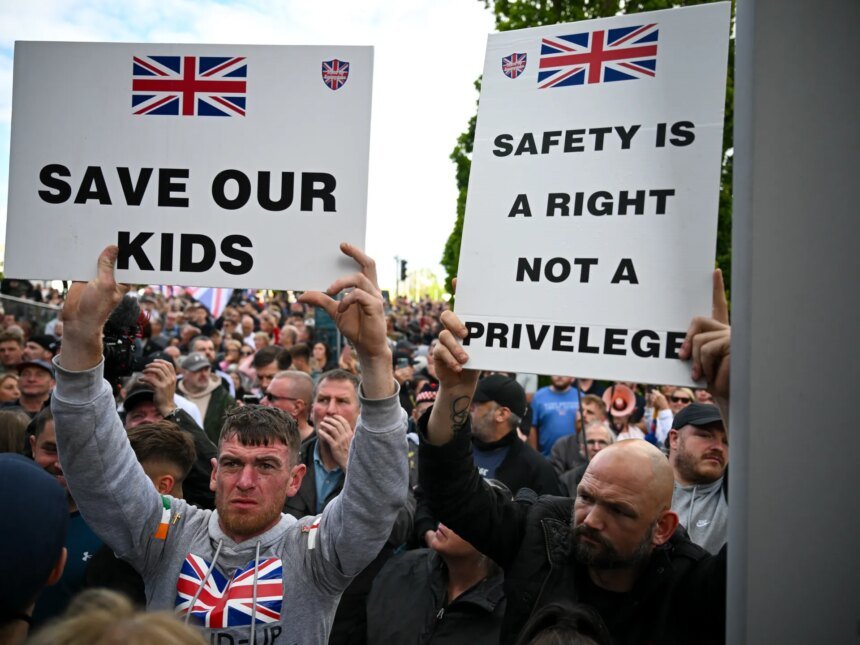
The killing of the young white British man, and the ensuing controversy over the police’s treatment of him, sparked a wave of angry protests that turned into acts of violence, in which a number of far-right leaders, anti-immigration influencers, and figures known for their affiliation with fascist movements participated.
Read also
list of 2 itemsend of list
Analysts warned that political figures seeking to use this tragic death in their political discourse may contribute to escalating popular anger and increasing the possibility of violence, pointing to the call of the leader of the right-wing Reform UK party, Nigel Farage, to express “tremendous anger.”
The incident occurred in the city of Southampton (southern England) last December, when Vikrum Digha, a member of the Sikh minority, stabbed Novak. Subsequently, police officers handcuffed Novak after believing the perpetrator’s allegations that Novak was the aggressor, and he later died from his wounds.
Body-mounted surveillance camera footage, published this week in conjunction with the perpetrator’s sentencing to life imprisonment, showed officers handcuffing Novak while he repeated the phrase “I can’t breathe,” according to British media.
These developments resulted in widespread controversy over police working methods and whether anti-racism policies played any role in the police’s failure to deal with Novak.
Was race a reason?
In this regard, The Guardian newspaper points out criticism from the right-wing movement that the police’s preoccupation with anti-racism policies played a prominent role in the failure of the officers at the scene of the accident to properly assess what happened.
But the Guardian confirmed – in a report based on an analysis of the evidence and interviews with police experts – that this narrative ignores fundamental aspects of the circumstances that led to a series of serious failures by the police at the scene of the incident.
Criticism has focused in particular on a document issued by the National Council of Police Chiefs last year entitled “Police Commitment to Combating Racism,” outlining actions police chiefs will take to reduce racial bias.
However, the Council clarified that the document does not represent an official policy nor a training guide for officers, and the newspaper also quoted an informed source that a small number of senior officers, as well as police officers in the field, are aware of its existence at all, let alone use it as guidance in their daily work.
Neil Basu, former head of Britain’s counter-terrorism unit, says police must take allegations of racial motivation seriously, but that does not automatically mean believing any claim that a crime was committed out of hate.
There are no official statistics proving the existence of anti-white bias in policing practices, while available data indicate persistent racial bias against ethnic minorities, especially blacks, according to the report.
Basu adds – to the Guardian – that the police made repeated promises to address racial bias, but the improvement remained limited or almost non-existent, describing the allegations that the police overreacted to evidence related to bias against blacks through bias against whites as “laughable.”
Basu continued, “How can we talk about an exaggeration in reaction to an issue that received no significant reaction?”
Regarding other factors that might explain the police’s treatment of Novak, the report quoted the trial judge as saying that the police remained until late “unaware that Novak had a serious chest wound.”
The Guardian pointed out that current and former police sources unanimously agreed on the lack of “professional curiosity” among the officers at the scene of the incident, which was evident in the recordings of cameras installed on their bodies, while questioning the decision to handcuff Novak.

Exploitation of the extreme right
While ordinary citizens participated in the demonstrations that took place in the city of Southampton on Tuesday evening, expressing their anger at the killing of Novak and the police’s treatment of him, many far-right leaders gave angry words during the protests, according to what the Guardian reported.
On the other hand, local leaders expressed their fears that right-wing extremist groups had transported participants from outside the city to attend the demonstration.
Among the speakers was far-right activist Tommy Robinson (whose real name is Stephen Yaxley-Lennon), who claimed that the police handcuffing Novak reflected “a difference in the way whites are treated compared to non-whites,” according to the report.
Paul Golding, leader of the far-right anti-immigration and anti-Islam “Britain First” party, who was a former member of the British National Party, also participated in the demonstration.
Golding called on the protesters to “turn their anger into political action,” claiming that the police are not dealing with “the real criminals who are turning Britain into a foreign country,” as he put it.

“British George Floyd”
In an article in the Independent newspaper, writer Sean O’Grady says that the Novak incident brought to mind the case of George Floyd, noting that the phrase “I can’t breathe” that Novak repeated in his last moments is reminiscent of the Floyd tragedy.
But the writer warns of the far-right’s efforts to portray Novak’s killing as Britain’s “George Floyd moment,” noting that Farage exploited the incident to link it to unrelated allegations about “anti-white racism,” “two-level society,” and “mass immigration.”
O’Grady points out that the killing of the young British man does not prove Farage’s claims, adding that there is not yet conclusive evidence that explains the reasons for the police’s negligence or proves that the matter is related to anti-racism policies.
The writer also believes that Farage should have acknowledged that the judiciary sentenced the perpetrator to life imprisonment, which means that justice was achieved – even partially – in favor of the victim, and in contradiction to some allegations that claim that the perpetrator was treated leniently.
The writer concluded that resorting to riots would not contribute to improving the situation, warning against allowing the “horrific” killing of Henry Novak to become a spark for an escalating political conflict.