Published on 6/16/2026
The US-Iranian agreement to stop the war and open the Strait of Hormuz and the Russian-Ukrainian war dominated the discussions of the leaders participating in the summit of the Group of Seven major industrialized countries in France.
The Group of Seven summit – which includes Britain, Canada, France, Germany, Italy, Japan and the United States – will be held from Monday until next Wednesday, at a resort in the French city of Evian.
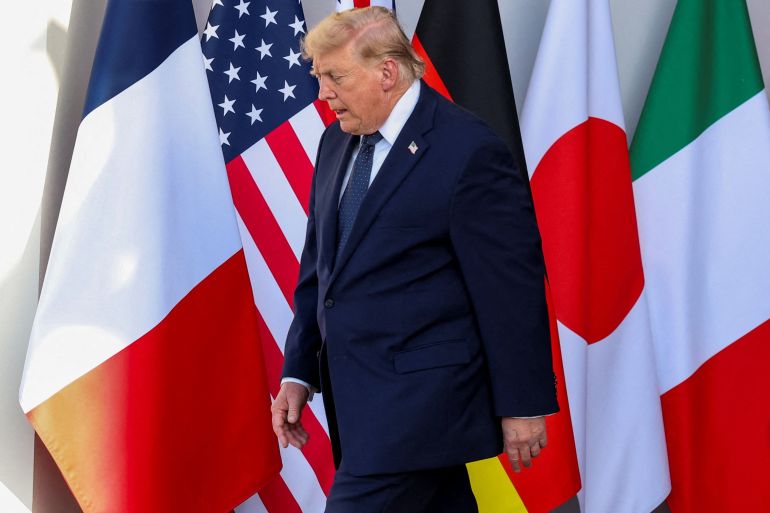
At the beginning of his participation in the summit meetings, US President Donald Trump praised the agreement signed with Iran last Sunday, considering that it “constitutes a potential breakthrough in global security.”
Turn a page
During his meeting with French President Emmanuel Macron, Trump said that the agreement heralds that the United States will turn the page on tense relations with its old adversary, Iran.
He added, “I believe that many good things will happen in the Middle East now, and the most important thing is the decline in oil prices and the rise in stock prices like a rocket today.”
During the meeting, the French President congratulated Trump on reaching an agreement with Iran, saying that the understanding was “a very important issue for peace in the entire world.”

Discussions regarding the Strait of Hormuz
News regarding the reopening of the Strait of Hormuz was present in the G7 discussions, as Trump stressed that his country does not need much help from its allies to reopen the vital strait.
The US President also confirmed – during his talks with Macron – that the Strait of Hormuz “will be completely open as of next Friday after the completion of mine clearance operations.”
For his part, the French President maintained his refusal to impose any potential Iranian fees on ships crossing the strait, saying, “There should not be any fees or anything else.”
European leaders hope that the strategic Strait of Hormuz will be reopened, after Iranian restrictions on shipping traffic during the war caused global energy prices to rise.
Controversy has raged over potential Iranian duties on ships crossing the Strait of Hormuz. Tehran had stressed that it would impose what it described as marine service fees, and said that it would not describe them as transit fees.
Pressure on Russia
On the other hand, European leaders and Canada are seeking to remind Trump of the importance of pressuring Russia to urge it to accept peace on Ukraine’s terms, after more than 4 years of war.
Ukrainian President Volodymyr Zelensky called on Monday for a decisive response from the G7 leaders to the latest Russian attacks, which killed at least 11 people in the Ukrainian capital, Kiev.
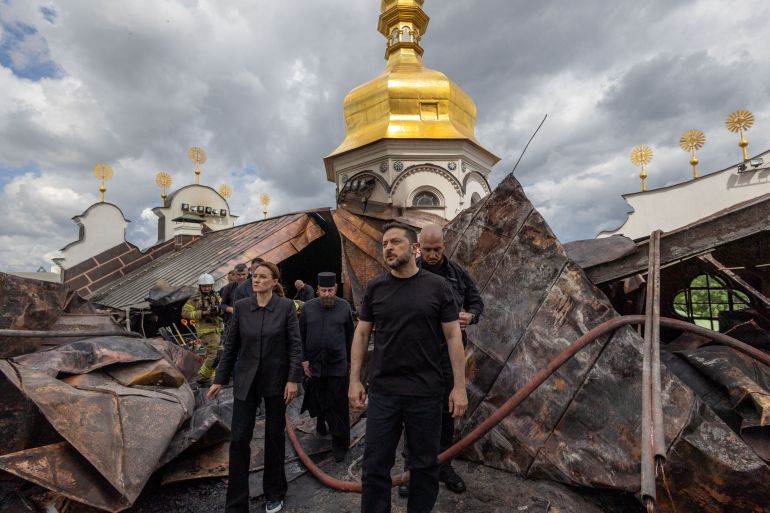
Zelensky’s statements came as he inspected the damage to the main cathedral in the Pechersk Lavra monastery complex, following a major Russian air attack on Kiev.
Zelensky said he proposed holding a meeting with Russian President Vladimir Putin during the G7 summit, but Moscow “was not ready” for that.
German caution
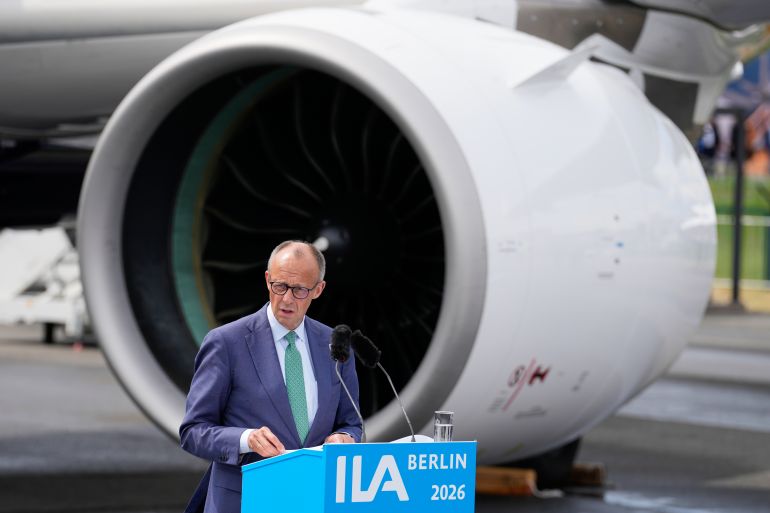
In turn, German Chancellor Friedrich Merz on Monday – ahead of the official launch of the G7 summit – expressed cautious optimism about the possibility of progress in efforts to put an end to the wars in Ukraine and Iran.
“This summit is being held at a very turbulent period in global politics,” Mertz said. “The situation presents us with great challenges, but it also provides some opportunities.”
France seeks to expand the G7 circle to include other countries. Brazilian President Lula da Silva was one of the first guests to arrive, and he will be joined by other leaders from outside the group’s countries, including Indian Prime Minister Narendra Modi.
The Emir of Qatar, Sheikh Tamim bin Hamad Al Thani, Egyptian President Abdel Fattah Al-Sisi, and UAE President Sheikh Mohammed bin Zayed Al Nahyan, are expected to attend the summit to discuss the issue of Iran on Tuesday.
Last Saturday, a senior US administration official said that Trump plans to meet with the leaders of Qatar, Egypt and the UAE on the sidelines of the summit to discuss efforts to end the war on Iran.