
Published 05.50
The US and Iran are said to agree to end the war on all fronts – including in Lebanon. The question is whether Israel plans to play along.
– It is difficult to have a ceasefire when Israel is in the middle of Lebanon, says Middle East expert Aron Lund.
The agreement had barely been announced before Israeli representatives began grumbling. Israel is not a party to the deal, ultra-conservative Security Minister Itamar Ben-Gvir claimed, as Israeli artillery continued to pound Lebanon.
Aron Lund, analyst at the Total Defense Research Institute (FOI), sees the Lebanon issue as the agreement’s biggest pitfall.
– If this is to last, the US will have to devote time to Lebanon in the future, he says.
The US clearly has the power to influence Israel’s actions, notes Lund. President Trump’s incentives to be “Israel’s best friend” are probably not as great as they once were, he says.
– Donald Trump has invested so much in this that he will want to keep an eye on Israel, that they comply with this.
– And when Trump directs his attention to something and puts his full force there, he mostly gets what he wants.
“From conflict to conflict”
However, the American president has a history of “declaring huge victories” in everything from the Gaza Strip to North Korea, Lund points out – only to lose interest and see the alleged agreements collapse.
– He seems to have the attention span of a five-year-old. He drifts from conflict to conflict, and as soon as he takes his eyes off something, things start happening.
Lebanon is not the most important issue for either the US or Iran, according to Aron Lund. The Strait of Hormuz, atomic energy and sanctions are likely to be significantly higher on the countries’ respective lists of demands. But the Lebanon issue is the one that hangs loose the most – and thus has the greatest risk of derailing the agreement.
Lost their homes
– A big problem is that a fifth of Lebanon’s population, a large, large part of the country’s Shia Muslims, have lost their homes. They live on football pitches and in schools – and their houses in southern Lebanon have begun to be blown up and bulldozed by Israel. It is not a situation that is sustainable internally, says Aron Lund.
In recent months, Israel’s ground invasion of the neighboring country has been stepped up in a unilaterally declared “security zone” with the aim of keeping the Shia militia Hezbollah at bay. The situation in southern Lebanon is a powder keg, notes Lund.
– I cannot imagine that Hezbollah would stop fighting that kind of Israeli presence, he says.
– The US will have to manage the crisis around Lebanon.
Background: The agreement between the United States and Iran
Much is unclear about the declaration of intent that the US and Iran have agreed on to end the Iran war. This is currently known:
Negotiations on Iran’s nuclear program for 60 days: When the US and Israel attacked Iran, it was justified by the fact that the country was close to acquiring nuclear weapons. How to prevent this – how underground facilities and highly enriched uranium can be destroyed – will be discussed in technical talks during the period, according to the White House.
Strait of Hormuz opens: The maritime route between Iran and Oman, so important for international oil trade, is scheduled to open to traffic on Friday. According to President Donald Trump, traffic should be “toll-free” and the US blockade lifted. However, Iran wants to be able to charge a fee for passing ships, according to AP.
Lifting of sanctions: International sanctions against Iran are to be lifted and some frozen assets become available. It is unclear which sanctions apply.
Peace in Lebanon: The settlement also includes an end to the fighting between Israel and the Iran-backed Shia militia Hezbollah in Lebanon. However, it is unclear how Israel will react to this, even though Prime Minister Benjamin Netanyahu has said that Israeli forces will remain in Lebanon “as long as necessary”.
Source: AP and others
Seven invasions in 50 years
In the past 50 years, Israel has entered Lebanon with ground forces on seven occasions.
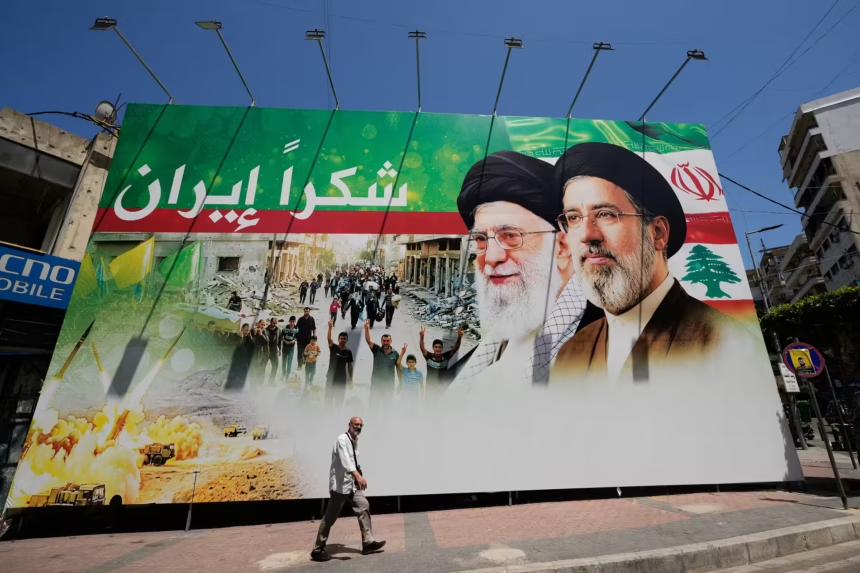
Israel’s opponent in Lebanon, the Shia Muslim movement Hezbollah, is a militia and a political party. It was founded in part with Iranian help after Israel’s occupation of southern Lebanon in the 1980s. It acts as a proxy for Iran in conflicts in the Middle East and has partly been labeled a terrorist by the EU and the US.
The long-standing conflict flared up again in connection with the Gaza war. In 2024, a cease-fire was concluded, which meant that both Hezbollah and Israel would withdraw from a buffer zone in southern Lebanon. The parties have accused each other of violating it.
In the spring of 2026, fighting broke out again when Hezbollah fired rockets at Israel in response to the country’s war on Iran. Israeli ground forces have advanced further into Lebanon, hundreds of thousands have been displaced and a permanent Israeli occupation has been announced.