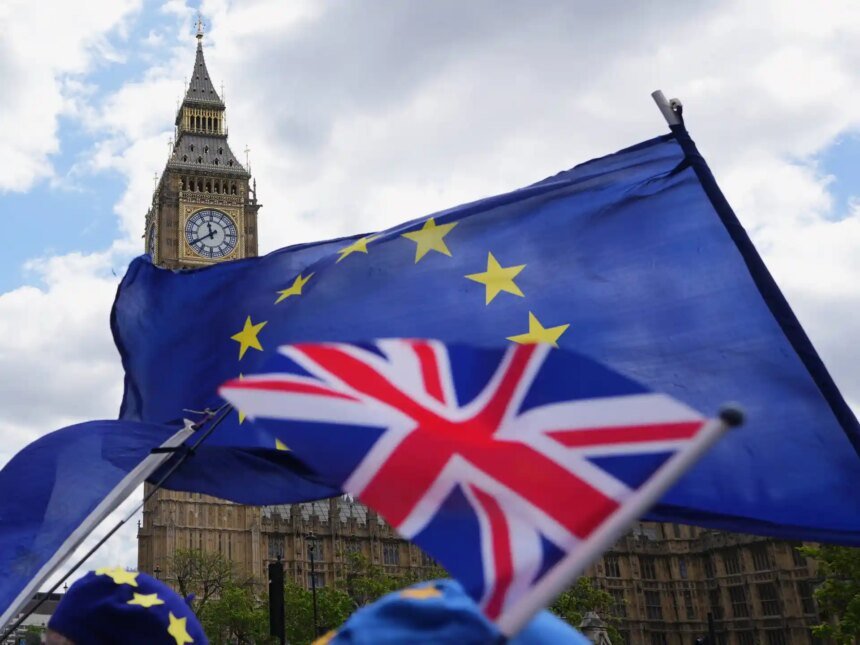
Ten years after the referendum that removed the United Kingdom from the European Union, questions are increasing in the British press and political and economic circles about the outcome of Brexit, and whether the country is close to reconsidering that historic decision.
While supporters of Brexit promised to restore the country’s sovereignty, achieve greater economic growth, and freedom from European restrictions, recent articles and analyzes indicate that skepticism about the feasibility of Brexit has increased, and with it calls for building a closer relationship with the European Union and perhaps returning to it in the future.
Read also
list of 2 itemsend of list
What changed?
Philip Rycroft, a former British official and one of the senior officials who supervised the Brexit files within the British government, believes that practical experience over the past years has shown that the expected gains from Brexit were much less than the promises that accompanied the pro-leaving campaign.
In an article published by the British newspaper The Independent, he calls for opening a serious discussion about the United Kingdom’s re-admission to the European Union, stressing that he was a supporter of exit previously, but today he believes that returning to the Union may be in the country’s interest.
< h2 id="limited-gains">Limited gains
In the writer’s opinion, the gains from the decision were limited, as Britain regained its legal sovereignty and its ability to make its decisions away from the institutions of the European Union, but this freedom reduced the prospects for British economic growth.
It also turned out that many of the reasons for weak growth – which Brexit supporters confirmed were linked to European Union membership – were mainly linked to British domestic policies, such as training, infrastructure, planning, and support for innovation, according to the author.
Rycroft stresses that supporters of return should be patient, focus on evaluating the results of the decision away from political slogans, and inform the British about this.
The writer says that the geopolitical and security transformations that Europe has witnessed since 2016 force Britain to rethink its position within the continent, considering that the real question is whether it is in the United Kingdom’s interest to remain outside the framework of European cooperation in the long term.

< h2 id="What-the-data-say?">What does the data say?
This reading is consistent with what was presented by Richard Partington, chief economics correspondent at The Guardian newspaper, who believes that the economic outcome of Brexit has become clearer, as most economic indicators indicate that the country has become poorer than it would have been if it had remained within the European bloc.
One of the most prominent indicators mentioned in the article is the decline in the value of the British pound. After it was close to $1.50 and 1.31 euros in June 2016, today it is only about $1.34 and 1.15 euros.
As for economic growth, the author uses a study prepared by economist Nick Bloom from Stanford University in the United States, which concluded that the gross domestic product per capita has become lower by between 6% and 8% compared to the scenario in which Britain would have remained a member of the European Union.
The article also focuses on the decline in trade and investment, as Brexit imposed border restrictions and bureaucratic procedures that slowed the growth of goods exports, especially since the European Union remains Britain’s largest trading partner.

The writer points out that the value of British exports to the European Union in 2025 amounted to 41% of total exports, while imports amounted to 49%.
The writer also points out that the political uncertainty that followed the referendum led to the freezing of companies’ investment plans for years.
It is estimated that the volume of investment has become about 18% less than it would have been if it had remained within the union, while productivity has declined by up to 4%, while employment levels have become about 3% to 4% lower than in the alternative scenario.
At the labor market level, the report shows that real wages have witnessed many years of stagnation, while employment rates have become lower by between 3% and 4% compared to the alternative scenario. The number of young people who are neither working, studying, nor receiving training exceeded one million, the highest level since 2013.

< h2 id="What-the-polls-say?">What do the polls say?
In an article entitled “Britain’s return to the European Union is only a matter of time,” European economic affairs expert in the Financial Times, Martin Sandbo, confirms that Britain’s return to the European Union is inevitable, given the failure of separation economically and politically, the increasing popular rejection of it, and the absence of any acceptable practical alternatives outside the bloc.
Sandbo cites opinion polls showing that British voters believe by 57% versus 30% that leaving the European Union was a wrong decision, while a clear majority supports establishing a closer relationship with Europe, and 56% even support re-joining the European Union.
The writer believes that the prediction he made after the 2016 Brexit referendum began to come true gradually, as he had warned at the time that Britain would lose its seat at the European decision-making table, but would remain subject to the influence of European decisions, and he expected that this would eventually push the country to think about returning to the European Union.
He initially points out in support of his theory that Britain did not gain “full sovereignty” as the secessionists claimed, but rather became “at the mercy of European Union laws” without having a voice in their formulation.

The evidence – in his opinion – is that the British government has adopted legislation that matches European laws in several areas, such as trade, security, and sanctions against Russia.
The article also mentions the British government’s recent attempt to present the idea of entering into a “common European market for goods only,” which is the same proposal that was presented by former Prime Minister Theresa May 8 years ago, and the request was rejected by Brussels again.
This repetition proves – according to the author – that geography and economics impose on any British government the same conclusion, which is the inevitability of rapprochement with Europe.
Conclusions
The author concludes that the future of British-European relations is limited to two paths: either a continuation of the current situation with some limited rapprochement, or a complete return to the European Union.
Given growing public discontent with the Brexit results, he believes the re-joining option may ultimately become the most politically and economically attractive path for Britain.

Together, these three readings indicate that Brexit did not lead to the immediate economic collapse that some of its opponents expected, but it also did not fulfill the economic and political promises affirmed by its supporters.
While there are increasing indications of a decline in popular support for exit and a rise in the desire for rapprochement with Europe, the question remains open as to whether Britain will be satisfied with rebuilding a stronger partnership with the European Union, or whether the coming years will witness the beginning of a long political path towards a full return to the bloc that it left a decade ago.