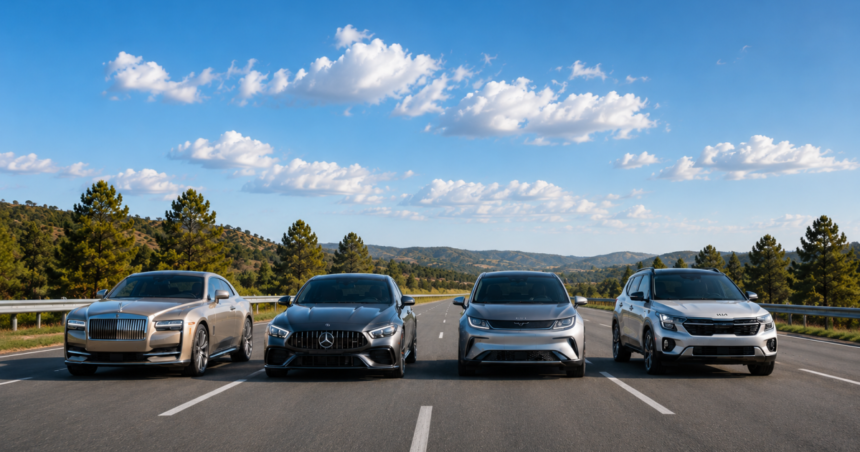
The automobile industry is no longer just about engine power or cabin luxury, but has become an open arena for a broader struggle between breakthrough electric performance, artificial intelligence, digital platforms, and designs that try to anticipate the future.
In one week, established and emerging brands revealed models bearing the features of a new phase, in which Rolls-Royce, Mercedes, Audi, Lotus, Kia, BYD and Mitsubishi compete, in addition to a new Chinese player betting on artificial intelligence as the basic identity of the car.
Rolls-Royce Specter Series II… electric luxury with a longer range
Rolls-Royce introduced an improved version of its luxury electric car, the Spectre, under the name Series II, with a clear focus on increasing efficiency and enhancing performance without compromising the design identity that has been widely accepted since the launch of the model.
The car received modifications to the electric propulsion system, in addition to developing the battery cells, reducing the charging time by about 14%. According to the announced numbers, the Specter is now able to cover a range of up to 628 kilometers, an increase of approximately 18% compared to the previous version.
In terms of power, the performance of the standard version increased to 593 horsepower, while the Black Badge version became the most powerful car in the history of Rolls-Royce, with a power of 671 horsepower and a torque of up to 1,100 Newton-meters, allowing it to accelerate from 0 to 100 kilometers per hour in just 4.3 seconds.
Although the exterior changes were limited, the company added new touches, including a special blue color, 23-inch forged wheels, and more luxurious options in wood and upholstery.

Mercedes-AMG GT Four-Door…electricity with power beyond supercars
As for Mercedes-AMG, it has gone to a more daring level with its new electric car, the AMG GT Four-Door, which it presents as one of its most technologically advanced cars.
The car is based on the new AMG.EA platform, and comes with three Axial Flux electric motors developed by Yasa, a Mercedes subsidiary. The AMG GT63 version produces a massive power of 1,153 horsepower, superior to the AMG One supercar, with the ability to accelerate from zero to 100 kilometers per hour in just 2.1 seconds.
The car carries a battery with a capacity of 106 kilowatt-hours, and an 800-volt electrical system that allows ultra-fast charging of up to 600 kilowatts, allowing the battery to be charged from 10% to 80% within 11 minutes.
Mercedes was not satisfied with the numbers, but added a system that simulates the sound of a V8 engine and shifting gears via handles behind the steering wheel, with vibrations inside the seat, in an attempt to give the driver the feeling of a traditional sports car inside a fully electric car.

Chinese AIVA.. a car that knows itself with artificial intelligence
In China, a new name has emerged that aspires to present a different concept of the smart car. Saido Technology announced the launch of its AIVA brand, as a project based on the idea of the “artificial intelligence-defined car.”
AIVA does not present itself as a traditional car brand, but rather as a platform capable of interacting with the driver and passengers more intelligently, by understanding voice and visual commands, analyzing the context, interacting with the user’s emotional state, and proposing solutions or options that suit the situation.
The brand relies on significant industrial and technical support, as its shareholders include the Ceres Group and CATL, which specializes in batteries. It also relies on an artificial intelligence model from the ByteDance system, in addition to an intelligent driving system from DeepRoute.ai.
It is expected that the first AiVA family electric crossover will be produced at the Phoenix factory of Ceres, with sporty design features that appear in the first teaser images.

Lotus Emera 420 Sport.. more lightness and an open driving experience
Lotus has unveiled a new version of its Emera sports car, called the 420 Sport, with a clear focus on reducing weight and increasing performance.
The car relies on a two-liter four-cylinder engine with a twin turbocharger, generating 414 horsepower and 500 Newton-meters of torque, enabling it to accelerate to 100 kilometers per hour in 3.9 seconds, and reach a maximum speed of 300 kilometers per hour.
Lotus was able to reduce the weight of the car by about 25 kilograms thanks to a lighter suspension system, a titanium exhaust, and a wider use of carbon fiber, in addition to reducing the height of the car and improving aerodynamics and cooling.
But the striking feature is the removable roof, which can be stored behind the seats, giving the Emera an open driving experience that brings back some classic fun features to a modern sports car.

Audi Q7…a new generation with a more mature design
Audi introduced the third generation of its Q7 SUV, with a more massive and presentable exterior design, and an interior cabin that appears calmer and more mature compared to the previous generation.
The highlight of the cabin is the reduced reliance on glossy black plastic accents, which were susceptible to fingerprints, and replacing them with options in natural woods and more luxurious interior colours.
The Q7 comes with seven seats, a panoramic glass roof with technology that allows you to change the degree of transparency, in addition to fast charging ports and multiple comfort equipment. At launch, it will be available with a 3-liter V6 diesel engine with a mild hybrid system, with a power of 295 horsepower, and a Quattro all-wheel drive system.
Plug-in hybrid versions are expected to be released later, along with the high-performance SQ7 version.

Kia Seltos in 2027… a larger crossover and a hybrid version for the first time
In 2027, the Kia Seltos received a comprehensive update that gave it a larger presence and a more solid design, with increased dimensions and improved interior space, and the appearance of a hybrid version for the first time in the model’s history.
The car is 4.43 meters long and has a wheelbase of 2.69 metres, which provides better space for rear-row passengers, and a spacious luggage box of up to 787 liters behind the seats, and increases to 1,815 liters when folded.
The Seltos is available with a 2.0-liter engine with a power of 147 horsepower, and a 1.6-liter turbo engine with a power of 190 horsepower, in addition to an expected hybrid version that combines a gasoline engine with an electric one to improve efficiency.
Inside, the car has two 12.3-inch screens for the instrument cluster and entertainment system, with a separate screen for climate control inside the cabin, and wireless support for Apple CarPlay and Android Auto systems.

BYD Dolphin G DM-i…a hybrid hatchback with a long range
BYD continues to strengthen its presence in Europe with its new Dolphin G DM-i, a plug-in hybrid hatchback targeting the small car segment, competing with models such as the Volkswagen Polo and Renault Clio.
The company says that the car is capable of covering a combined range of up to 1,000 kilometers when combining the electric motor and gasoline engine, which gives it a clear advantage in a category looking for efficiency and ease of daily use.
The car is likely to use a 1.5-liter gasoline engine within a hybrid system similar to that used in some other BYD models, and will be delivered to the market next fall.

Mitsubishi Eclipse Sportback EV.. The name returns with an electric spirit
Mitsubishi has brought the Eclipse name back to the forefront, but not as a sports coupe as fans of the brand remember it, but in the form of an electric car called the Eclipse Sportback EV.
The car is based on the architecture of the new generation Nissan Leaf within the alliance of the two companies, with an exterior design bearing special Mitsubishi features. Although the use of the Equilipse name may evoke nostalgia, the modern electric platform gives the car better range, faster charging and sharper lines.
The car is scheduled to be launched in the fall of 2026, with prices expected to be close to the new Nissan Leaf.

Audi Q9… German luxury to compete with Range Rover
Audi revealed the features of the cabin of its anticipated Q9, which will become the largest and most luxurious SUV in its lineup, in an attempt to enter a more luxurious area in which it competes with cars such as Range Rover.
The cabin includes an 11.9-inch digital screen for the driver, a 14.5-inch central screen, in addition to a third 10.9-inch screen for the front passenger, with a climate control system permanently present below the central screen.
One of the most prominent technologies is the smart door system, which allows them to be opened via a button, application, information screen, or even the brake pedal, with sensors that prevent the door from being opened if it detects an obstacle nearby.
The Q9 is available with six or seven seats, and a wide panoramic roof that can automatically block the sun’s rays, while its performance depends on V6 and V8 hybrid engines supported by the Quattro all-wheel drive system.