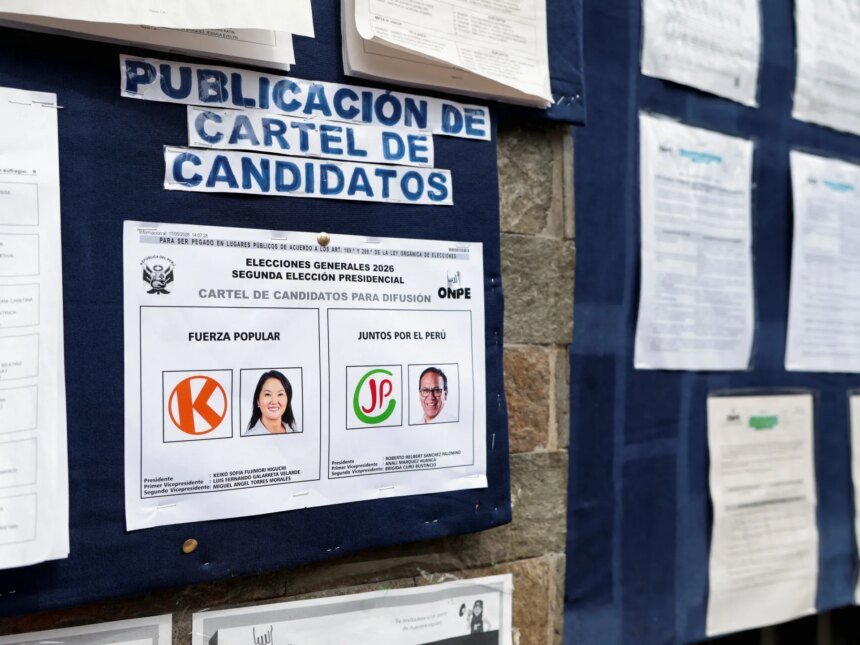
Just looking at the map of the results after 98.2% of the votes were counted in the second round of the presidential elections in Peru, the size of the gap is clearly revealed in a country that seems divided into two different groups of citizens, who share the same flag, but vote differently and view their country in completely contradictory ways.
The electoral map of Peru reflects a deep division, as it shows a “technical” tie between the candidates for the presidency of the country, despite an advance in votes in favor of the right-wing candidate Keiko Fujimori versus the left-wing Roberto Sanchez. These elections highlighted geographical and historical lines that seem to reproduce inherited inequalities.

Inherited variations
Vast kilometers, even entire worlds, separate Peru’s major cities, most notably the capital, Lima, from the rural areas concentrated in the south and the highlands located within the country.
To realize the magnitude of the differences between these two worlds, numbers are sufficient: In the San Isidro neighborhood, the richest neighborhood in Lima, the right-wing candidate, Keiko Fujimori, won about 85% of the votes in the second round of the elections.
While the leftist candidate, Roberto Sanchez, won more than 86% of the votes in the Puno region, located in the far south of the country on the border with Bolivia, where the majority of the population is of Quechua and Aymara origins, with a strong presence of indigenous cultures. Puno is one of the poorest regions of Peru, if not the poorest at all.
What are the roots of this division? Can a country so divided build a national consensus after an election campaign characterized by sharp polarization? Note that such consensus seems necessary to achieve the political stability that the country needs.

Dominance of influence groups
The Peruvian division is not a simple division between cities and the countryside, but in essence a division between Lima and the coast on the one hand, and the Andean regions on the other.
The capital, where about a third of the population lives, enjoys great economic and political weight, while large areas in the northern and southern highlands feel marginalized and excluded from decision-making centers.
This reality reflects a fragile balance between three main blocs: Lima, the northern coast, and the southern highlands, which are among the poorest and most marginalized regions of the country.
According to the academic specializing in social psychology, Hernan Chaparro, a professor at the Pontifical Catholic University in Peru, the roots of this division and its current interpretation are due to the dominance of economic, political and cultural influence groups, both official and unofficial, over state institutions and harnessing them to serve their own interests.
As a result, large areas outside the capital, Lima, suffer from weak public services, whether in the areas of health, education, security, or justice, which forces many citizens to live on the margins of the state.
Chaparro adds to Al Jazeera Net that voters in these areas are looking at every electoral election for a candidate who embodies their basic demand of integration and recognition within the state. However, traditional influential powers often view these demands as a threat to their interests.
But he also believes that exclusion in Peru is not limited to public services or the formal economy, but also extends to the presence of “deep ethnic discrimination,” adding that “half of the population votes against this reality.”
The surgeon of history
For his part, researcher Cesar Martinelli, in an interview with Al Jazeera Net, confirms that Peru, like all other Latin American countries, carries a heavy colonial legacy. He says: “It is true that portraying the two countries as ‘Peruan’; one of them is a product of European conquest and colonization, and the other represents an extension of indigenous cultures, is a simplification of reality, but it contains a degree of truth.”
The researcher believes that the “wounds of history” surface during periods of major economic and social transformations. Although the “Peruvian miracle,” that is, the period of economic growth experienced by Peru during the first decades of this century, contributed to reducing poverty, the fruits of growth went mainly to the sectors associated with the modern economy in coastal areas, while residents of rural and remote areas, including areas rich in mineral resources, benefited from them to a much lesser extent.
This “unequal growth,” the analyst adds, has generated a feeling of dissatisfaction with what is known as the “economic model,” considering that the poverty rate largely explains the vote for the leftist candidate Sanchez, in addition to the linguistic factor linked to the presence of indigenous cultures in Peruvian society.
This dimension is also evident in the image of the candidates, as Sanchez masters the Quechua language, one of the most prominent indigenous languages in the country, while his competitor, Fujimori, only speaks Spanish and English.
Which Peru do the two candidates want?
In their speeches and political projects during this electoral period, neither candidate presented proposals that would reduce the rift between Peruvians.
Rather, each of them addresses, to varying degrees, one of the two competing visions for the country’s future: one that defends the existing economic model and promises to enhance security, and another that believes that the roots of the crisis lie in historical marginalization and calls for a greater role for the state and a reconsideration of the rules of the political game.
Right-wing candidate Kaiko Fujimori embraces the political legacy of her father, former President Alberto Fujimori, known for his authoritarian rule, who was sentenced to 25 years in prison on charges related to crimes against humanity and corruption cases, before he was granted a pardon for health reasons in the last years of his life, and died in 2024.
This is the fourth time that the right-wing candidate has reached the second round of elections, carrying almost the same political program: a neoliberal economic approach, strict security policies to combat crime, including deploying the army on the streets, in addition to proposals such as obliging prisoners to work to pay for their maintenance.
As for her competitor, representative of the left, Roberto Sanchez, he embodies the exact opposite project, as he seeks to revive the political program of former President Pedro Castillo, the teacher and rural unionist who reached the presidency in 2021 promising to achieve greater social justice in a country that still needs it.
Castillo was unable to implement most of his promises, as he was arrested and imprisoned in 2022 after trying to dissolve Congress. His supporters accuse the right, which dominates Parliament, of obstructing his policies and preventing him from implementing his political program.
Roberto Sanchez calls for a greater role for the state in the economy and in the health and education sectors, and for reforms within the security services to enable them to combat crime more effectively. He also proposes reactivating the popular referendum mechanism to call for the election of a constituent assembly that will draft a new constitution, as well as seeking the release of Pedro Castillo.
Why is it difficult to govern in Peru?
One of the questions today is whether the winner will be able to complete his term. Peru has known nine presidents in one decade, and none of them completed their term. This situation, according to a number of researchers, is due to a deeper crisis that party life has been experiencing for decades.
In the 1980s, the party system that existed at the time, which was divided between the forces of the left, center, and right, collapsed. These were parties with relatively organized organizational structures and party bases.
But after the first term of Alan Garcia, who belongs to the center left, which ended with an inflation rate of 7,000% in its last year, and with the erosion of right-wing parties and the escalation of the activity of left-wing armed groups such as the Shining Path and the Tupac Amaru Revolutionary Movement, at a time when the forces of the democratic left were unable to clearly distinguish themselves from them, a strong wave of hostility to political parties emerged.

Between prison and justice
In this context, Alberto Fujimori emerged in 1990. He succeeded in achieving economic stability through liberal reforms, but he ruled the country in an authoritarian manner, and his administration of the state was characterized by corruption and nepotism.
After his decade in power ended, Peru entered what was described as a phase of democratic transition, but all the parties that emerged during that phase failed to consolidate themselves. Since 2001, most presidents have ended up in prison or stood trial.
In addition, no ruling party since 2001 has been able to obtain an absolute parliamentary majority, but rather was content with the largest minority bloc, relying on alliances that became increasingly fragile over time.
The weakness of the party system has led to the emergence of a large number of political formations that do not actually exist except on paper, and have turned into channels penetrated by illegal economic groups or individuals seeking to exploit power to achieve their own interests.
In his analysis for Al Jazeera Net, university professor Chaparro considers that Congress (Parliament) between 2021 and 2026 was an embodiment of this reality, as it was dominated by political blocs that sought to control state institutions to serve their interests.
He concludes, “We hope that the political forces will be able to regain their strength and rebuild themselves, but no one knows if that will happen.”