Published On 10/6/2026
A new study reveals that bumblebees can solve unfamiliar problems in a goal-directed way, even when they have not received direct training in the solution, a finding that adds new evidence that flexible thinking abilities are not limited to animals with large brains.
The study, published June 4 in the journal Science, tested bumblebees’ ability to use a moving object to reach a food reward placed out of their reach.

Between the flower and the ball
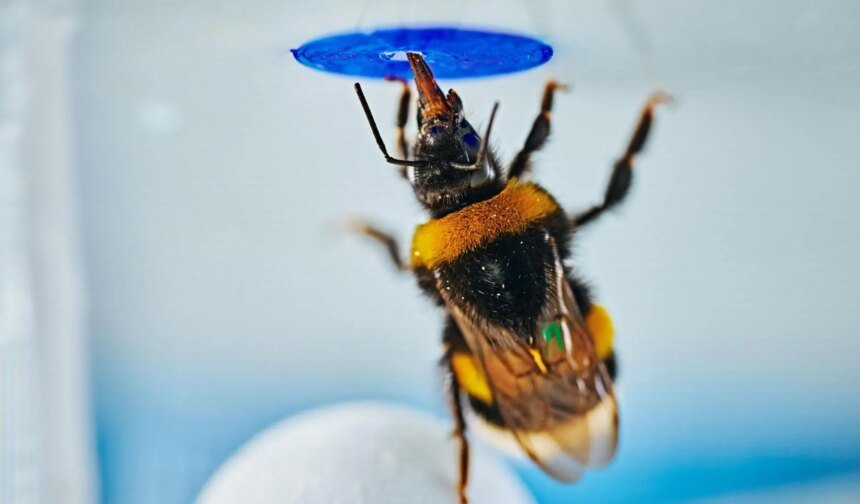
The researchers designed an experiment that was simple in form, but complex in behavioral terms. An artificial blue “flower” was placed on the ceiling of a small testing arena, while a light ball was placed on the ground. In order for the bees to reach the flower and obtain a sugar solution, they had to push the ball into a hole located below the flower, then climb above it to touch the target.
“The bees did not receive direct training on this solution,” says the lead author of the study, Oli Lukula, a lecturer in environmental behavior at the University of Oulu in Finland, who explained in statements to Al Jazeera Net that some individuals were previously trained on two separate things: that the blue flower indicates the presence of a reward, and that the ball is an object that can be moved and does not represent a danger. The researchers compared the performance of this group with the performance of two other groups. One of them only knew the flower, and the other had no previous training.
The results showed that the bees that had the previous two experiences were more successful in performing the task, as they were able to move the ball to the appropriate position and use it to reach the flower, while the performance of the other two groups was poor. The researchers believe that this indicates that previous experience helped the bees understand the elements of the problem, but did not provide them with the same solution method.
To verify that the bees were not pushing the ball randomly or only responding to what they saw in front of them, the team conducted additional experiments in which the flower was obscured from the bees’ view while moving the ball. In one experiment, 16 out of 22 bees successfully moved the ball through a hole in a barrier until it reached the bottom of the flower. But the researchers saw that this result does not completely rule out the possibility that the bees obtained subsequent visual signals during movement.
So, says Luculla, the team designed a “more conclusive” experiment in which the bees viewed the flower above one of two chambers during the habituation phase, and then the flower disappeared from view during the test. The bees had to remember the correct direction and push the ball to it. 23 out of 30 bees succeeded in moving the ball to the correct position, while 16 of them headed directly to the correct direction without trying the wrong direction first.
We haven’t come to the sudden realization yet
According to the study, this behavior cannot be easily explained as random movement or learning by trial and error. The results indicate that the bees used previous information about the location of the target and then directed the ball’s movement toward it, which the researchers describe as goal-directed behavior. Hence, the researchers believe that these results challenge the common idea that solving new problems requires large brains, such as those of primates or birds. The findings also add to growing evidence that insects possess more complex cognitive abilities than previously thought.
However, the researchers stress that the study does not prove that bees experience a “sudden realization” moment similar to what is known in humans as an “aha” moment. Photography angles and experimental limitations did not allow tracking the bees’ gazes or movements precisely enough to detect the mental shift before the solution. The experiments were also conducted in a laboratory environment and on only one type of bee, which means that generalizing the results to other insects requires further research.
The researchers also pointed out that understanding the causal relationship between the ball and the flower requires more precise future tests, especially to find out whether the bees actually realize that the ball is a means to reach the goal, or whether they use a successful strategy resulting from previous experience and exploratory behavior.