Published On 10/6/2026
|
Last updated: 11/6/2026 17:46 (Mecca time)
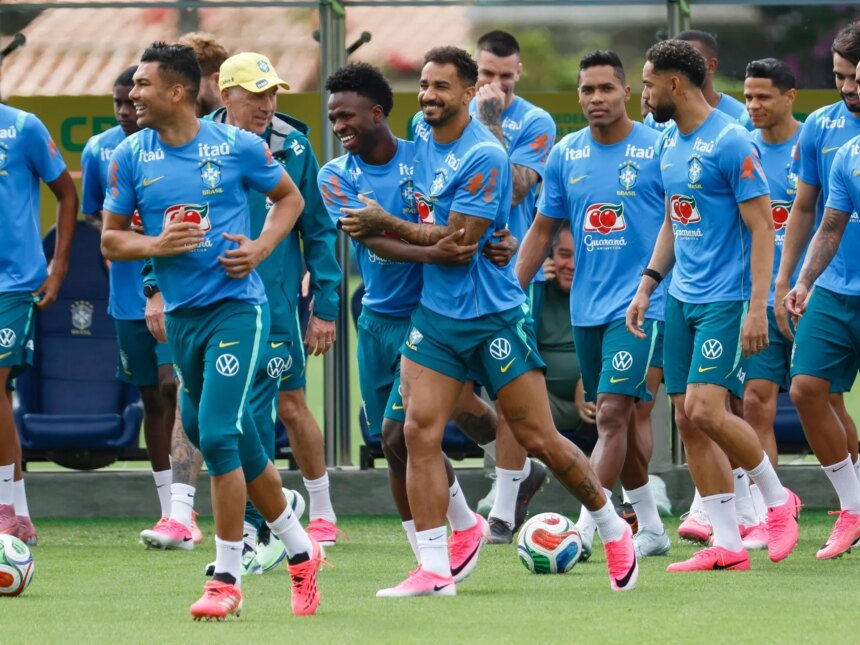
In the 2026 World Cup, Brazil is not chasing the cup alone; Rather, it is trying to regain its glory. The name is still big, and the yellow shirt is always a candidate for heartland, but the current team is less established and strong than the reputation suggests.
Since 2023, four coaches and 84 different players have coached the Brazilian national team. To reveal the extent of fluctuation and instability, it is enough to look at the conditions of the rival national team, Argentina, whose national team is still under the leadership of the world champion, Lionel Scaloni, since 2018. France is also still under the leadership of Didier Deschamps, the world runner-up in the previous edition since 2012.
Read also
list of 2 itemsend of list
Even coach Carlo Ancelotti, who came to save what could be saved, did not reach the helm until June 2025, and he enters the World Cup with only four official qualifying matches, two of which were without real pressure after qualifying was decided, while most of his work came in friendly matches. This is not an ideal preparation for a team that wants to regain the glory lost since 2002; Rather, it is a late attempt to transform the abundance of names into a team capable of victory, as Carlo Ancelotti usually does.
The burden of history
The problem with Brazil is that its history does not give it reassurance as much as it raises the ceiling for accountability. It is the only team that has participated in all World Cup editions, and holds a record of five titles, but that same position became a burden when the wait extended for 24 years since the 2002 title. Since that coronation, it has been eliminated from the quarter-finals in four of the last five editions, while the 2014 edition remains a wound in the Brazilian identity due to the 7-1 defeat to Germany on its soil in the midst of its fans. Therefore, Brazil enters the tournament carrying a great history, but also a recent history of stumbles at decisive moments.
Ancelotti has the attack, but he doesn’t have the balance yet
Ancelotti did not come to transform Brazil tactically and make it a team that dominates, possesses, and controls the tempo. Rather, according to specialized analyzes, he seemed closer to a team that attacks quickly, relying on the quality of its attacking players, while hoping and asking its defense to hold out.
The most common Brazilian tactical plan since Carlito took over is the 4-2-4, where a defensive quartet changes depending on choices and injuries, in front of them are the duo Casemiro and Bruno Guimarães as a base in the midfield, and in front of them are four attackers and playmakers. This tactical drawing and technical direction reflects the reality of Brazil’s unbalanced roster more than it expresses the tactical convictions of the Italian coach, specifically: the huge abundance of attacking players and the relative scarcity of midfield talent. In friendly matches, against Croatia and France, Brazil had less possession of the ball than its competitors, and against Egypt, it roughly shared possession of the ball.
Under Ancelotti, she recorded 25 direct attacks from quick transitions, compared to 30 from organized build-ups, with 19 shots from quick counter-attacks in 11 matches. In other words, Brazil may not be a possession team as much as it is a team of lightning-fast transitions that rely on the talent and speed of the likes of Rafinha, Vinicius Junior, Endrik and Neymar.
Here the solidity of the two centre-backs, Marquinhos and Gabriel Magalhaes, becomes a decisive element in Brazil’s future in the tournament. They are the counterweight to the momentum of the front line, even if their harmony is still in its infancy after only two matches together under the leadership of the Italian coach, both of which ended with a win and a clean sheet.

The abundance of names does not solve the problem of roles
The problem is not the lack of offensive options, but rather their abundance. Vinicius Junior and Rafinha are among the elite players in the world and Europe, but Opta reminds that shining with the club does not mean shining with the national team. Vinicius contributed to 183 goals in 257 matches with Real Madrid in the last five seasons, compared to only 17 contributions in 48 matches with Brazil, and Rafinha contributed to 127 goals in 177 matches with Barcelona, compared to 18 in 38 international matches.
This difference explains why Brazil sometimes seems richer in names than performances. On top of that, there is no consistent traditional No. 9; Igor Thiago, the English Brentford club striker, is available but is not a candidate to start, which opens the door to the presence of Manchester United striker Matheus Cunha as a flexible solution in the heart of the attack, or even to use Vinicius and Rafinha in depth, with Martinelli, Luis Henrique and Endrik remaining on the peripheries of the equation. As for Neymar, he should not be treated as a “savior” as much as he is an emotional and historical symbol, but he is also a tactical dilemma.
He can connect the midfield with the attack and make the difference, but Ancelotti is required to determine whether he will make him the centerpiece of the team, with the danger this poses to the balance, or a late weapon that changes the tone of the match in its decisive moments.

The virtual path to the final
If we assume that Brazil will find its ideal image, the path to the final does not allow for many mistakes. Brazil is in Group C with Morocco, Haiti and Scotland, and the Opta supercomputer gives it a 60.8% chance of topping the group and a 96.9% chance of reaching the round of 32. After that, “Opta Computer” expects to face Japan in the round of 32, then Norway in the round of 16, in an exciting confrontation open to all possibilities.
Before being subjected to a harsh test against England, which is led by experienced knockout matches Thomas Tuchel, in the quarter-finals, then Argentina in the semi-finals, then Spain in the final. Opta’s numerical predictions are important because they put the Brazilian names in their true size. England is not just a big name, but a team that the model gives a chance of winning the title of 11.4%. Argentina is the title holder with a 10.4% chance of retaining it, while Spain is the first candidate for the competition with a rate of 16.5%. According to 25,000 simulations conducted by Opta until June 5, 2026, Brazil’s chance of winning the title is only 6.7%. This percentage does not deny ability, but it confirms that the Brazilian road is difficult even in the most optimistic scenarios.

Brazil is capable, but..
Brazil is capable of obtaining the sixth star, but its ability is conditional, like previous versions, on many factors. This time, it has a coach with experience in qualifying matches, and no evidence of that is the fact that he topped the list of coaches with the most Champions League wins in history. It has a pivotal duo that seems capable of waging the midfield battle, two defensive backs that can give the Seleção a minimum of stability, and an offensive arsenal sufficient to confuse and penetrate any opponent. But she will not win by name or abundance alone. In the 2006 World Cup, Brazil entered with a star-studded roster of Ronaldo, Kaka, Adriano, Ronaldinho, Roberto Carlos, and goalkeeper Dida, and lost to France in the quarter-finals after a performance less than expected.
However, if Ancelotti succeeds in converting this attacking surplus into clear functions and roles, identifies Neymar’s position without disrupting the structure, and provides Vinicius and Rafinha with the appropriate positions to shine, then Brazil can go very far. However, if you remain a team that lives on assumptions and probabilities and does not have a cohesive tactical structure, then perhaps Brazil will have to wait a long time for the sixth star, 4 additional assistants.