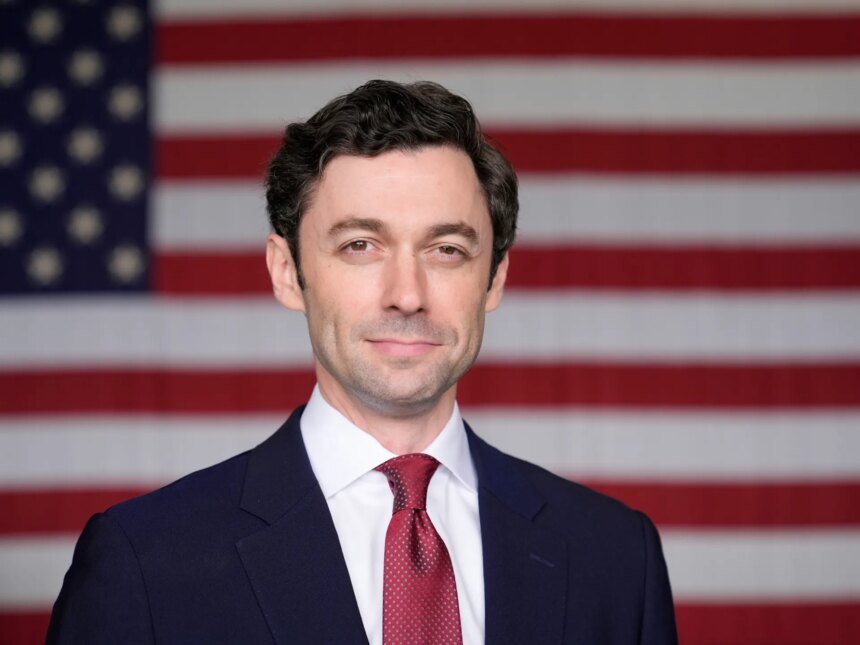
Amid the battles of the upcoming midterm elections in the United States, a name has begun to be increasingly mentioned within Democratic circles as one of the most prominent potential faces of the party’s leadership in the future: Georgia Senator Jon Ossoff.
The man, who is not yet forty years old, has transformed in recent months from a prominent member of the Senate into a person whom activists, commentators, and political strategists see as a strong candidate for the presidential race in 2028.
Read also
list of 2 itemsend of list
In a lengthy article, New York Times columnist Michelle Goldberg reviews his political career, praising his stances against US President Donald Trump and corruption, stressing that many want Ossoff to run for power.
It quoted journalist Mehdi Hassan as saying that if Ossoff succeeds in winning re-election, he “will immediately become one of the most prominent candidates for the Democratic Party’s presidential nomination in 2028.”

Who is Ossoff?
A prominent American Democratic politician of Jewish origins, who currently holds the position of Senator from the state of Georgia, and whose star has risen strongly in the American political arena, according to Goldberg.
He is currently leading his re-election campaign for a second term in the Senate in the midterm elections, and polls indicate his lead.
Ossoff was born – according to the article – in 1987, and was 33 years old when he was first elected in late 2020, and he is the youngest member of the Senate since former President Joe Biden was elected to the Senate in 1972.
The author believes that Ossoff’s background makes him an attractive candidate for many Democrats. He is a young politician, hails from the American South, represents a state that often leans Republican, and has a traditional family that is “beautiful” in the eyes of many, consisting of his wife, Alisha Kramer, a prominent obstetrician-gynecologist, and two young daughters.

What is the secret of his fame?
Goldberg believes that Ossoff’s continuous attacks on the president, in addition to his focus on issues of corruption and abuse of influence within the current administration, represent one of the most prominent reasons for his popularity within democratic circles.
It indicates that Ossoff’s speeches for re-nomination in the state of Georgia do not focus on his two Republican competitors as much as they aim to attack Trump and the “Mar-a-Lago Mafia,” according to what the article reported.
Goldberg confirms that video clips of his speeches contributed to launching a new wave of speculation about his political future.
Specifically, Ossoff’s speeches are usually based on two axes: The first is to dissect the manifestations of dysfunction and corruption within the American political system, and the second is to present a national liberal vision of multiple identity in the face of the nationalist discourse adopted by the current administration.
Among the phrases cited by the author is his statement to his supporters: “Our national greatness does not stem from blood or genes, but from our ideas.” She believes that this type of discourse attempts to restore a comprehensive American national narrative.

What is his professional background?
The writer stops at his professional career before entering politics, as he ran a company specializing in producing documentaries and investigative reports on corruption and human rights violations.
He supervised work dealing with ISIS crimes, investigations into sports corruption in Africa, and other issues related to abuse of power.
Ossoff believes that these experiences shaped his understanding of politics; He said that his conviction that “corruption stands at the heart of repression and tyranny goes back to before he entered public life,” and that his experience investigating war crimes and human rights violations showed him “the close relationship between corruption and authoritarianism.”
What is his political vision?
Besides his opposition to corruption, Ossoff gains unique appeal in Democratic circles because of his stance on Israel; He is Jewish by identity, but at the same time he is one of the most prominent critics of Israeli policies, which gives him the ability to address different parties within the party.
Ossoff asserts that he is not anti-Zionist, and is keen on “the safety and security of the Israeli people,” but at the same time he is one of the most prominent critics of Israel’s war on the Gaza Strip.
He confirms that he is not hostile to Zionism, and that he is keen on “the safety and security of the Israeli people,” but at the same time he is one of the most prominent critics of Israel’s war on the Gaza Strip, according to the article.

The author notes that in 2024, Ossoff was among only 19 senators who supported a draft resolution presented by Senator Bernie Sanders calling for halting some US arms shipments to Israel. In doing so, he contradicted the pressures of the Biden administration, which was opposed to this trend.
During a speech in the Senate at the time, Ossoff said that the American people “are rightfully shocked by the lack of adequate concern for the lives of innocent Palestinian civilians,” adding that a large number of children in Gaza were killed or suffered devastating injuries that could have been avoided.
Goldberg believes that this centrist position gives him a rare political advantage, as it is difficult for Israel’s supporters to accuse him of anti-Semitism, and it is also difficult for critics of the Biden administration to hold him responsible for the policies that led to large numbers of civilian casualties in Gaza.
Anti-“Epstein class”
Goldberg believes that Ossoff builds his political discourse on the idea that fighting corruption is the most effective way to confront authoritarian tendencies.
She cites the opinion of political science professor Adam Bonica, who believes that popular anger over corruption contributed to the overthrow of governments and leaders in several countries, and that anti-corruption movements are capable of uniting different segments of society.

According to the author, Ossoff is trying to apply this approach in the United States through his continued focus on issues of corruption and influence peddling.
An example of this is his repeated talk about what he calls “Epstein’s class,” referring to the networks of money and influence linked to the American billionaire accused of trafficking in minors, Jeffrey Epstein, which includes figures from both the Republican and Democratic parties.
Is he running for president?
Despite the hype surrounding his name, Ossoff insists that he does not plan to run for president. He described the growing chatter about this as a “curse” that distracts from the midterm elections, which he considers more important at the moment.
Ossoff insists he has no plans to run for president
But the author notes that American politicians often deny their presidential ambitions years before announcing their candidacy. She cites the example of former President Barack Obama, who refused to talk about the presidency when he ran for the Senate in 2004, before later becoming president of the United States.

Goldberg concludes that Ossoff is trying to change the nature of the political conflict in the United States; Instead of fighting the traditional battle between the right and the left, he seeks to transform it into a confrontation between reform and corruption.
Precisely for this reason, the author says, the number of Democrats who see in him a face capable of leading the party in the future is increasing. If he succeeds in winning a new term in Georgia, especially by a comfortable margin, he may find himself facing increasing pressure from party leaders and supporters to enter the presidential race, whether he plans to do so today or not.