Published On 9/6/2026
The Philippines is still witnessing the repercussions of the earthquake that shook the south of the country with a magnitude of 7.8 on the Richter scale yesterday, Tuesday, as hundreds of aftershocks struck the island of Mindanao and its surrounding areas.
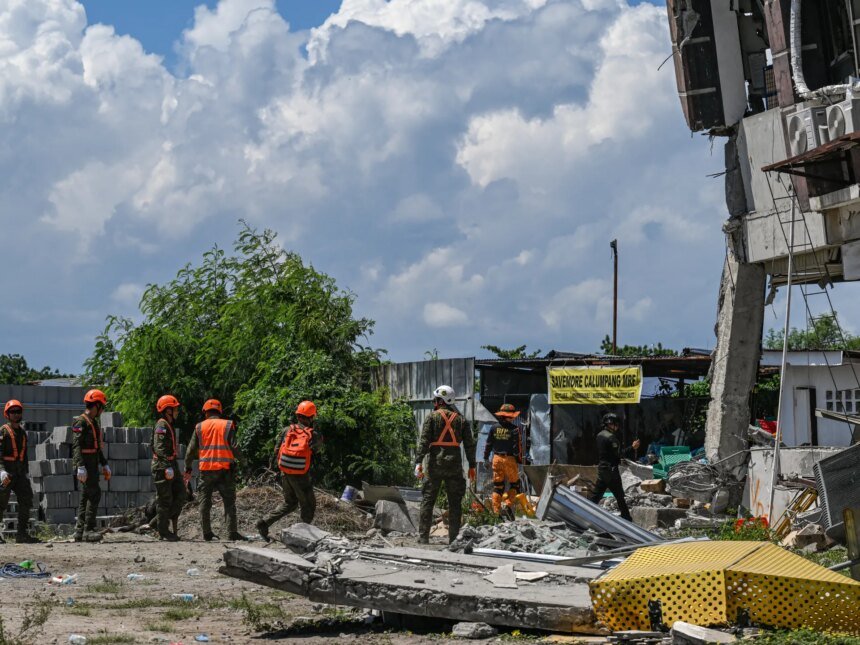
The extent of the devastation on the island of Mindanao began to appear with the arrival of emergency teams to coastal cities and towns, which continue to search for survivors among the rubble of destroyed buildings, amid fears and expectations of an increase in the number of deaths and injuries.

To date, the death toll as a result of yesterday’s earthquake, Monday, has reached 41 people, according to what Agence France-Presse reported from local sources, while about 487 other people were injured.
In this context, Bernardo Alejandro, assistant secretary of the agency supervising disaster response in the Philippines, told DZMM radio that the authorities hope that the death toll will not rise further, but they expect that to change with the passage of time, adding that “our priority today is search and rescue.”

Search for survivors
Reuters quoted the regional fire official and leader of the search operation, Edgar Tanawan, as saying that rescue teams succeeded in extracting two people alive from under a commercial building, while a third person was found dead.
As for the head of the regional civil defense, Rodrigo Sosmina, he warned – during a press conference – of the continuation of aftershocks, recommending rescue personnel to be extremely careful during their work.

The US Geological Survey reported that the earthquake occurred at a depth of 35 kilometers off the island of Mindanao, which led to tsunami warnings being issued along the coasts of the Philippines, Indonesia, Palau, Taiwan and Papua New Guinea.
According to local reports, yesterday’s earthquake and the hundreds of aftershocks that followed led to the collapse of buildings, cracked roads, and even landslides, while landslides buried parts of some areas. Electricity services and the communications network were also cut off from large areas of the island.

Parts of the city of General Santos, which has a population of more than 700,000 people and where a state of disaster was declared, witnessed widespread destruction, with a number of buildings collapsing and debris scattered in the streets, with electricity poles falling and power lines intertwined.
Since yesterday, emergency and rescue teams have begun assessing the damage in the affected buildings and restoring electricity and water services to thousands of residents.

This earthquake comes only 8 months after the most violent earthquake the Philippines witnessed in 12 years, when a 6.9-magnitude earthquake struck off the island of Cebu, killing 79 people.
The Philippines is exposed to hundreds of earthquakes annually, due to its geographical location within the “Ring of Fire” in the Pacific Ocean, a seismically active region that extends from the coast of South America to the far east of Russia in Asia.